
Most competitive battlecards die the moment they’re shared.
They start with good intentions. Someone, usually in enablement or product marketing, builds a thoughtful document about a key competitor. It goes into a folder. A few reps glance at it. Then competitors shift their pricing, new objections start showing up in deals, a rep figures out a sharper way to handle the “but how is this different from [X]?” question — and none of that ever finds its way back to the document.
Six months later, the battlecard is stale, the reps don’t trust it, and the team is right back where it started: tribal knowledge, Slack threads, and whatever the rep happens to remember from their last competitive deal.
“Competitive execution is the last broken layer in B2B sales. Most teams have the data, the research, the documents, but none of it makes it into the moment that actually matters: the live deal.” — Paul, Founder & CEO, Playwise HQ
This release is a step toward fixing the part of that layer that hurts most: keeping battlecards alive long enough to actually be useful.
The shift: battlecards that compound
The most valuable competitive intelligence almost never comes from a single research project. It comes from the field, from reps handling objections live, winning competitive deals, losing to new positioning, and figuring out what actually moves buyers.
If your competitive system doesn’t capture that, you’re starting over every quarter.
Everything in this release is built around one idea: every deal should make your competitive intelligence sharper than the last one. That means:
- Battlecards reps actually want to update, not just read
- Field insights that get validated before they spread
- Signals when content is going stale, before it does damage
- A clean line from CRM outcomes back to the battlecard that helped (or didn’t)
- AI doing the heavy lifting so the humans doing high-judgment work can move faster
Here’s what’s new.
AI-assisted editing inside battlecards
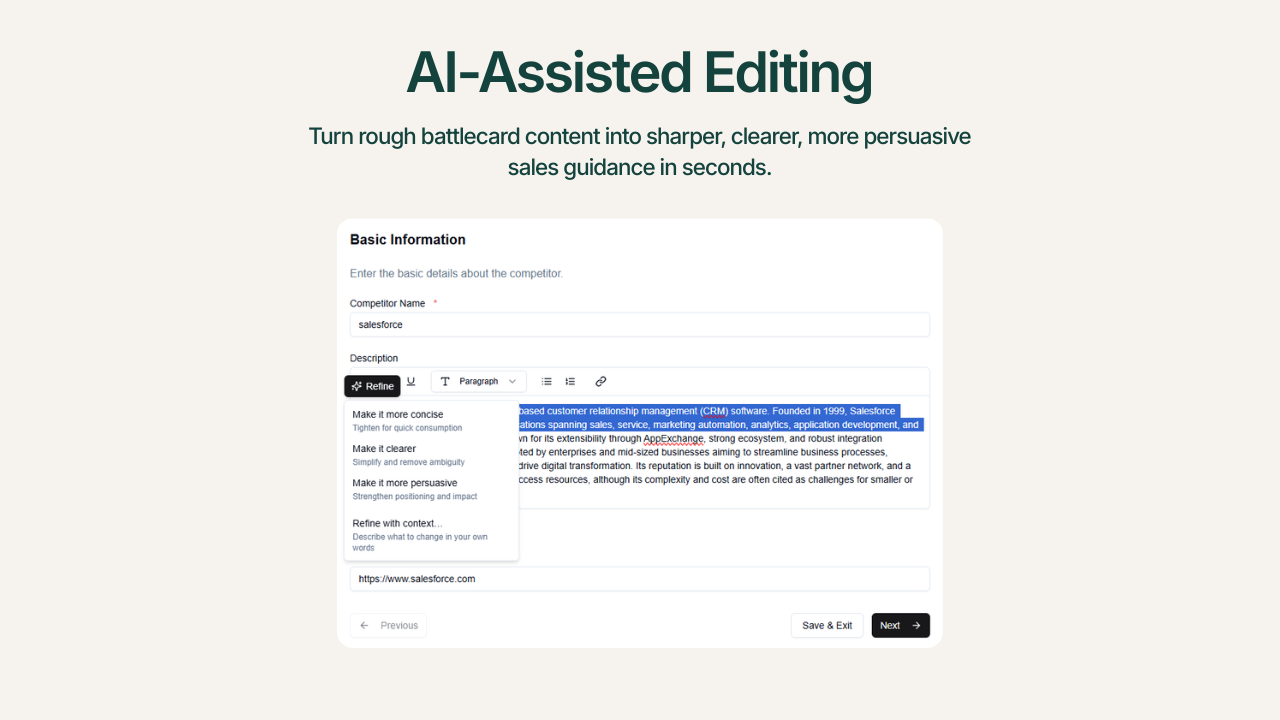
Highlight any text inside a battlecard, and you can now ask AI to make it:
- More concise
- Clearer
- More persuasive
- Shaped to a custom instruction you give it
This is the simplest of the new features and probably the one reps will feel first. Battlecards usually fail in one of two ways: too long to use during a live deal, or too vague to be useful. Both are editing problems, not research problems.
“The judgment about what your battlecard should say belongs to the human. AI’s job is to remove the friction between knowing what you want to say and getting it on the page — not the other way around.” — Paul, Founder & CEO, Playwise HQ
A common workflow: an enablement manager writes a strong but bloated section on a competitor’s weakness. They highlight the paragraph, ask AI to tighten it for an AE prepping for a call, and ship the cleaner version.
Version history and archiving
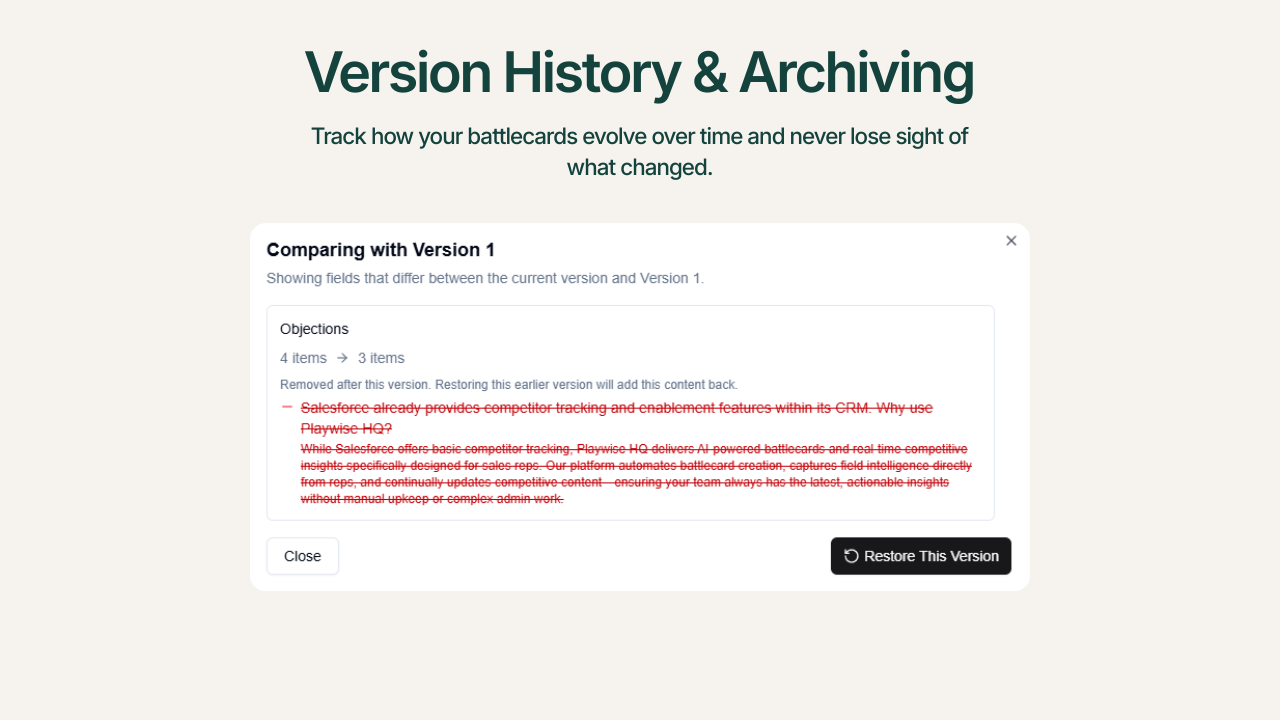
You can now see how a battlecard has changed over time, and archive battlecards instead of deleting them.
Why this matters:
- Competitive positioning evolves. The version of a competitor’s pricing story from six months ago is rarely the same as today’s.
- Archive ≠ delete. When a battlecard becomes irrelevant for the current motion, you want it out of the active library — but not gone forever. Archive keeps the content available without cluttering what’s live.
- Cleaner active library, safer change management. Reps stop grabbing the wrong battlecard mid-deal, and admins stop being afraid to update important content.
Field insights with AI polish and supporting references
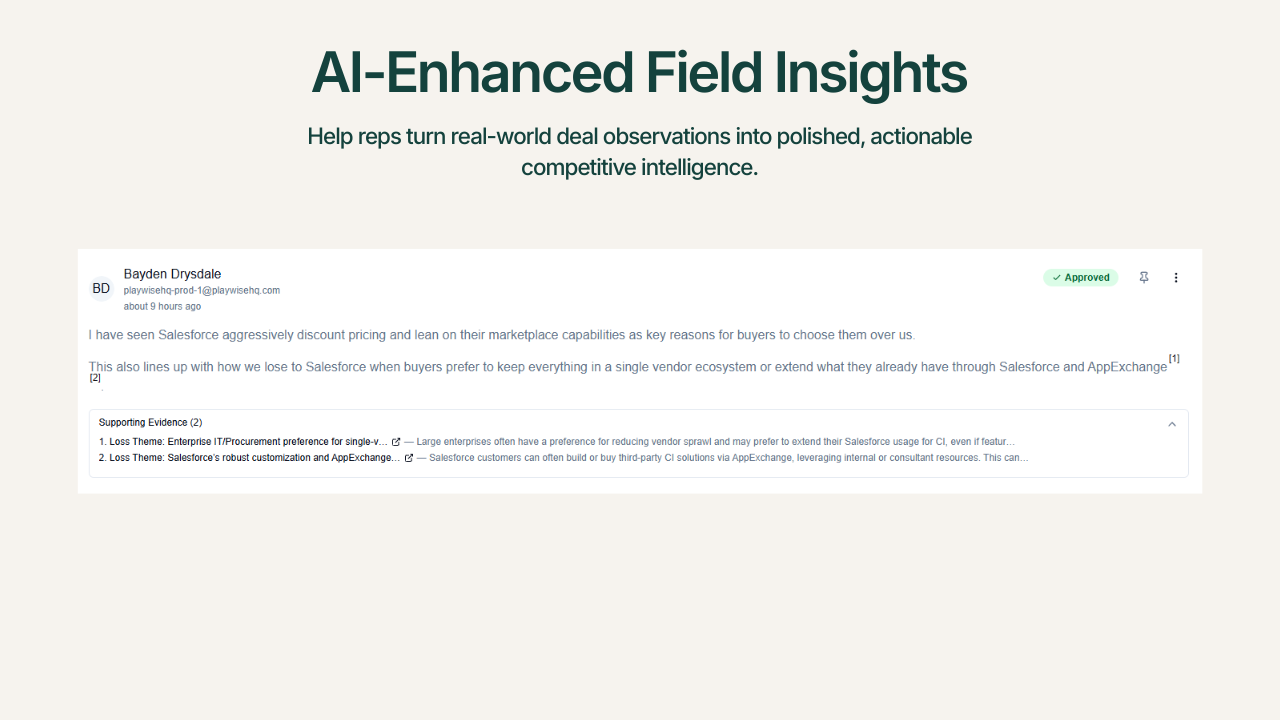
When a rep submits a field insight, two things now happen:
- AI helps shape the contribution. Rough notes become a clearer, more useful insight. A rep coming off a call doesn’t want to spend ten minutes wordsmithing, but the team needs the insight to be structured enough to act on. AI closes that gap.
- Supporting references surface automatically. Playwise HQ scans the relevant battlecard and references existing content in the battlecard that validate the new insight, providing increased confidence that share has been shared is accurate.
When a rep flags a competitor pushing a new integration story in enterprise deals, the system shows the existing objection handling, integration positioning, and product comparison sections that validate it as being accurate.
The point of both changes is the same: field intelligence is only as valuable as how easy it is to contribute and how well it connects to the rest of your competitive knowledge.
Validation signals on field insights
Reps can now mark field insights as:
- Helpful — useful context worth knowing
- Used in a deal — actually pulled into a live conversation
- Helped win a deal — directly moved an opportunity forward
- Potentially outdated — no longer matches what reps are seeing
When an insight gets enough “potentially outdated” signals, admins are notified so they can review, update, archive, or delete it.
“The hardest question in competitive intelligence isn’t ‘what do we know?’ It’s ‘what should we trust?’ We wanted the team itself to answer that, not a single admin trying to audit a library that grows faster than any one person can read.” — Paul, Founder & CEO, Playwise HQ
The effect is meaningful:
- Reps can validate what’s actually useful in the field
- Admins get quality signals without manual audits
- Insights that helped win deals can be promoted with confidence
- Outdated information gets flagged before it costs a deal
Notifications, without the inbox flood
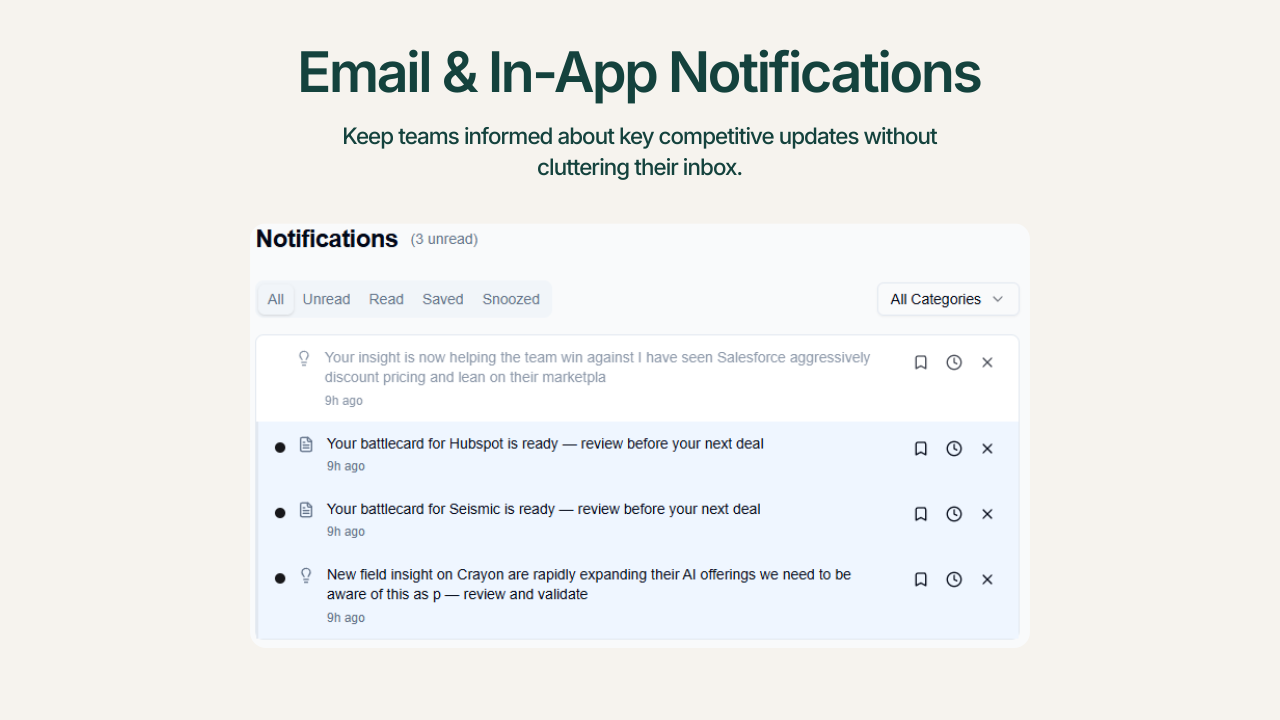
Playwise HQ now supports in-app and email notifications for important updates, with user-level control over what comes through and how often.
The principles behind how we built this:
- No email for every individual activity. Notification fatigue is the fastest way to make a team tune out.
- Daily and weekly digests group important updates together rather than firing one alert per change.
- Full user control. Subscribe, unsubscribe, mute by category, or turn the whole thing off.
- In-app where it makes sense, email when it doesn’t.
A rep should be able to start their week with a quick view of what changed across the competitors they sell against — without dreading another inbox.
HubSpot and Pipedrive integrations: tighter onboarding, deal-level linking
The HubSpot and Pipedrive integrations got two meaningful upgrades:
- Faster onboarding with more fields synced automatically
- Deal-to-battlecard linking — connect won or lost deals to a specific competitor battlecard
- Win/loss intelligence attached at the deal level — capture what worked, what didn’t, and why
- A live feedback loop between CRM outcomes and competitive content — past battlecards get reviewed against actual deal data, so future ones get sharper
“For most teams, CRM data and battlecards live on different planets. The intelligence about why a deal closed almost never makes it back to the battlecard that was supposed to influence it. Closing that loop is where competitive intelligence actually starts to compound.” — Paul, Founder & CEO, Playwise HQ
In practice: a rep wins a competitive deal, links the opportunity back to the relevant battlecard, and adds notes on what worked, which objection response, which pricing comparison, which positioning. That intelligence is now structurally attached to the right place.
How this all fits together
These aren’t independent features. They form a loop:
- Battlecards get created and tightened with AI-assisted editing
- Reps contribute field insights from live deals
- AI shapes the contribution and surfaces related existing content
- The team validates which insights are useful, used, or won deals
- Admins get a heads-up when something looks stale
- Version history preserves how it all evolved
- Notifications keep the right people informed without overwhelming them
- CRM integration connects the whole thing back to actual deal outcomes
The result: every customer conversation, every objection, every win, and every loss can sharpen the competitive knowledge the rest of the team works from.
Who this is for
- Reps get battlecards that are easier to use, more current, and grounded in what other reps have actually seen work — plus a low-friction way to contribute what they’re learning.
- Sales managers get visibility into what’s helping the team in live deals and where reps need stronger competitive guidance.
- Enablement teams stop guessing about what content is working. They see what’s being used, what needs improvement, and which field insights deserve to be promoted into core battlecards.
- Revenue leaders get a clearer picture of how competitive execution connects to deal outcomes and win/loss patterns — at the team level, not just anecdotally.
- CS and account teams running competitive plays around renewals, expansion, or churn prevention get the same loop applied to post-sale motions.
Why this matters now
B2B sales has gotten harder in a specific way. Buyers are better informed, competitors move faster, and generic messaging is easier than ever to ignore. The teams that win competitive deals aren’t the ones with the longest battlecards. They’re the ones that can capture what’s happening in the field, turn it into useful guidance, and get that guidance back to reps before the next deal.
“Competitive advantage isn’t about having more information. It’s about getting the right intelligence to the right person at the right moment — over and over. Most revenue teams don’t lack competitive knowledge. They lack a system that holds onto it, validates it, and pushes it back into the deals where it matters.” — Paul, Founder & CEO, Playwise HQ
That’s the system we’re building.
What’s next
Playwise HQ is moving toward a future where competitive intelligence isn’t a static folder of documents, it’s a living layer across the revenue team. This release sharpens the editing, contribution, validation, change-management, and CRM-feedback parts of that layer.
The goal stays the same: help sales teams win more competitive deals today, while building a competitive intelligence system that gets stronger every quarter.
If your team is still managing competitive intel through PDFs, Slack threads, CRM notes, and scattered docs, we’d love to show you what we’re building at Playwise HQ.