
A mid-market SaaS company recently discovered something uncomfortable during a quarterly enablement review: their enterprise AEs were ignoring 70% of their battlecard library, while their SMB reps complained the same cards were “too dense to use on a live call.” Both segments were losing winnable deals, not because the intelligence was wrong, but because the delivery mechanism was built for a fictional, average seller that didn’t exist.
This is the hidden tax of one-size-fits-all competitive intelligence. And it’s far more common than most revenue leaders realize.
Enterprise and SMB sales motions are fundamentally different games. The buying committees, deal velocity, objection patterns, pricing dynamics, and competitive pressure points diverge so sharply that serving both with identical battlecards is like handing a marathon runner and a sprinter the same training plan. It technically covers “running,” but it optimizes for neither.
This post breaks down exactly how enterprise and SMB battlecards should differ, in structure, governance, update cadence, and delivery, and provides a concrete framework for designing segment-specific competitive execution that actually gets used.
The Hidden Cost of “One-Size-Fits-All” Battlecards

Most CI and enablement teams start with good intentions. They build a comprehensive battlecard, pack it with positioning, objection handling, pricing comparisons, and competitive differentiators. Then they distribute it to every seller across every segment.
The result? Nobody uses it well.
Enterprise reps find the cards too shallow for multi-stakeholder deals that span six months and involve procurement, legal, and security reviews. SMB reps find them too long, too complex, and impossible to reference during a fast-moving discovery call.
The symptoms are predictable:
- Low adoption rates across one or both segments
- Stale content because update workflows don’t match the pace of either motion
- Tribal knowledge hoarding where top reps build their own cheat sheets instead
- Inconsistent messaging across the org because reps cherry-pick what seems relevant
The core problem isn’t content quality, it’s content-motion mismatch. Battlecards need to be designed as execution systems tuned to how sellers actually sell, not as static reference documents built for an internal audience.
As Paul Towers, Founder of Playwise HQ, puts it: “The moment you treat a battlecard as a document instead of a workflow, you’ve already lost the adoption battle. Sellers don’t need more content, they need the right content at the right speed for the deal they’re actually in.”
How Enterprise Sales Actually Uses Battlecards

Enterprise deals aren’t won with a single killer slide. They’re won through sustained, multi-threaded engagement with buying committees that often include 6–12 stakeholders across business, technical, procurement, and executive functions.
This reality demands battlecards that go far deeper than feature comparison grids.
What enterprise AEs actually need
- Stakeholder-specific messaging. A CTO evaluating your platform has entirely different concerns than a CFO scrutinizing total cost of ownership. Enterprise battlecards need stakeholder mapping layers that provide tailored positioning for each persona in the buying committee.
- Multi-stage deal support. A typical enterprise deal moves through discovery, technical evaluation, business case, procurement, and legal/security review. Battlecards that only cover the “why us vs. them” positioning are useless during a procurement showdown or security questionnaire.
- Governed, version-controlled content. When 50+ AEs are selling into Fortune 500 accounts, a rogue pricing claim or outdated competitive comparison creates real legal and brand risk. Enterprise battlecards require governance workflows with clear ownership, review cycles, and version control.
- Multi-team collaboration. Enterprise deals pull in presales engineers, solution architects, customer success, legal, and sometimes product. The battlecard system needs to support input and review from all of these teams — not just the CI analyst who built the original card.
How SMB Sales Actually Uses Battlecards

SMB sales is a different animal. Cycles are measured in days or weeks, not months. Buying committees are small — often a single decision-maker or a two-person evaluation. The competitive landscape shifts fast, and reps handle high volumes of opportunities simultaneously.
What SMB reps actually need
- Speed above all. An SMB rep on a live demo who encounters a competitive objection needs the answer in under 10 seconds. If the battlecard requires scrolling through three pages of stakeholder analysis, they’ll wing it instead.
- Sharp differentiators and pricing narratives. SMB deals are often won or lost on perceived value and price. Battlecards need to deliver crisp, battle-tested talk tracks that address “why are you more expensive?” or “your competitor includes X for free” without hesitation.
- Ramp acceleration. SMB teams typically have higher turnover and faster hiring cycles. Battlecards serve as a critical enablement tool that helps newer reps sound credible in competitive conversations within weeks, not the quarters it takes to build organic competitive instinct.
- Minimal friction. Every additional click, tab, or search query between the rep and the answer is a moment where they lose confidence or momentum on a call. SMB battlecards must fast and easy to navigate.
Key Differences: Enterprise vs SMB Battlecard Design

Understanding the philosophical differences is one thing. Translating them into concrete design decisions is where most teams stall. Here’s a direct comparison across the dimensions that matter most:
Content depth and structure
- Enterprise: Multi-layered narratives with executive summaries, deep-dive sections, persona-specific positioning, and technical comparison matrices. Think 4–8 structured sections that a rep navigates based on deal stage.
- SMB: Condensed, scannable cards — that answer “Why us?” and “Why now?” with punchy differentiators and ready-to-use talk tracks.
Stakeholder mapping and use-case coverage
- Enterprise: Explicit stakeholder maps linking each competitor’s strengths and weaknesses to specific buyer personas (technical evaluator, economic buyer, end user, procurement). Cards should address how competitors position to each persona.
- SMB: Minimal stakeholder mapping. Focus on the primary decision-maker’s top 2–3 concerns and how to address them directly.
Update cadence
- Enterprise: Governed release cycles (monthly or quarterly) with formal review, plus urgent micro-updates when a competitor makes a major move (pricing change, acquisition, new product launch).
- SMB: Lightweight weekly or biweekly refreshes driven by frontline feedback and competitive signal monitoring. Speed of update matters more than formal governance.
Governance and access controls
- Enterprise: Role-based permissions, approval workflows, version history, and audit trails. Content governance for sales assets isn’t optional — it’s a risk management function.
- SMB: Simpler governance with clear ownership but fewer approval layers. The priority is keeping content fresh, not locking it down.
Designing Enterprise Battlecards That Match Reality
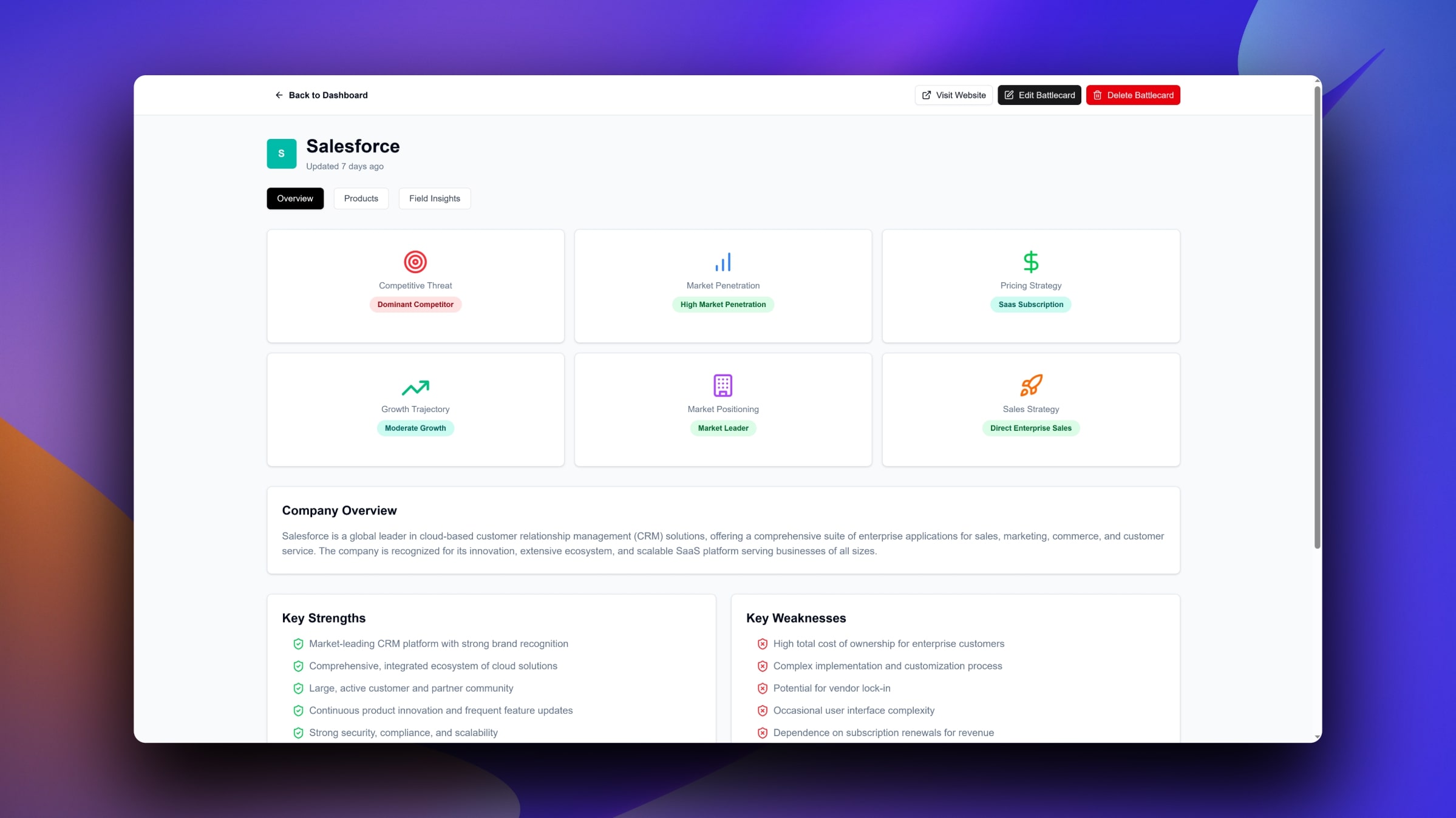
Multi-layer templates
The most effective enterprise battlecards use a layered architecture:
- Executive summary (1 screen): High-level competitive positioning, key differentiators, and strategic narrative for the account team
- Persona-specific sections: Tailored messaging for CTO/technical, CFO/economic, end-user/champion, and procurement stakeholders
- Deep-dive objection handling: Detailed objection responses with supporting evidence, customer proof points, and rebuttal frameworks
- Stage-specific playbooks: Guidance for RFPs, security reviews, procurement negotiations, and technical bake-offs
Mapping competitors to business context
Enterprise battlecards should map competitors not just to features, but to initiatives, industries, and personas. A competitor that’s strong in financial services may be weak in healthcare. A competitor that wins on price may lose on compliance. This contextual mapping transforms a battlecard from a static comparison into a strategic planning tool.
Governance that scales
With 50+ reps accessing enterprise battlecards, you need:
- Clear ownership per competitor card (typically CI lead + product marketing)
- Review workflows with defined SLAs for updates
- Version control so reps always access the latest approved content
- Feedback mechanisms so field insights flow back to card owners
Designing SMB Battlecards for Speed and Clarity
Condensed templates that answer the only questions that matter
SMB battlecards should be ruthlessly focused. Every element should pass the test: “Would a rep use this on a live call?” If not, cut it.
The ideal SMB-friendly battlecard template includes:
- Positioning statement (2–3 sentences): Why you win against this competitor
- Top 3 differentiators: Specific, evidence-backed, easy to articulate verbally
- Quick-hit objection responses: The 3–5 most common objections with crisp rebuttals
- Pricing/packaging narrative: How to handle the price comparison conversation
- Trap questions: Questions the rep can ask to expose competitor weaknesses
Competitive pricing narratives that close on the call
Pricing is the battleground in SMB sales. Reps need more than “we’re competitively priced.” They need specific narratives:
- “They charge per user, we charge per team — here’s why that saves you $X at your size”
- “Their base plan doesn’t include [critical feature], which means you’ll upgrade within 3 months”
- “Here’s what three customers told us they actually paid after the first year with [competitor]”
These pricing narrative strategies need to be pre-built, tested, and embedded directly in the battlecard.
Mini-scenario: The afternoon competitor pivot. An SMB rep has four demos scheduled in one afternoon, two against Competitor A, one against Competitor B, and one against an unknown incumbent. Between calls, they pull up each competitor’s condensed battlecard, scan the top differentiators and trap questions, and walk into each conversation with a tailored competitive angle. On the third call, the prospect mentions a competitor the rep hasn’t encountered before. They quickly search the battlecard library, find a recently updated card with sales-sourced insights from a colleague who faced the same competitor last week, and use the suggested positioning to win the deal on a same-day close.
This is what segment-tuned content delivery looks like in practice — fast, contextual, and friction-free.
Paul Towers frames it this way: “SMB battlecards should feel like a cheat code, not a research paper. If your rep can’t absorb the competitive angle in the 30 seconds between hanging up one call and dialing the next, you’ve over-engineered it.”
Smart Update Cadences and Governance by Segment

One of the most overlooked aspects of battlecard programs is how and when content gets updated. Most teams either update everything on a rigid quarterly schedule (too slow for SMB, often unnecessary for stable enterprise competitors) or update nothing until someone complains (too reactive for both).
Segment-aligned update rhythms
Enterprise cards:
- Quarterly deep reviews aligned to competitive landscape shifts, product releases, and win/loss patterns
- Micro-updates within 48 hours for material changes (pricing shifts, major product announcements, leadership changes)
- Formal review gates before updates go live — especially for pricing, legal, and compliance-sensitive content
SMB cards:
- Weekly or biweekly refresh cycles driven by frontline rep feedback and competitive signal monitoring
- Lightweight approval (CI lead or enablement manager signs off, no multi-team review board)
- Real-time updates for pricing and packaging changes, which are the highest-impact content in SMB competitive selling
Understanding how often you should update your competitor battlecards is critical — and the answer is different for each segment.
Role-based ownership
Effective governance requires clear ownership, not committees:
- CI team owns competitive positioning and market intelligence
- Product marketing owns messaging frameworks and differentiation narratives
- Enablement owns delivery, training, and adoption
- Frontline reps own feedback — they’re the sensor network that detects when cards are stale or missing the mark
The feedback loop from reps back to card owners is where most programs break down. Without a structured mechanism for turning lost deals into future wins, battlecards slowly drift from reality.
Tailoring Workflows and Access Controls for Adoption
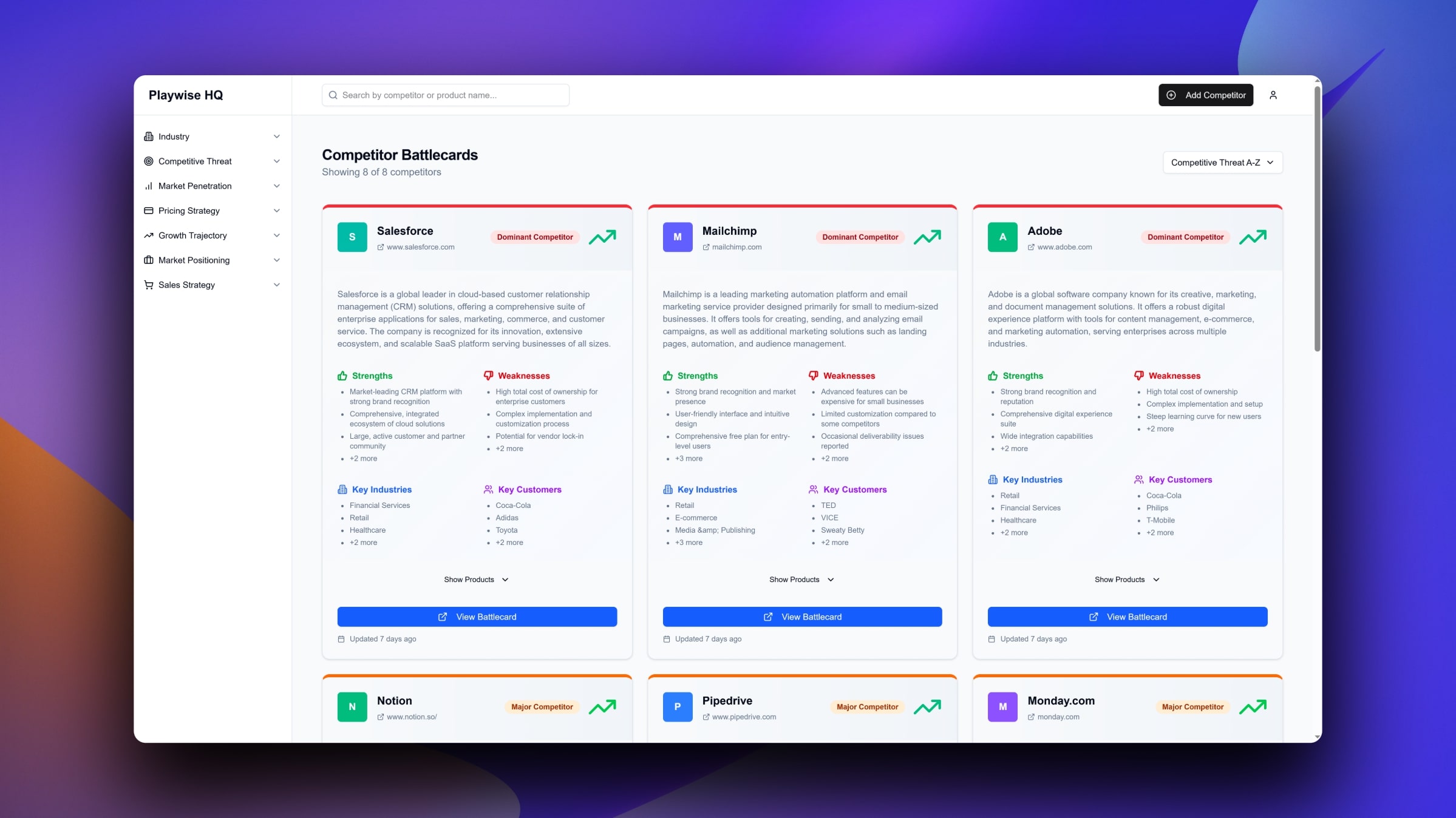
The fastest way to kill battlecard adoption is to overwhelm reps with content that isn’t relevant to their deals. This is where segment-specific library design becomes a force multiplier.
Separate with intent
Enterprise and SMB battlecard libraries should be distinct — not just tagged differently within a single undifferentiated repository. Reps should see only the cards designed for their motion, with the depth and format that matches their workflow.
Role- and segment-based access
- Enterprise AEs see multi-layer cards with full stakeholder mapping and stage-specific playbooks
- SMB reps see condensed cards optimized for speed
- Managers see both, plus usage and performance data
- CI and enablement see everything, plus editing and governance tools
Contextual triggering
The most effective delivery happens when the right battlecard surfaces automatically based on deal attributes — competitor tagged in CRM, deal size, industry, or product line. This eliminates the “go find the battlecard” step that kills adoption in both segments.
As Paul Towers notes: “Adoption isn’t a training problem, it’s a design problem. If you have to teach reps how to find and use your battlecards, you’ve already introduced too much friction. The card should arrive at the point of need, formatted for the deal context, without the rep lifting a finger.”
Real-World Usage Patterns and Outcomes
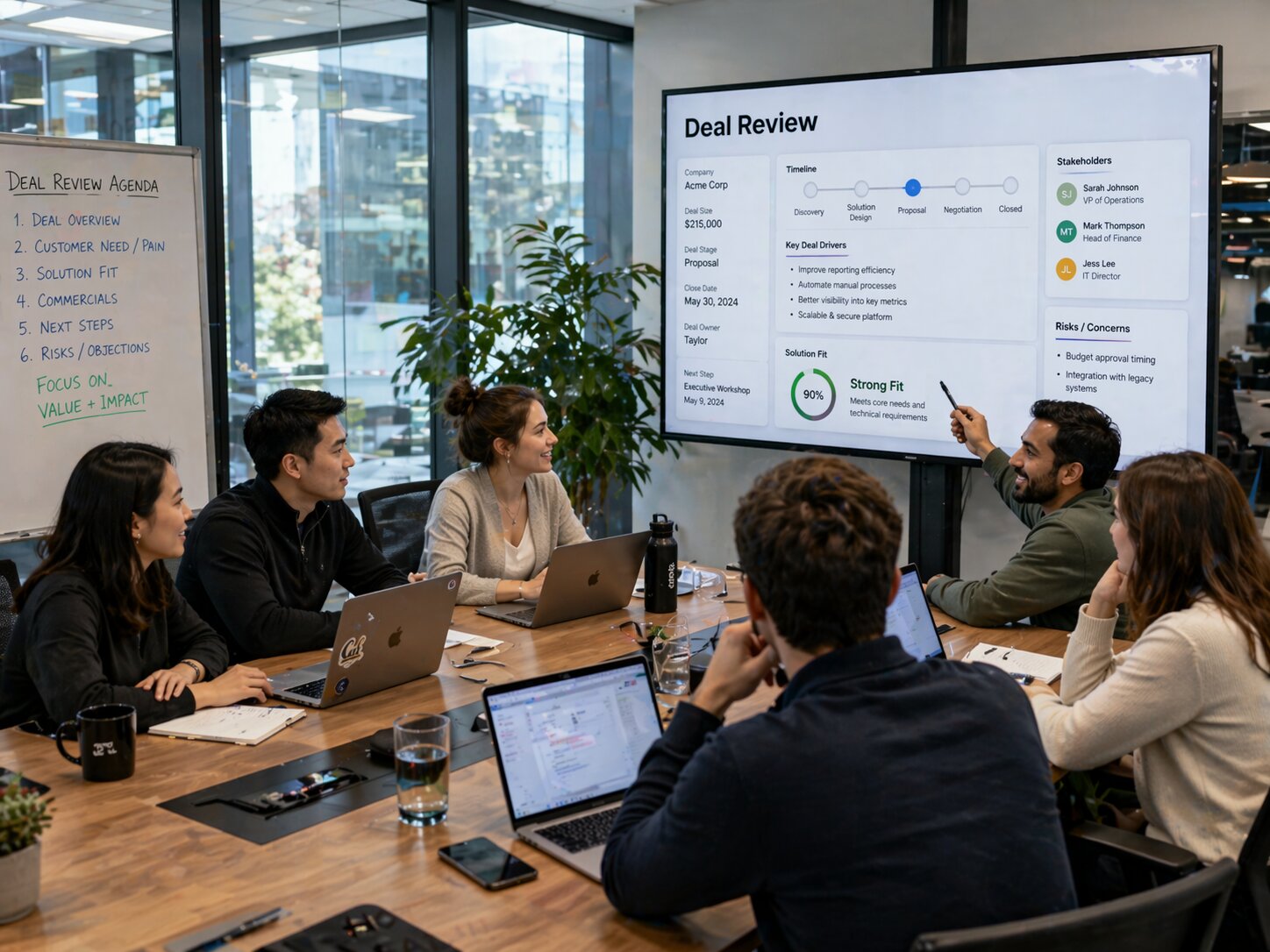
Enterprise AE: Layered engagement across a 6-month cycle
Consider an enterprise AE managing a $500K opportunity against two competitors over six months. In the first month, they use the executive summary layer to brief their champion on competitive positioning. In month three, they pull the technical deep-dive section to prepare their solutions engineer for a bake-off. In month five, they reference the procurement playbook to navigate a surprise RFP that the competitor pushed for. At each stage, the battlecard serves a different function — but it’s all part of one structured, governed system.
SMB rep: Competitor agility in real time
An SMB rep handles 40+ active opportunities. They don’t have time to study battlecards before each call. Instead, they rely on contextual deliver. They scan the top three differentiators, note the trap question, and walk into the call prepared. This happens dozens of times per week, and the cumulative effect on win rate is significant.
Managers and enablement: Pattern recognition
Sales managers use battlecard usage data alongside win/loss outcomes to identify patterns. Which competitors are we losing to most? Which battlecards are being used in won deals vs. lost deals? Where are reps not accessing cards at all, and is that a content problem or a delivery problem? This analytical layer transforms battlecards from a content project into a competitive intelligence feedback system.
Making the Shift: From Static Docs to Segment-Tuned Competitive Execution
If your current battlecard program serves both enterprise and SMB with the same content, format, and delivery mechanism, you’re leaving revenue on the table. Here’s how to make the shift.
Step 1: Audit your current state
Pull usage data on your existing battlecards. Identify which cards are used by which segments, where adoption drops off, and where reps have built their own workarounds (shadow battlecards in personal docs, Slack channels with competitive tips, etc.). These workarounds are a signal, they tell you exactly where your official content fails to meet the seller’s need.
Step 2: Split and refactor
Take your highest-priority competitor cards and create segment-specific versions:
- Enterprise version: Expand with stakeholder mapping, stage-specific guidance, governance metadata, and deeper objection handling
- SMB version: Condense to essentials — positioning, differentiators, pricing narrative, top objections, trap questions
Don’t try to refactor every card at once. Start with your top 3–5 competitors by deal volume and iterate.
Step 3: Establish ownership and feedback loops
Assign clear owners per card and per segment. Build a lightweight feedback mechanism so reps can flag stale content, suggest updates, and share field intelligence. This is where getting sales teams to actually use competitive content shifts from aspiration to reality.
Step 4: Instrument and measure
Define success metrics for each segment:
- Adoption rate (% of competitive deals where battlecard was accessed)
- Win rate delta (win rate in deals where battlecard was used vs. not)
- Time-to-update (how quickly new intelligence reaches the field)
- Rep satisfaction (qualitative feedback on usefulness and accessibility)
Step 5: Iterate based on evidence
Use the data from Step 4 to continuously refine. Kill cards that aren’t used. Expand cards that correlate with wins. Adjust update cadences based on competitive market velocity.
Paul Towers summarizes the shift: “Competitive execution isn’t a side project anymore, it’s a core revenue function. The teams that treat battlecards as living, segment-tuned systems will consistently outperform those still emailing PDFs and hoping for the best.”
Stop Guessing, Start Designing for How Your Teams Actually Sell
The gap between enterprise and SMB battlecard needs isn’t subtle — it’s structural. Bridging it requires intentional design, segment-specific governance, and delivery mechanisms that match the speed and complexity of each motion.
Playwise HQ is built for exactly this challenge. With structured battlecard templates, role-based access controls, easy to navigate tabs for competitive content, the ability to tag win/loss themes and objections, and it gives CI and enablement teams the infrastructure to operationalize competitive execution — without the chaos of managing it all in docs and spreadsheets.
If you’re ready to move beyond one-size-fits-all battlecards and build a competitive program that matches how your enterprise and SMB teams actually sell, book a demo and see how Playwise HQ makes it work.