
More emails don’t necessarily create more pipeline.
More contacts don’t necessarily create better conversations.
And more meetings don’t matter if they are with buyers who were never likely to become customers.
That is the problem Outbound Panda is built to solve.
Outbound Panda helps Seed to Series A B2B companies build and operate outbound prospecting systems without immediately hiring an internal SDR or BDR team.
Its approach is not based on simply building a larger contact list and increasing send volume.
The team first diagnoses what is already happening, sharpens targeting and positioning, builds the enrichment and sequencing infrastructure, tests the motion, and then continuously improves it based on what happens after prospects respond.
Playwise HQ helps Outbound Panda close one of the most important gaps in that process: connecting what happens in sales meetings back to the next outbound campaign.
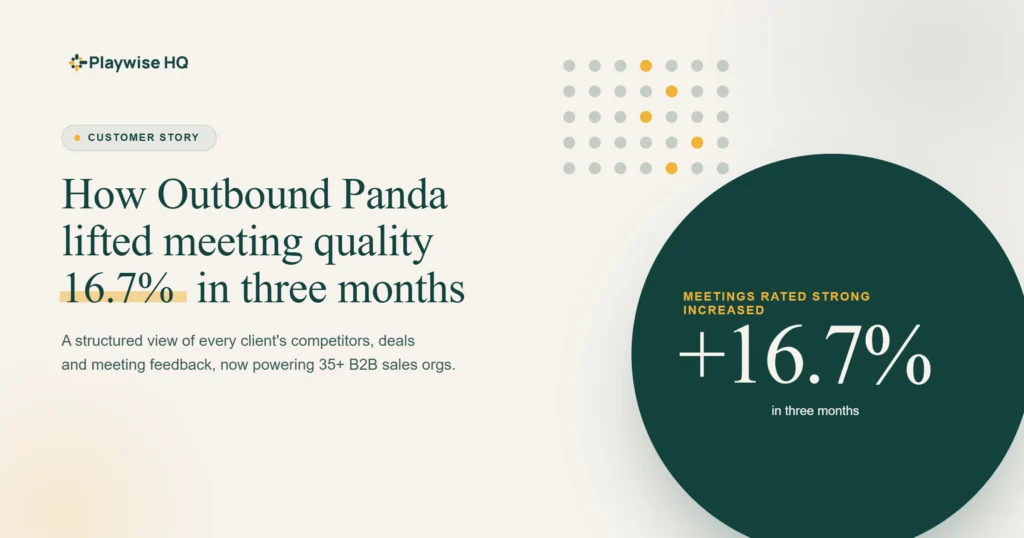
Since adopting Playwise HQ, Outbound Panda has scaled its services across more than 35 B2B sales organisations, improved targeted email response rates by 13.5%, and increased the number of meetings rated strong or very strong by client sales teams by 16.7% in three months.
Quick Snapshot
Industry: B2B Outbound Sales & Prospecting
Company Size: Specialist outbound agency supporting 35+ B2B sales organisations, primarily Seed to Series A companies
Problem: Outbound Panda needed a scalable way to understand each client’s competitive landscape and connect what happened in sales meetings back into future targeting and messaging, without relying on disconnected CRM notes, call recordings or manual research.
Solution: Outbound Panda uses Playwise HQ to centralise competitor intelligence, surface relevant deal outcomes and capture structured feedback from client sales reps after meetings, so each campaign can be refined based on what prospects actually respond to and what happens once sales takes over.
Key Results:
- Services scaled across 35+ B2B sales organisations
- 13.5% increase in targeted email response rates
- 16.7% increase in meetings rated strong or very strong in three months
The Challenge: Outbound Is More Than a Contact List
Outbound Panda works with early-stage B2B companies that often have sales traction but have not yet built a repeatable outbound engine.
They may have grown through referrals, founder-led selling or an initial sales hire.
The obvious next move can be to hire SDRs, buy more data and dramatically increase prospecting volume.
Outbound Panda takes a more deliberate approach.
Before changing anything, it diagnoses what is already happening.
That includes reviewing:
- ICP and account lists
- personas being targeted
- current sequences
- messaging and value propositions
- enrichment workflows
- response metrics
- recent meetings
- meeting outcomes
- qualification
- resulting pipeline
The objective is not simply to understand whether emails are being opened or replied to.
It is to understand whether the overall system is producing qualified conversations with buyers who have a realistic chance of becoming customers.
Why Competitive Context Changes the Message
A company’s value proposition may sound strong in isolation.
But buyers do not make decisions in isolation.
They are comparing vendors, existing processes and alternative ways of solving the problem.
Outbound Panda Founder Oliver Neumeister believes that context should influence outbound messaging from the beginning.
Many outbound programmes build sequences around a company’s headline value proposition.
Outbound Panda goes further.
The question becomes:
What message resonates for this product, in this industry, with this persona, given the alternatives that buyer is likely to consider?
Playwise HQ gives the team a way to build and maintain that competitive understanding across dozens of different client environments.
Building the Competitive Picture
When Outbound Panda begins working with a client, the relevant competitors can be added to a dedicated Playwise HQ environment.
That gives the team a central view of competitor positioning, strengths and weaknesses, differentiation, common objections, and where the client tends to win or lose.
It provides another layer to the diagnosis Outbound Panda performs before rebuilding the outbound motion.
The team can spot situations where the messaging on a company’s website or existing sequences does not line up with the reasons customers actually choose the business.
“Without Playwise HQ, there would be no way for us to get the depth of knowledge that we have across all of our clients’ competitors.”
— Oliver Neumeister, Founder & CRO, Outbound Panda
Competitive Insight Without Giving an Agency Full CRM Access
For some Outbound Panda clients, there is another important consideration: data access.
An external prospecting partner needs enough context to understand which competitors are appearing, which opportunities are progressing, and why deals are being won or lost.
But that does not necessarily mean the client wants agency employees operating directly inside its CRM.
Playwise HQ provides another route.
A client can connect its CRM to Playwise HQ and make the relevant competitive and deal intelligence available to Outbound Panda without necessarily giving the agency broad access to the underlying CRM itself.
That gives Outbound Panda the context it needs while allowing the client to retain tighter control over its primary sales system.
It also means the information Outbound Panda works from is structured around competitors and deal outcomes, rather than being scattered across raw opportunity records.
From the Meeting Handoff Back to the Next Campaign
This is where Playwise HQ becomes especially useful in Outbound Panda’s operating model.
Outbound Panda runs the prospecting motion and books the meeting.
That meeting is then handed directly to the client’s sales team.
The job does not end there.
The sales rep can rate whether the meeting was weak, average, strong or very strong, and add what actually came up in the conversation: a competitor, an objection, a reason the prospect responded positively, or something that made the opportunity less attractive than it first appeared.
Outbound Panda can then use that feedback when deciding what to change in the next campaign.
A segment may generate lots of replies but poor meetings.
Another message may produce fewer responses but much stronger conversations.
A competitor objection that repeatedly appears in first meetings may need to be addressed earlier in the outreach.
That is the loop: campaign → meeting → rep feedback → campaign refinement.
Tools such as Gong can preserve the underlying conversation, but Playwise HQ structures the relevant insights by competitor and connects them back to deal outcomes, rather than leaving them buried inside recordings and transcripts.
Neumeister explains why that matters:
“We would not be able to automate the collection of insights from their sales reps on what is working and isn’t working in meetings and conversations they’re having in the field every day.”
From Diagnosis to Launch
Once the initial diagnosis is complete, Outbound Panda builds tighter segments and buyer-persona hypotheses.
Instead of targeting a broad group such as “B2B SaaS companies,” it looks for more precise combinations of industry, company profile, persona and relevant buying signal.
The team typically uses tools such as Clay to build enrichment workflows around those segments.
Messaging can then be developed for different products, industries and personas.
Competitive intelligence helps make those messages more specific.
A prospect using one alternative may need a different angle from someone using another. A CRO may care about different points of differentiation from a VP Sales.
Historical win/loss patterns can also reveal which segments deserve more attention before the campaign is scaled.
Measure the Signal Before Scaling
Outbound Panda deliberately does not scale a new outbound motion immediately.
For roughly the first two weeks, the team watches which segments respond, which messages create meaningful replies, which personas engage, and what happens after those meetings are handed to sales.
That last point is critical.
A campaign can generate impressive top-of-funnel activity while producing poor commercial outcomes.
Outbound Panda wants to know whether client sales representatives actually regard those meetings as valuable.
The feedback from those meetings then becomes another input into the next round of targeting and messaging.
A 13.5% Increase in Targeted Email Response Rates
Since adopting Playwise HQ, Outbound Panda has recorded a 13.5% improvement in response rates from targeted outbound emails.
In cold outbound, that is meaningful.
Prospects are surrounded by automated sequences, generic personalisation and increasingly high volumes of AI-generated outreach.
More volume alone is unlikely to solve the problem.
Greater relevance can.
By understanding competitors, historical deal outcomes and what prospects actually say once they reach sales, Outbound Panda can continuously refine the messages used at the top of the funnel.
As Neumeister explains:
“This is really important because we take that information and leverage it in our outbound strategies to increase open rates, improve replies, and secure more meetings.”
The competitive intelligence is not research for its own sake.
It changes who is targeted, how they are approached and what Outbound Panda says to them.
Improving Meeting Quality by 16.7%
Replies are not the final measure.
Neither are meetings booked.
Once Outbound Panda hands a meeting across, the client sales representative assesses the quality of the conversation.
Over a three-month period, Outbound Panda saw the number of meetings rated strong or very strong increase by 16.7%.
That distinction matters.
An outbound provider could increase total meetings while simultaneously wasting more sales time if those conversations are badly qualified.
Outbound Panda wants better targeting and messaging to result in better sales conversations and, ultimately, better pipeline.
Across the majority of clients using Outbound Panda for B2B outreach, the company has also seen an increase in average deal size.
Neumeister attributes that in part to the team’s ability to understand each client’s competitive landscape more quickly and tighten the connection between the messaging used in outbound and what sales reps actually experience once conversations begin.
Scaling the Model Across 35+ Sales Organisations
This process gets harder as an agency scales.
Outbound Panda now supports more than 35 B2B sales organisations.
Each has different buyers, competitors, products, objections and sales histories.
Without a repeatable intelligence system, adding more clients could easily mean sacrificing depth.
Playwise HQ helps Outbound Panda avoid that trade-off.
Each client can have its own competitive environment while the intelligence improves as new meetings take place, new objections appear and sales teams provide more feedback.
Instead of completing competitor research once during onboarding and allowing it to go stale, Outbound Panda can continually refine the picture based on what is happening in the market.
Outbound That Learns From the Sales Team
Outbound Panda does not treat outbound as a volume exercise.
It treats it as a system that should improve as more prospects move through it.
The prospecting campaign tells the team which messages create interest. The sales meeting reveals whether that interest came from the right buyer and what happened when the conversation became real. Deal outcomes add another layer of evidence about which opportunities were ultimately worth pursuing.
Playwise HQ helps Outbound Panda connect those signals.
That is how the company has been able to scale across more than 35 B2B sales organisations while improving both initial response rates and the quality of the meetings it creates.
The goal is not simply to book another meeting.
It is to make every completed meeting improve the next one.