
Every quarter, your team loses deals you should have won. Not because your product was weaker or your price was wrong, but because nobody systematically asked the buyer why they chose someone else and then did something useful with the answer.
Win/loss interviews are the single most direct line between your revenue team and the truth about how buyers actually make decisions. Yet most B2B organizations either skip them entirely, run them inconsistently, or — worst of all — conduct them diligently and then let the insights rot in a Google Doc that no one reads.
This post gives you a complete, structured win/loss interview template you can deploy immediately. More importantly, it shows you how to turn raw interview data into competitive intelligence that actually changes deal outcomes, through sharper battlecards, better objection handling, and a sales organization that learns from every deal it touches.
Why Win/Loss Interviews Are Your Most Underused Growth Lever
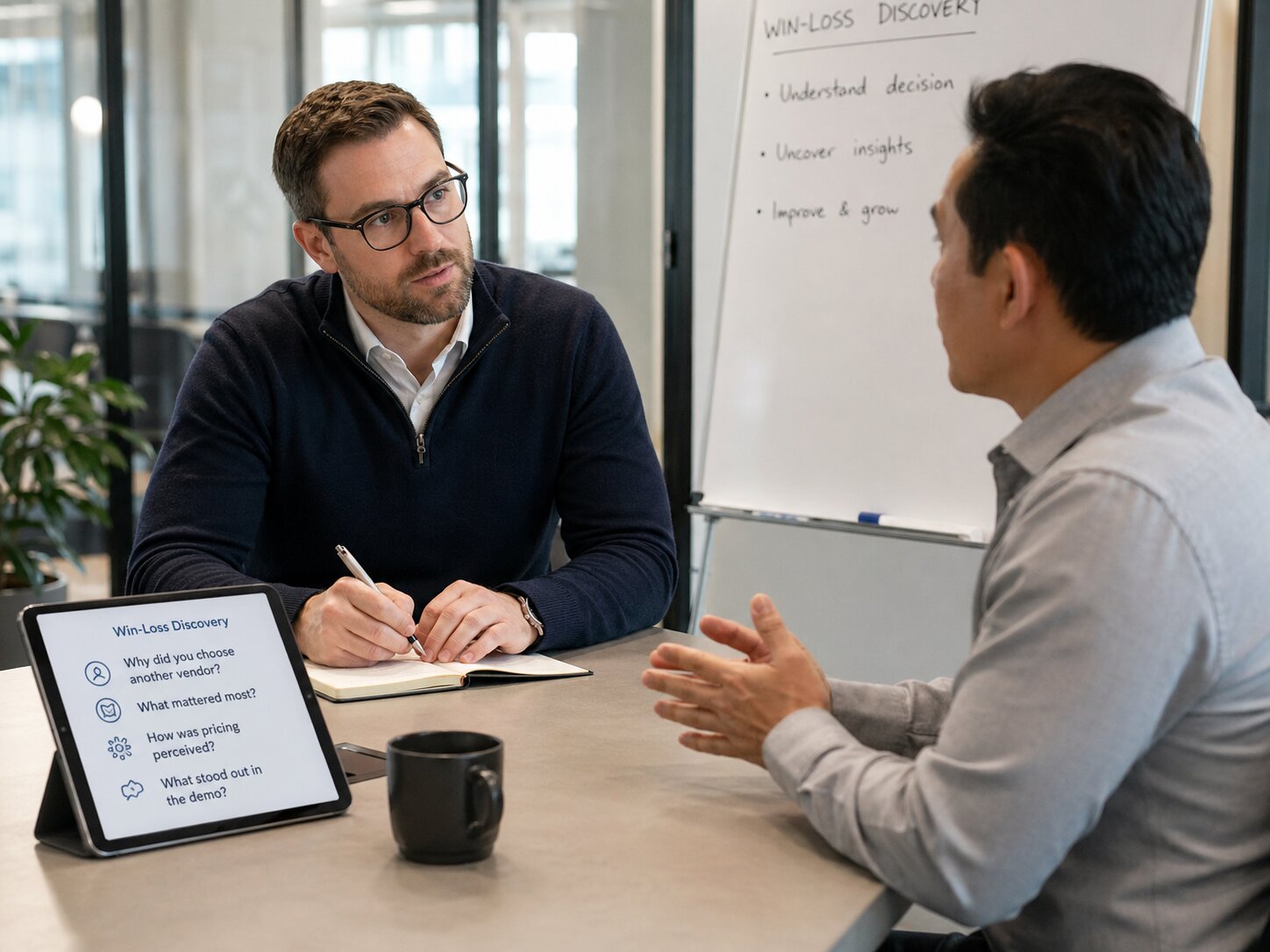
If you want to improve win rates, you have two options: guess what buyers care about, or ask them.
Most teams guess. They rely on CRM disposition codes (“lost on price”), anecdotal feedback from reps, and internal assumptions about why deals break their way — or don’t. The problem is that these sources are filtered through self-interest, recency bias, and incomplete information. A rep who lost a deal rarely has full visibility into the buyer’s internal deliberations, competing vendor evaluations, or the real weight assigned to each decision criterion.
“We lost on price” is almost never the full story. When you actually interview the buyer, you discover that price was the tiebreaker, but the real gap was in perceived implementation risk, or the competitor’s reference customer in the same vertical, or the fact that your champion lost an internal argument to a stakeholder you never engaged. Price is the easy answer. The interview reveals the useful one.
Win/loss interviews give you something no other data source can: the buyer’s own language for why they chose what they chose. That language, the specific phrases, concerns, comparisons, and decision criteria, is the raw material for positioning, messaging, battlecards, and objection handling that actually resonates because it mirrors how buyers think, not how your marketing team thinks buyers think.
The organizations that run structured win/loss programs consistently outperform those that don’t. Not because the interviews are magic, but because they create a feedback loop between the market and the frontline that compounds over time. Every interview makes the next similar deal more winnable — if you have the system to capture, structure, and distribute the insight.
How Most Teams Mismanage Win/Loss (And Leave Insights on the Table)
Before we get to the template, it’s worth understanding the failure modes — because most teams that do run win/loss interviews still don’t get the value they should.
- No standardized win/loss interview template. Different people ask different questions. Sometimes it’s the AE. Sometimes it’s a product manager. The questions vary by mood, by deal, by who remembers to do it. Without a structured interview template for deals, you can’t compare responses across interviews or spot patterns.
- Notes buried in docs with no structured data. Even when interviews happen, the output is typically a wall of text in a shared document. There’s no tagging by competitor, segment, or theme. No way to query “what are the top three objections buyers raise when evaluating us against Competitor X?” The insight exists, but it’s inaccessible.
- Feedback never reaches the frontline. This is the most common and most costly failure. A product manager runs a thoughtful interview, captures a critical insight about how buyers perceive your onboarding experience versus a competitor’s, and writes it up. The sales team never sees it. The battlecard never gets updated. The next rep walks into the same deal with the same blind spot.
- One-off insights instead of data-driven win/loss patterns. A single interview is an anecdote. Twenty interviews coded by theme and competitor are a strategic asset. Most teams never make the leap from anecdote to pattern because they lack the structure and rhythm to accumulate and analyze responses systematically.
The template below is designed to solve all four problems.
The Complete Win/Loss Interview Template: Core Sections & Flow
A strong win/loss interview follows a deliberate arc. You’re not just collecting data — you’re guiding a conversation that moves from context to evaluation to decision to reflection. Here’s the structure:
- Setting context and securing candor — Establish rapport, explain the purpose, and make it safe to be honest.
- Decision process & stakeholder mapping — Understand who was involved, what triggered the evaluation, and how the decision was made.
- Evaluation criteria & tradeoffs — Learn what mattered most, what was negotiable, and how vendors were compared.
- Competitor perceptions & positioning — Surface how your brand and competitors were perceived at each stage.
- Product gaps, objections, and friction points — Identify where doubt crept in and what created hesitation.
- Sales motion & buying experience — Evaluate how your team showed up relative to the competition.
- Retrospective: what would have changed the outcome — The single most actionable section.
Each section below provides the specific questions. Adapt the language to your context, but preserve the structure — it’s what makes the data comparable across interviews.
Win/Loss Interview Questions: Discovery & Decision Process
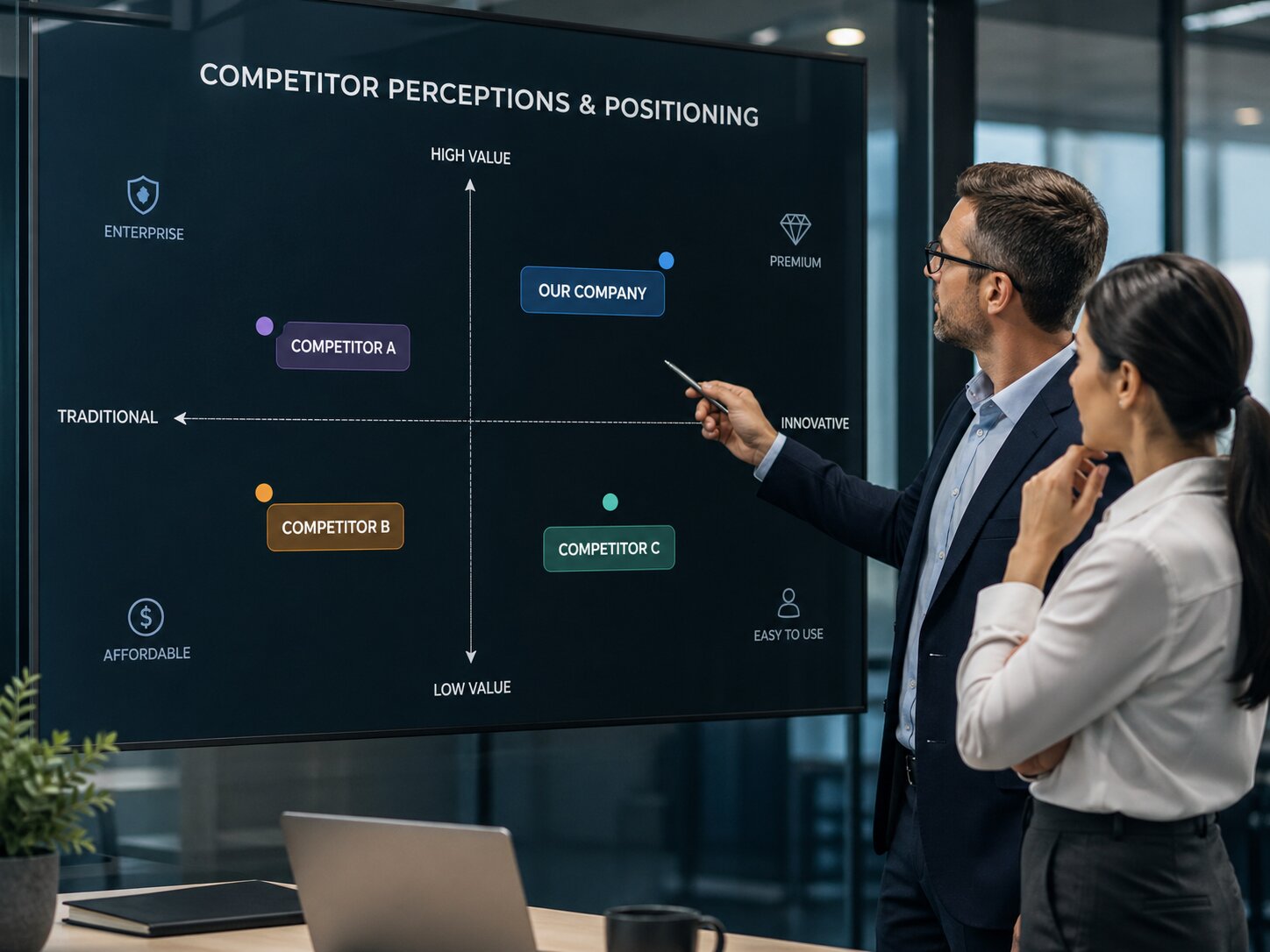
This section establishes the “why now” and “who was involved” — critical context that shapes everything else.
- What initially prompted you to look for a solution in this space? Was there a specific trigger or event?
- How long had this problem existed before it became a priority? What changed?
- Who was involved in the decision? Can you walk me through the key stakeholders and their roles?
- Probe: Who was the primary champion? Were there skeptics or blockers?
- What was the timeline from initial research to final decision? Were there any delays or accelerators?
- How was the budget approved? Was there a formal business case, or was it discretionary?
- Were there any internal constraints — budget caps, procurement requirements, security reviews — that shaped the process?
Why these matter: Stakeholder mapping in decision making is one of the most overlooked outputs of win/loss interviews. When you discover that your champion was a mid-level manager but the final decision was made by a VP you never spoke to, that’s not a product problem, it’s a sales motion problem. And it’s fixable.
Win/Loss Interview Questions: Evaluation Criteria & Tradeoffs
This is where you learn what the buyer actually optimized for, which is often different from what they told your rep during the sales process.
- What were the top three criteria you used to evaluate vendors? How did you weight them?
- Were there any must-haves that would have immediately disqualified a vendor?
- How did you shortlist vendors? What got someone on the list, and what got them removed?
- Where did you make tradeoffs between price, functionality, and risk? Can you give a specific example?
- Probe: Was there a moment where a cheaper option felt too risky, or a more expensive option felt worth the premium?
- What did “good enough” look like versus “game-changing”? Where did we fall on that spectrum?
- Were there criteria that became more or less important as the evaluation progressed?
Why these matter: Understanding pricing vs. functionality tradeoffs from the buyer’s perspective is gold. You’ll often discover that buyers didn’t choose the cheapest option, they chose the one that best reduced perceived risk. That insight changes how you position, price, and sell.
Win/Loss Interview Questions: Competitor Perception & Positioning
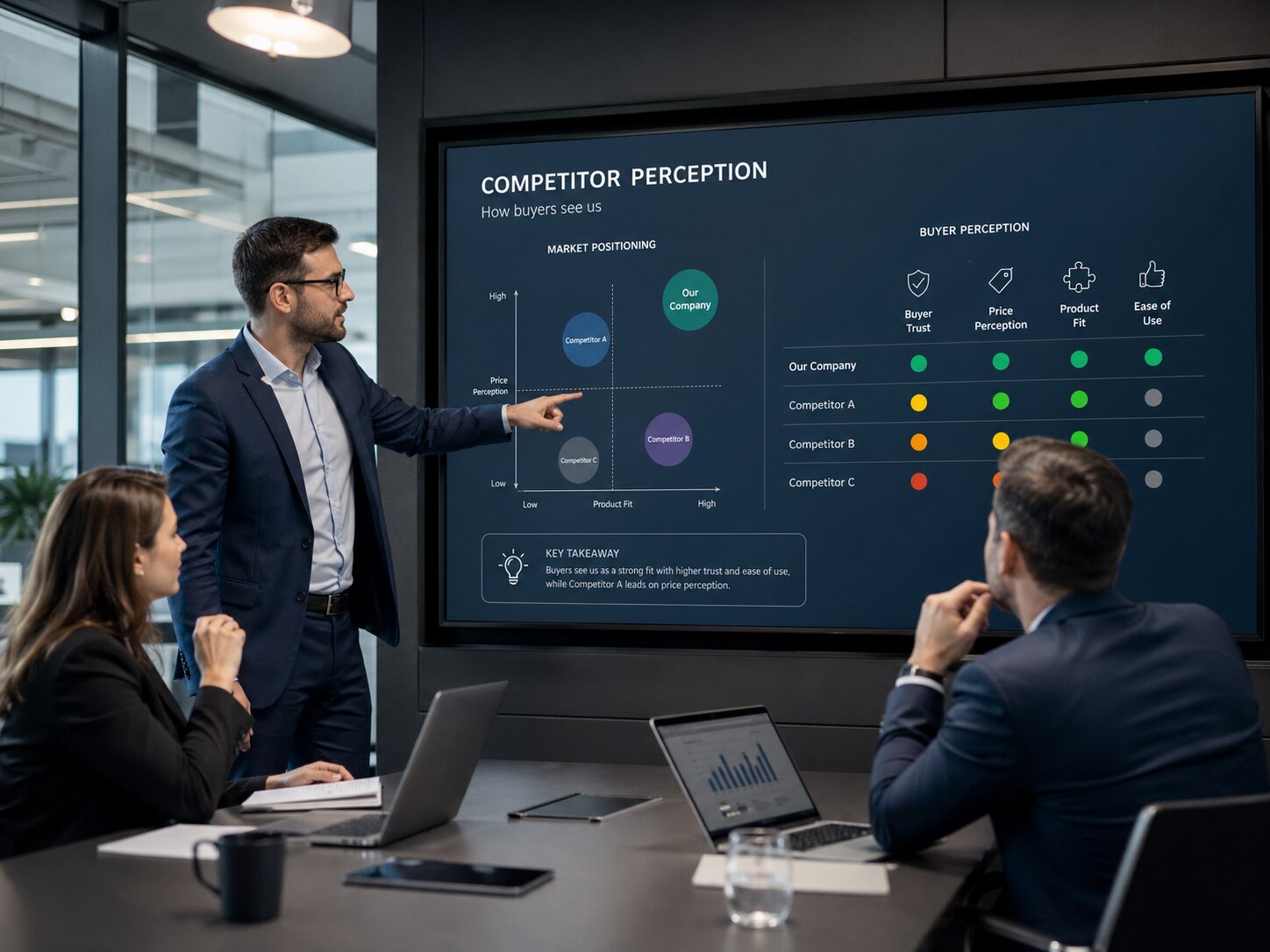
This section is the core of competitive intelligence gathering. Handle it with care — buyers will share a lot if you ask without defensiveness.
- What was your initial impression of us compared to [Competitor X]? Where did that impression come from?
- Were there moments during the evaluation where a competitor clearly pulled ahead? What happened?
- What did the winning vendor do particularly well that others didn’t?
- Were there specific strengths or weaknesses you associated with each vendor on your shortlist?
- Did the chosen vendor feel “safer,” “more modern,” or “better aligned” in some way? Can you describe that feeling?
- Was there anything a competitor said about us — or that you read about us — that influenced your perception?
“The most valuable competitive intelligence doesn’t come from monitoring competitor websites, it comes from buyers telling you, in their own words, why someone else’s story was more compelling than yours.” — Paul Towers, Playwise HQ
These responses are the foundation for competitive positioning that actually resonates in live deals. When a buyer tells you “Competitor X felt like they understood our industry better because they showed us a case study from a company like ours,” that’s a positioning gap you can close, if you capture it.
Win/Loss Interview Questions: Product, Gaps & Experience
- Which features or capabilities mattered most in your final decision?
- Were there specific product gaps that created doubt or slowed your momentum toward us?
- How important were UX, onboarding experience, and ease of integration in your evaluation?
- Did you evaluate based on current capabilities or future roadmap? How much weight did roadmap promises carry?
- If you could design the ideal solution, what would it include that no vendor offered?
- Were there any “aha moments” during demos — for us or a competitor — that stood out?
Win/Loss Interview Questions: Sales Motion & Buying Experience
The buying experience is often the deciding factor in competitive deals, yet it’s the area most teams are least willing to examine honestly.
- How would you describe your experience working with our sales team?
- Were we responsive? Did we demonstrate genuine expertise in your problem space?
- How did our demo compare to competitors’ demos? What stood out — positively or negatively?
- Did we provide proof points, references, or customer stories that were relevant to your situation?
- Were there any red flags or disconnects in our sales process that gave you pause?
- Did you feel like we understood your specific needs, or did the pitch feel generic?
Mini-Scenario: The CFO Objection You Never Saw Coming
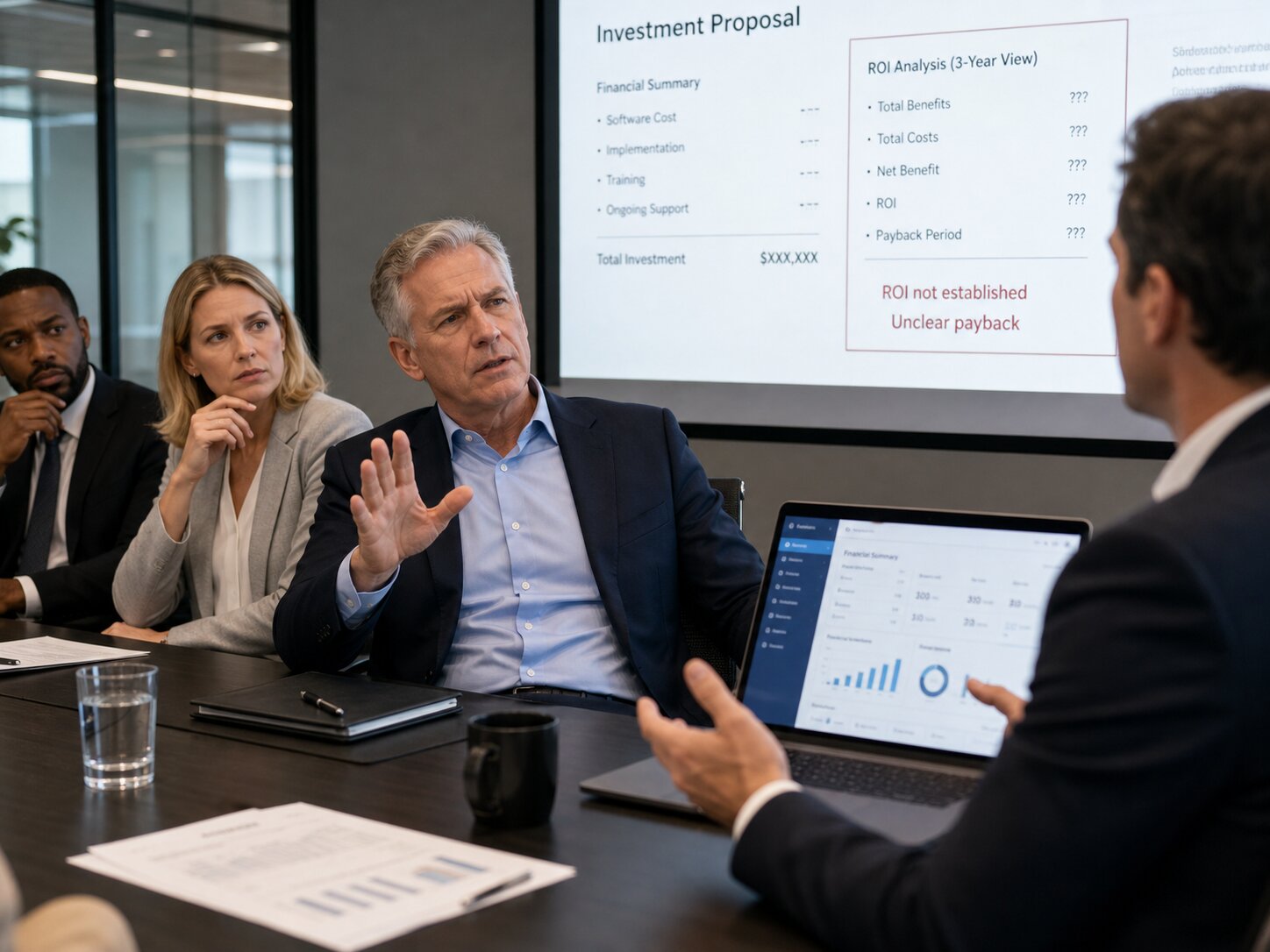
A mid-market SaaS company ran win/loss interviews after losing three consecutive deals to the same competitor. The reps reported “lost on price” in the CRM. The interviews told a different story.
In two of the three deals, the CFO had joined the final evaluation call. The competitor’s rep had proactively addressed total cost of ownership, including implementation, training, and Year 2 renewal pricing, before the CFO asked. The company’s reps had focused on feature differentiation and left pricing questions for procurement to sort out later.
The buyer’s exact words: “Your product was probably better, but the other team made it easier for me to say yes to my CFO.”
That insight didn’t belong in a Google Doc. It belonged in a battlecard, in an objection handling script, and in every deal review for that competitor segment.
Win/Loss Interview Questions for Wins vs. Losses
Not all interviews are the same. The tone, depth, and focus should shift depending on the outcome.
For wins — calibrate for honesty, not celebration:
- “What almost made you choose someone else?”
- “Was there a moment where you seriously considered not choosing us?”
- “If a colleague asked you to describe our biggest weakness, what would you say?”
- “What would have made this decision easier or faster?”
Wins are dangerous because they reinforce existing assumptions. The best win interviews surface the fragility of the win, the moments where you almost lost, the concerns the buyer suppressed, the competitor strengths they chose to overlook.
For losses — calibrate for learning, not blame:
- “Was there a single moment or factor that tipped the decision?”
- “What could we have done differently that might have changed the outcome?”
- “Is there a scenario where you’d reconsider us in the future?”
- “What advice would you give our team for the next time we’re in a similar evaluation?”
That last question is remarkably powerful. Buyers will often give you the most candid, actionable feedback when framed as advice rather than criticism.
Watch for “delayed wins”: Sometimes a loss isn’t permanent. If the buyer says “we chose them for now, but we’re not fully committed” or “your roadmap was more aligned with where we’re heading,” that’s a signal for your team to nurture, not abandon.
How to Run Win/Loss Interviews That People Answer Honestly
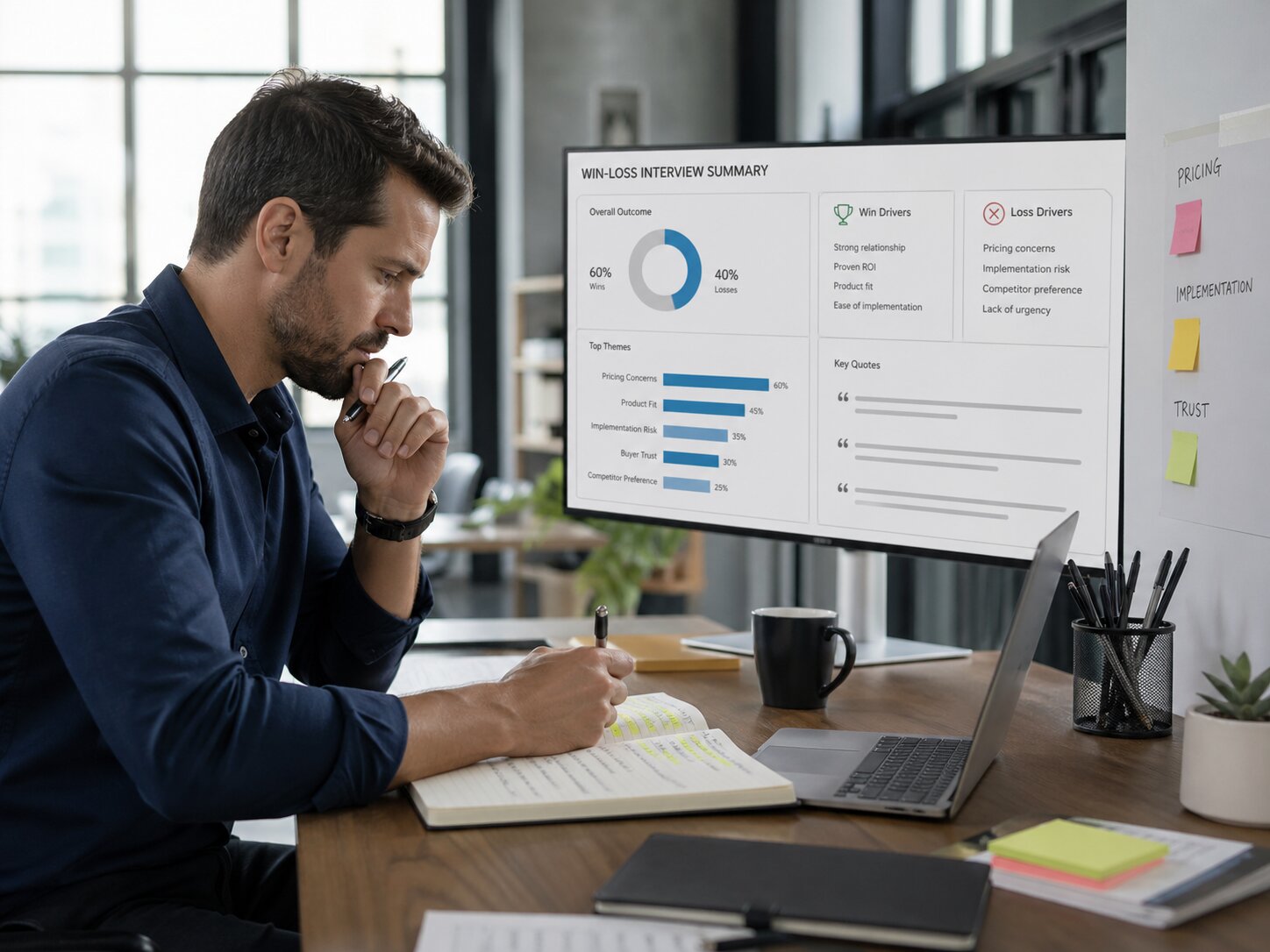
The quality of your insights depends entirely on the quality of the conversation. A few non-negotiable principles:
- Who should conduct the interview: Ideally, someone the buyer hasn’t interacted with during the sales process — a CI analyst, enablement lead, or even a third party. The AE who ran the deal should never conduct the interview. Buyers won’t be candid with the person they just rejected (or chose despite reservations).
- Set expectations early: “This isn’t a sales call. We’re not trying to reopen the deal. We’re trying to learn so we can improve. Your candid feedback, including the tough stuff, is genuinely valuable to us.”
- Use neutral, non-leading questions: Instead of “Did you feel our pricing was fair?” ask “How did pricing factor into your decision?” Instead of “Was our demo better?” ask “How did the demos compare across vendors?”
- Handle sensitive topics gracefully: When asking about competitors, frame it as perception: “How did you perceive Competitor X’s approach?” rather than “What did Competitor X say about us?” Buyers are more comfortable sharing perceptions than repeating specific claims.
- Keep it to 25–30 minutes. Longer interviews have diminishing returns and lower completion rates.
Turning Raw Interviews into Structured Win/Loss Data
Individual interviews are anecdotes. A structured corpus of interviews is a strategic asset. Here’s how to bridge the gap.
Standardize for Pattern Recognition
Use the same template for every interview. This isn’t about rigidity, you should absolutely follow interesting threads, but the core questions must be consistent so you can compare responses across deals, competitors, and segments.
Code Responses by Theme
After each interview, tag key findings:
- Competitor mentioned (e.g., Competitor X, Competitor Y)
- Decision theme (e.g., pricing, implementation risk, UX, sales experience)
- Segment (e.g., mid-market, enterprise, specific vertical)
- Outcome (win, loss, no-decision)
Over time, this coding reveals patterns: “We lose to Competitor X in financial services 70% of the time, and the primary theme is implementation risk.”
Separate Signal from Noise
One buyer mentioning a product gap is an anecdote. Five buyers across different deals mentioning the same gap is a pattern. Ten is a strategic priority. Resist the urge to over-react to any single interview. Build the discipline to wait for patterns before making major changes.
Build a Recurring Review Rhythm
Win/loss insights should be reviewed monthly with GTM leaders — sales, enablement, product, and marketing. This isn’t a passive readout. It’s an active session where the team decides: What do we change based on what we’ve learned?
From Win/Loss Insights to Stronger Battlecards & Messaging
Here’s where most programs break down: the translation layer. You have the insight. Now what?
- Translate objections into battlecard rebuttals. When a buyer says “We were worried about your integration timeline,” that’s not just feedback — it’s a live objection your reps will face in the next deal. Turn it into a specific rebuttal with proof points: “Our average integration timeline for [segment] is X weeks. Here’s a reference customer who went live in Y days.”
- Capture real buyer language for positioning. Buyers don’t say “our solution provides a unified data orchestration layer.” They say “we needed something that just worked with Salesforce without a six-month project.” Use their language in your talk tracks, not yours.
- Align product roadmap with recurring decision drivers. When win/loss data consistently shows that buyers are choosing competitors because of a specific capability, that’s a product prioritization signal. Share it with product leadership — with the data, not just the opinion.
- Close the loop with frontline teams. Every insight that makes it into a battlecard or talk track should be communicated back to the reps who contributed to the original deals. This creates a virtuous cycle: reps see that their lost deals led to better tools, which makes them more willing to participate in future win/loss efforts.
How Playwise HQ Operationalizes Win/Loss Insights
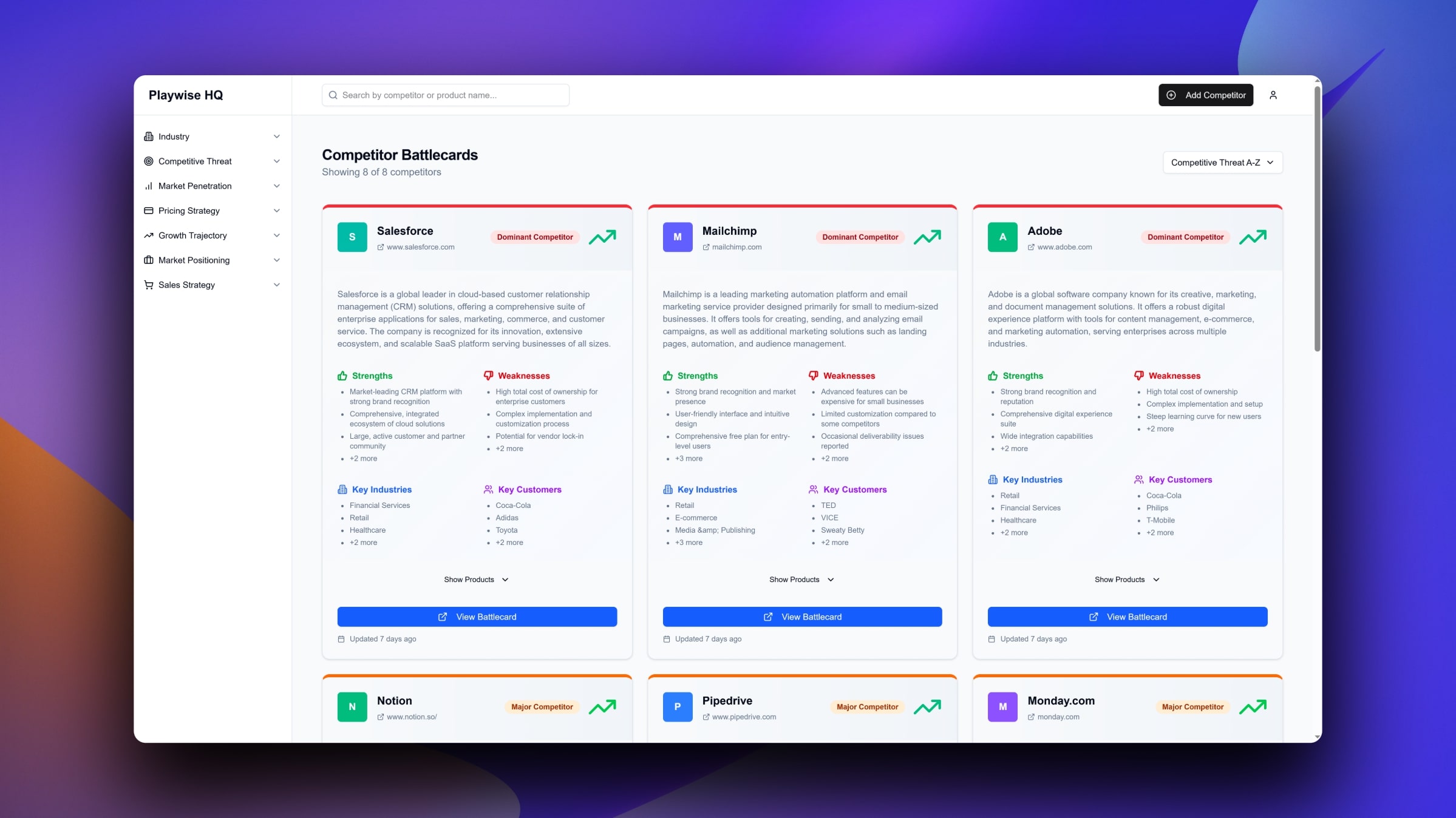
The gap between “we have win/loss insights” and “our reps use win/loss insights to win deals” is an operational problem. Playwise HQ is built to close that gap.
- Centralize win/loss takeaways by competitor and scenario. Instead of insights scattered across documents, Playwise HQ’s centralized knowledge repository organizes findings by competitor, segment, and deal type — so the right insight surfaces for the right deal.
- Embed buyer quotes and decision patterns directly into battlecards. When a buyer says “we chose them because their onboarding felt less risky,” that quote goes into the battlecard as a rebuttal trigger — with the counter-narrative and proof points right next to it. Playwise HQ’s AI-powered battlecard builder makes this translation fast and consistent.
- Surface insights at the moment of conversation. Reps access competitor-specific win/loss insights in a central platform.
“Win/loss interviews are only as valuable as the system that turns them into seller behavior. The insight that stays in a doc is worth nothing. The insight that shows up in a rep’s next competitive conversation is worth everything.” — Paul Towers, Playwise HQ
Practical Example: Applying the Template in a Competitive Deal
Here’s how the complete workflow looks in practice:
Quarter 1: A B2B SaaS company runs 15 structured win/loss interviews across deals involving their top three competitors, using the template above. Interviews are conducted by the enablement lead, not the AEs.
Pattern emerges: In 9 of 15 interviews, buyers mention that Competitor B’s “customer success plan” presented during the sales process made them feel more confident about post-sale support. The company’s reps weren’t addressing post-sale experience at all during evaluations.
Quarter 2–3: Win rate against Competitor B improves from 34% to 47%. Average deal cycle shortens by 11 days because reps are addressing the post-sale concern proactively instead of reactively.
That’s measuring the impact of competitive intel in action — not as a vanity metric, but as a direct line from interview to revenue.
Common Pitfalls to Avoid
- Interviewing only losses. Win interviews are equally valuable — they reveal fragile wins, hidden competitor strengths, and the real reasons buyers chose you (which are often different from what your reps believe).
- Letting the AE conduct the interview. Buyers filter their feedback based on the relationship. An independent interviewer gets 3–5x more candid responses.
- Over-indexing on a single interview. One buyer’s opinion is not a strategy. Wait for patterns across 5+ interviews before making structural changes to messaging or positioning.
- Treating win/loss as a quarterly project instead of a continuous engine. The companies that get the most value run interviews as a persistent, ongoing program — not a burst of activity before QBRs.
- Capturing insights but not distributing them. If your win/loss findings don’t make it into the tools reps use daily — battlecards, CRM, talk tracks — they might as well not exist. This is the operational gap that kills most programs.
Strategic Impact: Building a Learning Sales Organization
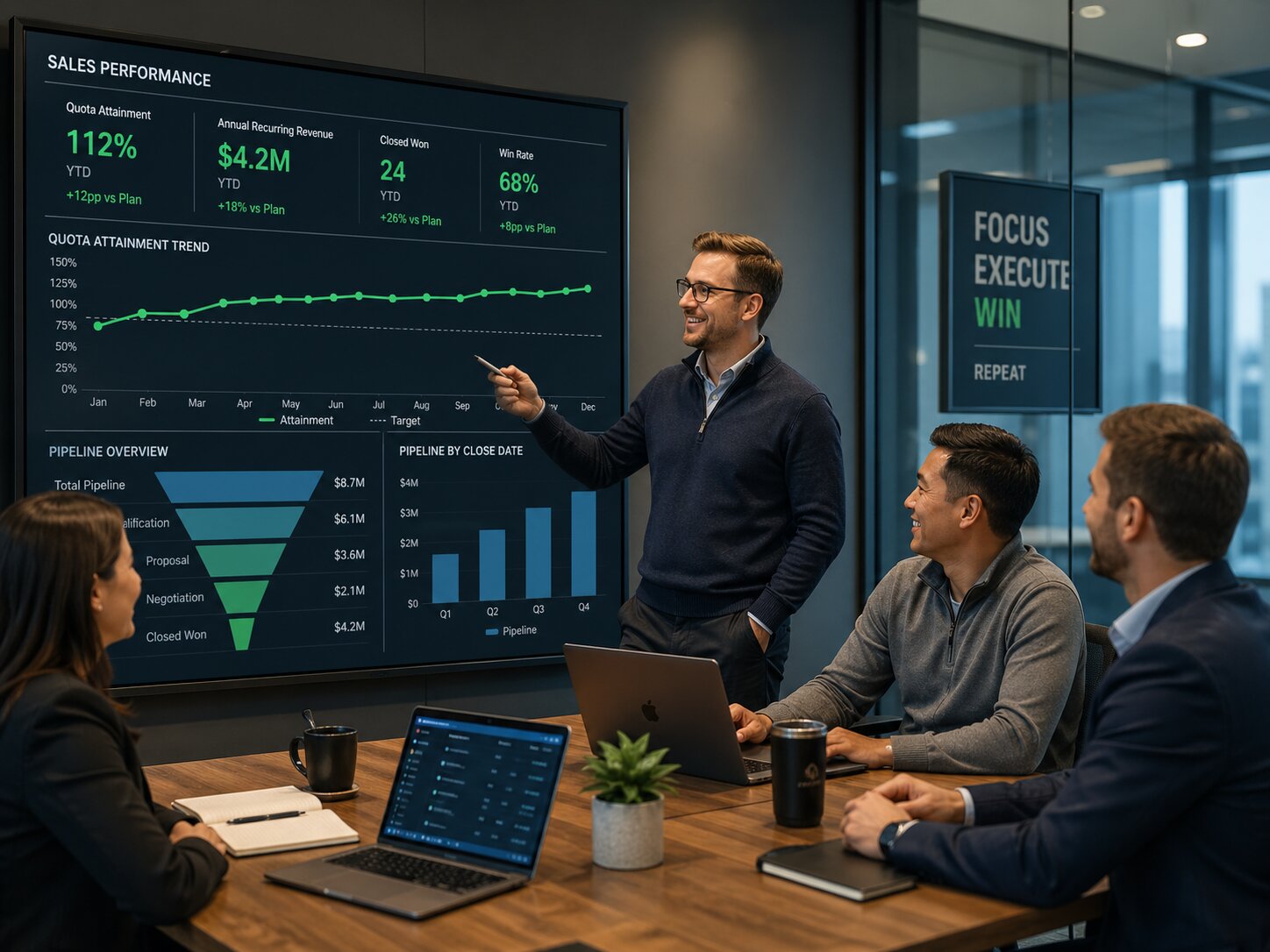
The real value of a structured win/loss program isn’t any single insight. It’s the organizational capability you build over time.
- From opinion-led to evidence-led competitive strategy. When your battlecards are built on 50 buyer interviews instead of internal assumptions, your competitive positioning is fundamentally stronger. You’re not guessing what buyers care about — you know.
- Every loss makes the next deal more winnable. This is the compounding effect. Each interview adds to a growing body of evidence that refines your messaging, sharpens your objection handling, and exposes blind spots in your sales motion. Organizations that run this program for 12+ months develop a significant and durable competitive advantage.
- A shared language for decision criteria. When sales, product, marketing, and enablement all reference the same buyer-voiced decision criteria, alignment improves dramatically. You stop arguing about what buyers want and start building around what they’ve told you.
- Win/loss as a revenue engine, not a side project. The organizations that treat win/loss interviews as core infrastructure, on par with pipeline reviews and forecasting, consistently outperform those that treat it as optional. It’s not a nice-to-have. It’s the mechanism by which your go-to-market machine learns and adapts.
Make Win/Loss Interviews a Core Part of Competitive Execution
A complete win/loss interview template isn’t a document — it’s a system. It standardizes how you capture buyer truth, structures it for pattern recognition, and connects it to the tools your reps use every day.
The risk isn’t that you’ll run bad interviews. The risk is that you’ll run good interviews and let the insights die in a document no one opens. The gap between insight and action is where most competitive intelligence programs fail.
If you’re ready to close that gap — to turn every win/loss interview into sharper battlecards, better objection handling, and a sales team that gets smarter with every deal — book a demo of Playwise HQ and see how structured win/loss insights become frontline competitive clarity.