
Every competitive intelligence program starts the same way. A few sharp reps share what they’re hearing in deals. Someone builds a Google Doc with competitor notes. A Slack channel fills up with “heads up, Competitor X just changed their pricing” messages. And for a while, it works.
Then you hire your twentieth rep. Your fiftieth. Your hundredth. And suddenly, the system that felt scrappy and effective becomes a liability. New reps don’t know where to find intel. Veteran reps hoard what they know. Battlecards are six months stale. And your win rate in competitive deals starts slipping, not because your product got worse, but because your competitive execution couldn’t keep pace with your growth.
Scaling competitive intelligence isn’t a nice-to-have. It’s the difference between a sales org that gets sharper with every hire and one that gets diluted. This post lays out exactly why most CI programs break as teams grow, what a scalable competitive intelligence system actually looks like, and how to build one, whether you have 5 reps or 500.
The Hidden Breaking Point in Competitive Intelligence as You Grow

At five reps, competitive intelligence is a conversation. Your best sellers know the landscape cold. They’ve been in the deals, heard the objections, and developed their own rebuttals through trial and error. Knowledge flows naturally because everyone sits in the same room — or at least the same Slack channel.
But tribal knowledge doesn’t scale. It walks out the door when a top rep leaves. It never reaches the new hire in their second week. And it creates wildly inconsistent narratives across your team, one rep positioning against Competitor X on price while another leads with feature superiority.
Here’s what the breakdown actually looks like:
- At 5 reps, informal knowledge-sharing covers most competitive scenarios.
- At 50 reps, half the team has never seen your best competitive positioning. New hires are left guessing.
- At 200+ reps, you have multiple versions of “battlecards” floating in different formats, none of them current, and no one knows which is authoritative.
The cost isn’t abstract. Stale or inconsistent competitive content directly impacts win rates in competitive deals. When a rep walks into a head-to-head evaluation armed with last quarter’s positioning against a competitor who just launched a new product, they lose. Not because they’re a bad seller — because the system failed them.
“Good enough” battlecards become a liability the moment your headcount outpaces your ability to keep them current and accessible.
Why Most Competitive Intelligence Programs Don’t Scale
The root cause isn’t a lack of intelligence. Most organizations have plenty of competitive data scattered across analyst reports, win/loss interviews, product marketing decks, and Slack threads. The problem is how that intelligence is packaged, distributed, and maintained.
Four patterns consistently kill CI scalability:
1. Ad-hoc battlecards in docs, wikis, and decks
When competitive content lives in Google Docs, Confluence pages, and PowerPoint decks, there’s no single source of truth. Reps can’t find what they need. When they do find something, they can’t tell if it’s current. The result: they stop looking and wing it.
2. One-off enablement sessions with no reinforcement
A quarterly “competitive landscape” training might energize the team for a week. But without reinforcement at the point of need, inside the deal, during the conversation, that knowledge decays rapidly. Enablement without workflow integration is a leaky bucket.
3. Analyst-centric CI tools that never reach the front line
Many legacy competitive intelligence platforms are built for analysts and strategy teams, not for the rep who needs a sharp rebuttal in the next 30 seconds. If the tool requires logging into a separate platform, navigating complex dashboards, and interpreting raw data, frontline adoption will be near zero.
4. Reactive updates that leave reps with stale intel
When battlecard updates happen only after a rep loses a deal and complains, you’re always behind. Competitors move fast, stale battlecards are one of the most common reasons CI programs fail at scale.
The common thread: these aren’t intelligence problems. They’re execution and distribution problems. And they compound with every rep you add.
The New Standard: Treating Competitive Execution as a System

The shift that separates high-performing CI programs from the rest isn’t more data or better analysts. It’s treating competitive execution as a system, with standardized inputs, clear governance, workflow integration, and continuous feedback loops.
This means four things:
- Standardizing how competitive content is created and structured. Every battlecard follows the same framework. Every objection rebuttal uses the same format. This isn’t about stifling creativity, it’s about making competitive content instantly usable by any rep, in any segment, without a learning curve.
- Treating governance as a growth lever, not bureaucracy. Clear ownership, review workflows, and approval processes don’t slow you down. They’re what allow you to scale without quality degrading. When you know exactly who owns the Competitor X battlecard, who reviews it quarterly, and who gets notified when new field intel comes in, you can grow confidently.
- Embedding real-time competitive insights in sales workflows. The best intelligence in the world is worthless if it sits in a tool reps don’t open. Scalable CI means surfacing the right insight at the right moment, inside the CRM, during deal prep, at the point of the conversation.
- Connecting win/loss feedback loops to CI content, not just reporting. Win/loss analysis shouldn’t just produce a quarterly report. It should directly update battlecards, refine objection handling playbooks, and inform positioning changes. This is how CI becomes a living system rather than a static library. Teams that build feedback loops from lost deals into their competitive content see compounding improvements over time.
Building a Centralized Competitive Knowledge Repository That Actually Gets Used
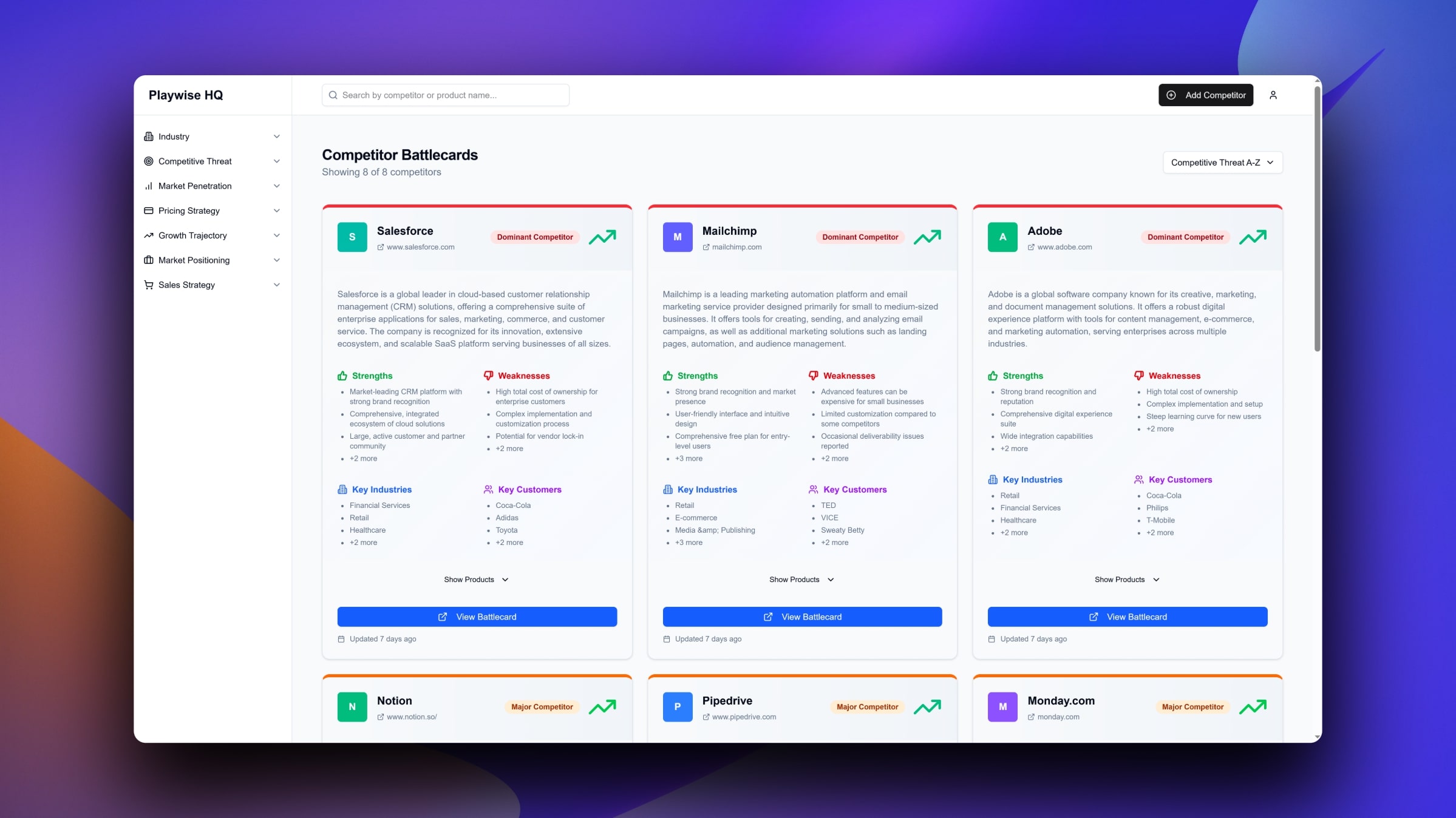
A centralized CI knowledge base is the foundation of scalable competitive intelligence. But “centralized” alone isn’t enough. The repository has to be structured, searchable, role-aware, and maintained, or it becomes just another graveyard of good intentions.
What a high-functioning CI repository looks like
Single source of truth for competitors, playbooks, and objections. One place where every rep, in every region, goes for competitive content. No competing versions. No “I think there’s a newer one somewhere.” One authoritative source.
Role- and segment-specific battlecards for different selling motions. A mid-market AE selling against Competitor X needs different content than an enterprise rep in a different vertical. A scalable repository supports role-based content governance, the same core intelligence, tailored for different contexts.
Searchable, structured intel vs. scattered “FYI” information. Reps should be able to search by competitor, objection type, deal stage, or product line and get exactly what they need. This is the difference between a searchable competitive intel library and a folder of PDFs.
Version control, audit trails, and ownership for every battlecard. At scale, you need to know when a battlecard was last updated, by whom, and what changed. Versioning and audit trails aren’t overhead — they’re trust signals that tell reps the content is current and reliable.
Mini-scenario: The new hire who closes in week three
Imagine a rep joins your team on Monday. By Wednesday, they’re preparing for their first competitive deal against your top rival. In a mature CI system, they search the centralized repository, find the current battlecard with positioning, objection rebuttals, pricing traps to set, and proof points, all structured and ready to use. They don’t need to ask five colleagues or dig through Slack history. They walk into the call prepared. That’s the power of a centralized, well-governed knowledge base.
Standardizing Competitive Battlecard Creation at Scale
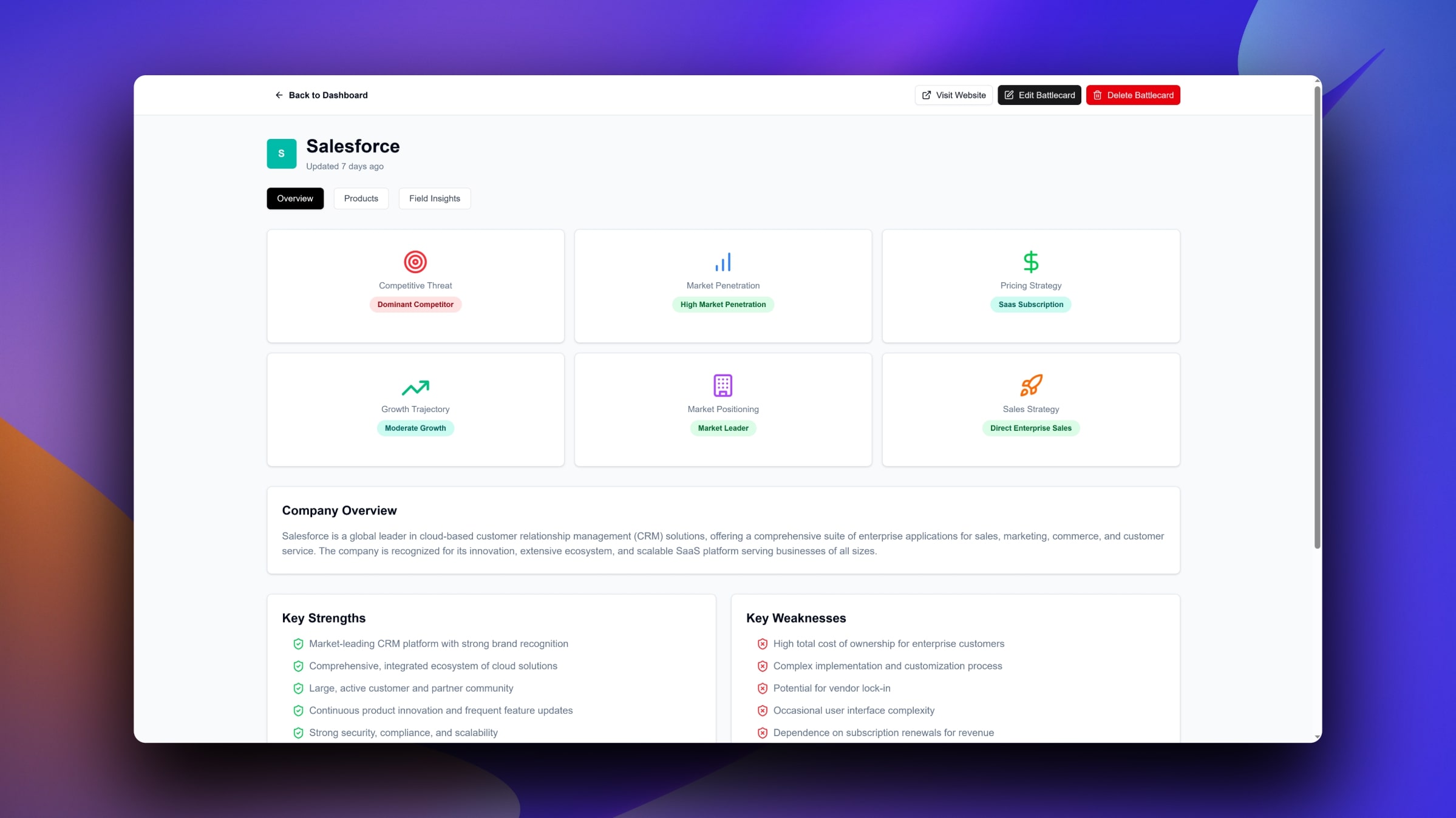
Standardized battlecard creation is what turns competitive intelligence from an art (dependent on individual talent) into a repeatable, scalable capability.
The framework for scalable battlecard templates
Every battlecard should follow a consistent structure that reps can navigate instantly:
- Competitor overview — Who they are, their positioning, their ideal customer
- Key differentiators — Where you win and where they win (honest assessment)
- Positioning guidance — How to frame the conversation when this competitor is in the deal
- Traps to set — Discovery questions that expose competitor weaknesses
- Landmines to avoid — Topics or comparisons where the competitor has an advantage
- Objection rebuttals — Specific objection handling talk tracks with proof points
- Pricing and ROI comparisons — Structured, defensible comparisons
- Customer proof points — References, case studies, and quotes that reinforce your position
This framework works whether you’re building your first battlecard or your fiftieth. The consistency is what makes it scalable, new contributors can create content that fits the system, and reps always know where to find what they need.
Turning expert knowledge into repeatable content
Your best reps have developed killer competitive plays through hundreds of conversations. The problem is that knowledge lives in their heads. Standardized battlecard templates give you a structured way to extract and encode that expertise so it benefits the entire team.
As Paul Towers, founder of Playwise HQ, puts it: “The gap between your best competitive seller and your average one isn’t talent, it’s access to the same battle-tested plays in a format they can actually use.”
Governance, Collaboration, and Real-Time Updates as You Grow

Governance is where most CI programs either mature or stall. At five reps, you don’t need formal governance. At 50 or 500, governance is the difference between a trusted, living CI system and a content graveyard.
Clear ownership model
At the enterprise level very battlecard needs three roles defined:
- Creator — Who drafts and maintains the content (typically CI, product marketing, or enablement)
- Reviewer — Who validates accuracy and relevance (typically a subject matter expert or senior seller)
- Approver — Who signs off before content goes live (typically CI lead or enablement manager)
This isn’t bureaucracy. It’s how you ensure that 500 reps are never working from unvetted content.
Field feedback loops
The reps using battlecards in live deals are your best source of real-time competitive intelligence. A scalable CI program makes it easy for sellers to contribute insights directly back into the system, flagging what’s working, what’s outdated, and what competitors are saying in the field.
Real-time competitor updates
When a competitor changes their pricing, launches a new feature, or shifts their messaging, your team needs to know — not next quarter, but now. Real-time alerts and notifications ensure that battlecards stay current and reps stay confident.
Continuous improvement from usage data
Which battlecards are being used most? Which are correlated with higher win rates? Which are being ignored? Usage analytics close the loop between content creation and deal outcomes, enabling continuous improvement based on actual impact.
Embedding Competitive Intelligence in Sales Workflows for Maximum Adoption
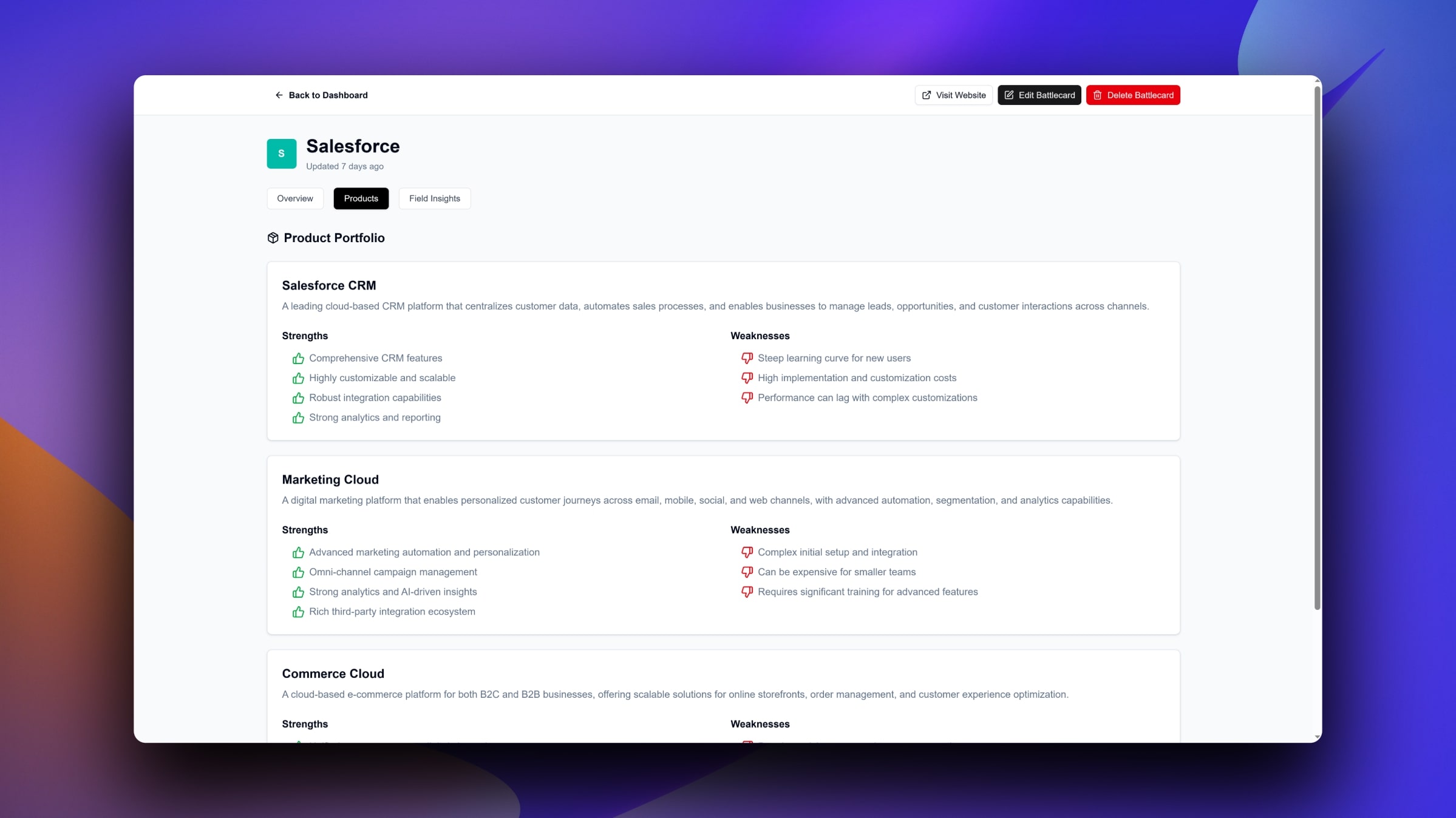
Here’s the uncomfortable truth about CI adoption: if reps have to go find competitive content, most of them won’t. Not because they don’t value it, but because they’re busy, they’re in the flow of a deal, and any friction kills adoption.
The solution is sales workflow integration, making CI a natural part of how reps work, not a separate task.
What workflow-integrated CI looks like
- Central Competitive Intelligence Repository – If sales reps have to look in your company Wiki, search their email and navigate through 10 different Slack threads it all becomes too much. They need a central location to find up-to-date and relevant battlecards.
- Stage-based guidance — Different competitive insights matter at different deal stages. Early-stage discovery needs trap-setting questions. Late-stage negotiation needs pricing defense and ROI proof points. A mature CI system delivers context-aware content based on where the deal is.
- Reduced rep effort — The shift from “go search for the battlecard” to “the battlecard is already here” is the single biggest driver of frontline adoption in selling motions.
Mini-scenario: The CFO objection in a late-stage deal
Your enterprise AE is in a final evaluation against Competitor Y. The prospect’s CFO raises a concern: “Competitor Y’s total cost of ownership looks 20% lower over three years.” Without workflow-integrated CI, the rep scrambles, maybe they remember something from a training three months ago, maybe they ping a colleague on Slack. With integrated CI, the relevant battlecard is already surfaced in their deal view, complete with a structured TCO comparison, hidden cost callouts for Competitor Y, and a customer proof point from a similar-sized company. The rep responds confidently in real time. That’s the difference between CI as a system and CI as a hope.
How Playwise HQ Enables Scalable Competitive Execution
Playwise HQ was built specifically for this problem: making competitive intelligence structured, actionable, and scalable for revenue teams.
- Centralized, seller-ready battlecards serve as the backbone — a single source of truth that every rep trusts and uses. Standardized AI-powered battlecard templates encode your best competitive plays into repeatable, shareable content that new reps can leverage from day one.
- Real-time updates and notifications keep the entire team aligned when competitors shift.
- Easy to navigate access to win / loss Themes and common objections – A UI that makes it easy for reps to quickly see key reasons why you win (and lose), as well as objections that are likely to come up in a deal.
- A feedback loop that constantly improves battlecards – Playwise HQ collects insights from your reps in the field, as well as insights from deals won and lost so battlecards become self-improving over time.
Paul Towers notes: “Most CI programs fail not because the intelligence is bad, but because it never reaches the rep at the moment it matters. Scalable CI is an execution problem, and that’s what we solve.”
Practical Playbook: Scaling CI from 5 to 50 to 500 Reps
Scaling competitive intelligence isn’t a single project, it’s a phased evolution. Here’s how to approach each stage:
Stage 1: 0–5 Reps — Capture Tribal Knowledge
- Interview your best reps and document their competitive plays
- Build initial battlecards for your top 3–5 competitors using a consistent template
- Establish a single location for all competitive content (even if it starts simple)
- Assign one person as the CI owner
Stage 2: 5–50 Reps — Introduce Templates, Governance, and a Central Hub
- Standardize battlecard structure across all competitors
- Implement a review and approval workflow for content updates
- Move from ad-hoc docs to a centralized CI knowledge base
- Begin collecting field feedback from reps on competitive encounters
- Ensure new hires can ramp on competitive content within their first week
Stage 3: 50–200 Reps — Integrate CI into Daily Sales Workflows
- Implement real-time alerts for competitor changes
- Create role-specific and segment-specific battlecard variants
- Build objection handling playbooks tied to specific competitors and deal stages
- Establish a regular cadence for win/loss insights feeding back into battlecards
Stage 4: 200–500+ Reps — Optimize with Analytics and Tiered Coverage
- Track battlecard usage and correlate with win rates and deal velocity
- A/B test different positioning approaches and measure outcomes
- Implement tiered coverage (deep battlecards for top competitors, lighter coverage for emerging threats)
- Scale governance with regional or segment-level CI contributors
- Continuously refine based on usage data and deal outcomes
What to Implement This Month: A CI Scaling Checklist
Use this checklist regardless of your current team size to identify your most urgent gaps:
- [ ] Audit your current competitive content — How many battlecards exist? When were they last updated? Where do they live?
- [ ] Identify your top 5 competitors by deal frequency — Prioritize battlecard creation or refresh for these first
- [ ] Define a single source of truth — Decide where all competitive content will live and communicate it to the team
- [ ] Assign clear ownership — Name a creator, reviewer, and approver for each top-competitor battlecard
- [ ] Standardize your battlecard template — Adopt a consistent structure every battlecard will follow
- [ ] Collect one round of field feedback — Ask 5 reps what competitive questions they can’t answer today
- [ ] Set a freshness SLA — Define how often each battlecard must be reviewed (monthly for top competitors, quarterly for others)
- [ ] Measure current adoption — Do you know which reps are using competitive content and which aren’t?
- [ ] Establish one feedback channel — Create a simple way for reps to flag outdated intel or share new competitive observations
Common Pitfalls When Scaling CI
Even well-intentioned CI programs stumble. Watch for these traps:
- Over-indexing on coverage breadth. Building battlecards for 30 competitors when your reps only encounter 5 regularly. Depth and freshness on your top competitors matters far more than thin coverage across dozens.
- Treating battlecards as a one-time project. A battlecard that’s “done” is already decaying. Scalable CI requires ongoing maintenance, not a launch-and-forget mindset.
- Ignoring the adoption problem. You can build the best competitive content in the world, but if it’s not designed for how sales reps want to work adoption will be a challenge.
- Centralizing creation without decentralizing input. CI teams can’t see everything. The reps on the front line hear things first. If you don’t build easy mechanisms for field-sourced intelligence to flow back into the system, your content will always lag reality.
- Waiting to formalize until it’s painful. The best time to build CI infrastructure is before you need it at scale. Retrofitting governance and structure onto a 200-person sales team is exponentially harder than building it at 30.
Strategic Outcomes of a Mature, Scalable CI Program
When competitive intelligence operates as a system, centralized, governed, workflow-integrated, and continuously improved, the outcomes compound:
- Higher win rates in competitive deals — Reps enter every evaluation with current, battle-tested positioning and objection handling.
- Faster new rep ramp — Consistent competitive narratives mean new hires aren’t starting from zero. They’re leveraging the collective intelligence of the entire team from day one.
- Reduced deal cycle times — Sharper objection handling and proactive competitive positioning eliminate delays caused by uncertainty or scrambling for answers.
- Confident, aligned messaging across global teams — Whether a rep is in New York, London, or Singapore, they’re telling the same compelling story against each competitor.
- A defensible competitive moat — Over time, the intelligence compounds. Every deal, every win/loss insight, every field observation makes the system smarter. Competitors can copy your product — they can’t copy your competitive execution engine.
Make Competitive Intelligence a Force Multiplier, Not a Bottleneck
Scaling CI is fundamentally about execution, not accumulating more data. The organizations that win consistently in competitive deals aren’t the ones with the most intelligence, they’re the ones that get the right intelligence to the right rep at the right moment, every time.
The risk of waiting is real. If you’re scaling headcount now and plan to “figure out CI later,” you’re building on a foundation that will crack. Every rep you add without scalable competitive infrastructure dilutes your competitive edge rather than strengthening it.
Assess your current CI maturity in under an hour. Walk through the checklist above. If you find more gaps than strengths, that’s your signal.
If you’re ready to turn competitive intelligence into a system that scales with your team — not against it — book a demo of Playwise HQ and see how teams are operationalizing CI from 5 reps to 500.