
“You’re 20% more expensive than the other vendor we’re evaluating.”
Every sales rep has heard some version of this. Most respond with a discount, a vague reference to “better value,” or an awkward pause followed by “let me check with my manager.”
Here’s the uncomfortable truth: price objections in competitive deals are rarely about price. They’re about positioning failure – a signal that your team hasn’t built a compelling enough narrative around differentiated value, total cost of ownership, or risk. And when every rep handles that moment differently, you don’t just lose deals. You erode your pricing power across the entire market.
The teams that consistently win competitive deals at full price aren’t doing it with charisma. They’re doing it with standardized price objection scripts embedded in a repeatable competitive motion — scripts that adapt to the competitor, the buyer persona, and the deal stage. This post breaks down exactly how to build, deploy, and measure that system.
The Real Problem With Price Objections in Competitive Deals

Price pushback is the most common objection in B2B sales. It’s also the most misdiagnosed.
When a prospect says “you’re too expensive,” most organizations treat it as a pricing problem. They offer discounts, restructure payment terms, or strip features. But in competitive deals, price objections are almost always a positioning problem masquerading as a budget conversation.
What’s actually happening:
- The prospect doesn’t understand the differentiated value well enough to justify the delta.
- A competitor has anchored the conversation around a lower price point, and your team hasn’t reframed it.
- The buyer is testing your conviction — and your rep doesn’t have a confident, rehearsed response.
The cost of getting this wrong compounds fast. When reps default to discounting, you train the market to expect concessions. When tribal knowledge lives in Slack threads and individual seller headspace, your best price-objection responses die with rep turnover. And when your messaging is inconsistent, one rep leads with ROI, another with features, a third with a desperate discount, buyers sense the lack of conviction.
The result: longer sales cycles, lower win rates, and compressed margins on the deals you do close.
Why Most Price-Objection Scripts Don’t Hold Up Under Pressure
If your enablement team has created price-objection talk tracks before, you’ve probably noticed something frustrating: reps don’t use them. Or they use them once, get pushed back on, and abandon them.
That’s not a rep problem. It’s a script design problem.
Most competitive price objection scripts fail for four reasons:
- They ignore competitive context. A generic “here’s why we’re worth it” script is useless when the prospect is comparing you to a specific competitor with a specific pricing model. Reps need scripts tailored to the competitor they’re actually facing.
- They don’t adapt to deal stage or buyer persona. The price conversation with a technical evaluator in week two is fundamentally different from the one with a CFO in week six. Static scripts treat every price objection as interchangeable.
- They go stale. Competitors change pricing, launch new tiers, or offer aggressive discounts to win market share. If your TCO comparison narratives reference last quarter’s pricing, reps lose credibility the moment a buyer fact-checks them.
- There’s no feedback loop. Nobody tracks which value framing scripts actually correlate with wins. Without that data, you’re guessing about what works — and your “best practices” are just opinions.
As Paul Towers, the Founder of Playwise HQ, puts it: “The teams losing on price aren’t being outspent, they’re being out-positioned. And you can’t fix positioning with a discount.”
The Shift: From One-Off Price Responses to a Repeatable Competitive Motion

The highest-performing sales organizations treat price objections the way they treat any other predictable moment in the deal cycle: as a designable, rehearsable, measurable event.
This requires a fundamental shift in how you think about competitive price conversations:
From reactive to proactive. Instead of waiting for the objection and scrambling, map the most common price objections by competitor and prepare specific responses in advance. If you know Competitor X undercuts you by 20% in 80% of deals, that objection is not a surprise — it’s a certainty. Design for it.
From canned rebuttals to deal-specific narratives. The best price objection handling doesn’t sound scripted. It sounds like a confident consultant who understands the buyer’s world. That means building modular script components that reps can assemble based on the specific deal context — not reading from a teleprompter.
From gut feel to data-driven refinement. When you surface competitive threats early in discovery, you can track which price-objection responses correlate with closed-won outcomes and feed those insights back into your script library. Over time, your objection handling playbook for reps gets sharper with every deal.
This is what separates teams that “handle” price objections from teams that win through them.
Core Types of Price Objection Scripts for Competitive Deals
Not all price objections are the same, and your scripts shouldn’t be either. Here are the four categories every competitive script library needs:
Value-Framing Scripts
These reframe “too expensive” around business outcomes. Instead of defending your price, you shift the conversation to what the buyer gains — or risks losing.
Structure: Acknowledge the concern → Redirect to the outcome they care about → Quantify the value gap.
Script 1 — The Cost of Inaction:
“I hear you, and price should absolutely be part of this decision. Can I ask: what’s the cost to your team of the problem we’re solving if it persists for another six months? Most of our customers in [segment] see [specific outcome] within [timeframe], which means the investment pays for itself by [milestone].”
Script 2 — The Outcome Reframe:
“Totally fair to push on price. Let me ask it differently though — if I could show you that [specific outcome, e.g. ‘your reps closed 12% more competitive deals next quarter’], would the delta between us and [Competitor] still be the deciding factor? Because that’s the conversation I’d rather have with you. Price is what you pay. Outcome is what you actually take to your board.”
Script 3 — The Per-Unit Reframe (great for budget-conscious buyers):
“I get it. But let’s break this down differently. The price difference between us and [Competitor] works out to roughly [$X per rep, per month / $X per deal]. If our platform helps just one rep close one additional competitive deal per quarter, the math flips immediately. Want to walk through what that looks like for your team specifically?”
Total Cost of Ownership (TCO) Comparison Scripts
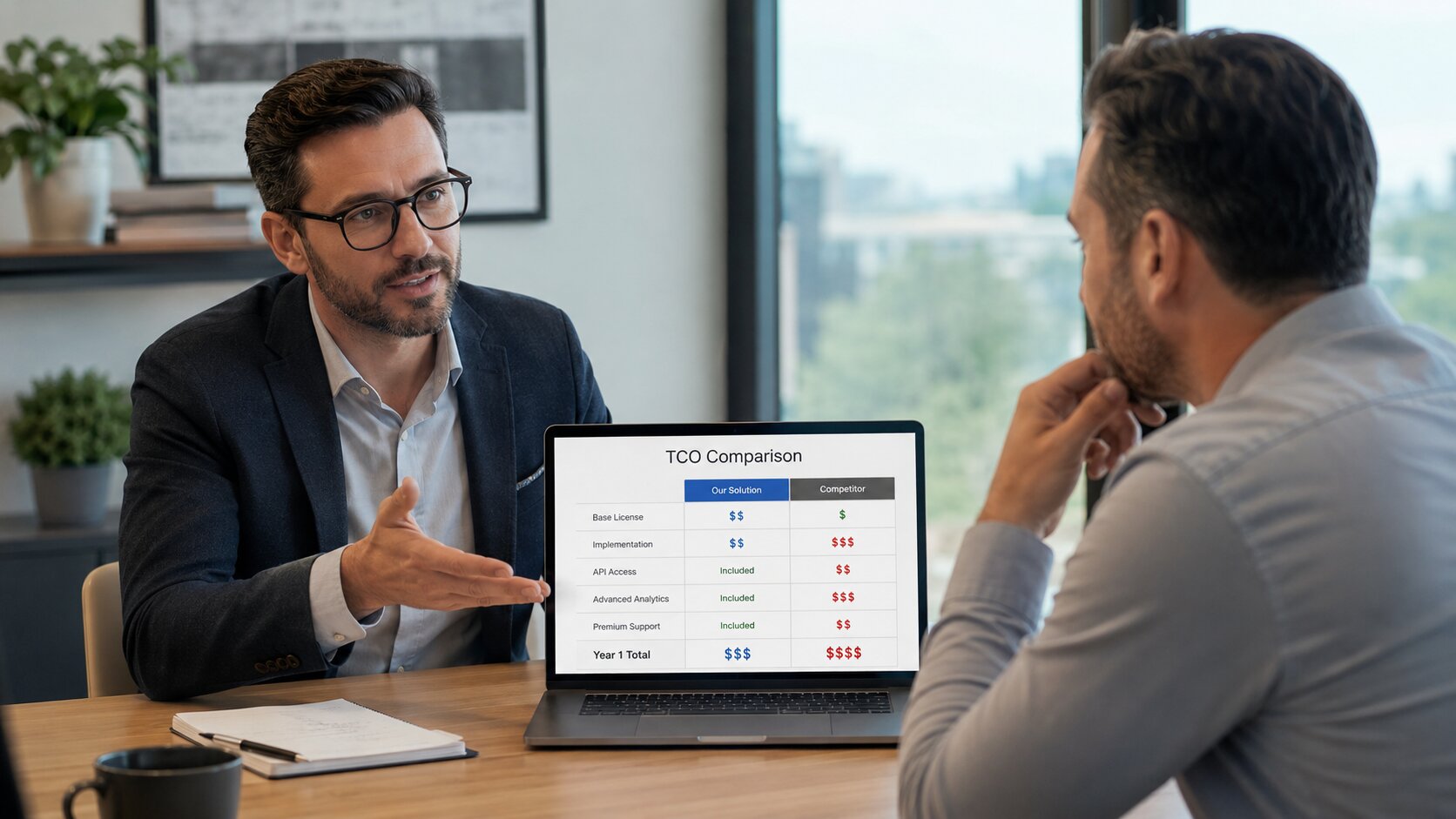
These are essential when competitors offer a lower sticker price but require more implementation effort, add-ons, or hidden costs. TCO scripts normalize pricing across competitors so the buyer is comparing equivalent investments.
Structure: Validate the comparison → Introduce the full cost picture → Walk through the delta.
Script 1 — The Hidden Cost Surface:
“I appreciate you sharing that — and on sticker price, you’re right, they’re cheaper. But I want to make sure you’re seeing the full picture before you take this to your CFO. Their base license doesn’t include [implementation services / API access / advanced analytics / premium support]. Based on your requirements, you’ll need all of those — which typically adds [$X] in year one. When our customers do the side-by-side, the total cost lands within 5-8% of each other. Want me to put a TCO comparison together so you have it in writing?”
Script 2 — The Implementation Tax:
“Here’s what I’d want to know if I were in your seat: their pricing assumes you have internal resources to handle implementation, integration, and ongoing admin. Most of our customers who evaluated [Competitor] told us the real cost wasn’t the license — it was the 200+ hours of internal time to get it production-ready. With us, that’s included. So when you’re comparing line items, make sure ‘time to value’ is one of them.”
Script 3 — The Year-Two Reality:
“One thing worth flagging: their first-year pricing is competitive, but their renewal uplifts average [X%] — and the add-on modules you’ll likely need by year two are priced separately. We’ve had customers come back to us in year two specifically because their TCO ballooned. Happy to share a couple of those stories if it’s useful.”
“Apples-to-Oranges” Normalization Scripts
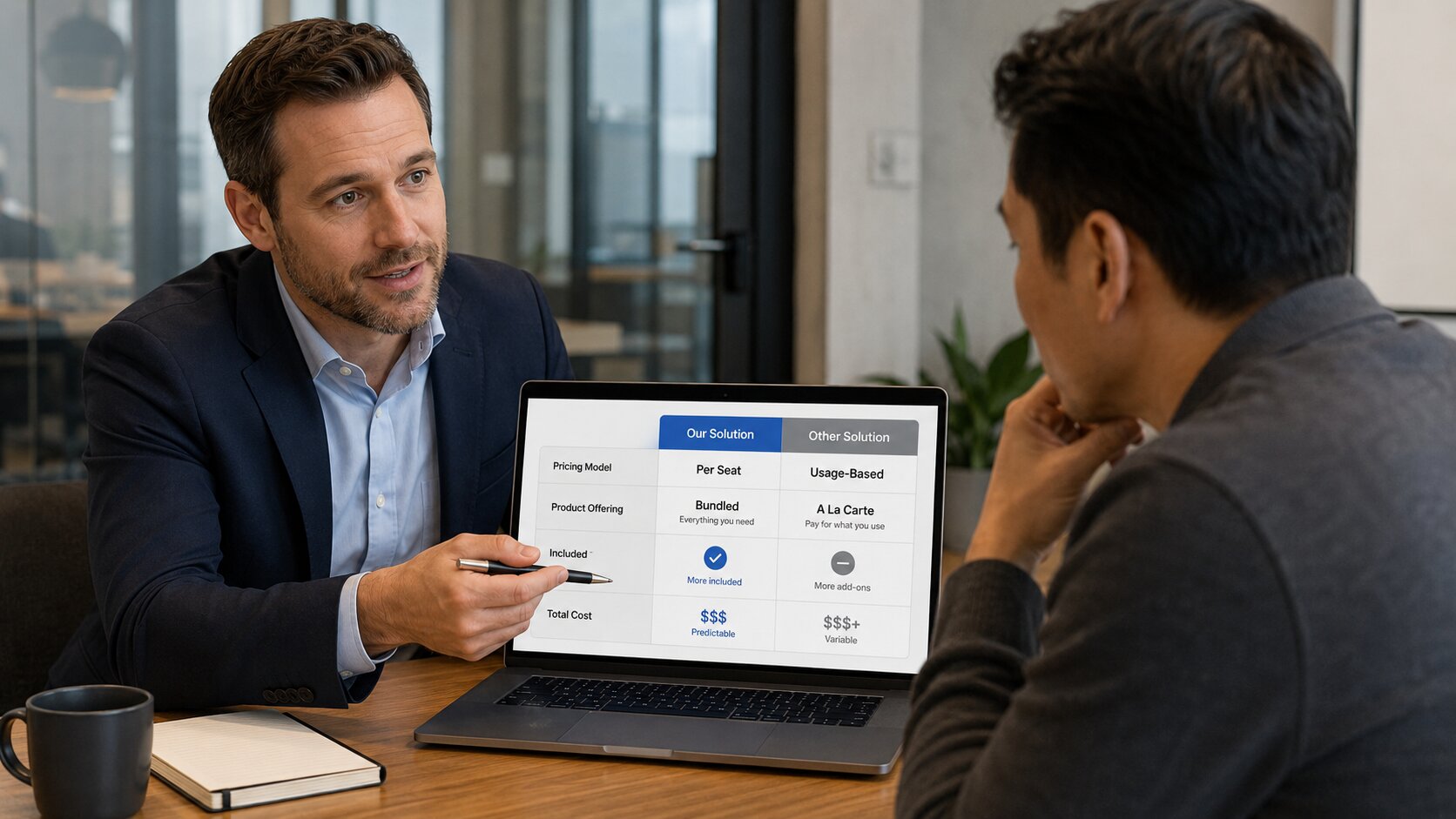
When competitors use fundamentally different pricing models — per-seat vs. usage-based, bundled vs. à la carte — buyers often compare numbers that aren’t comparable. These scripts help reps guide the buyer through a fair comparison.
Structure: Acknowledge the comparison challenge → Translate both pricing models into a common unit → Show the real delta.
Script 1 — Per-Seat vs. Usage-Based:
“Quick thing on the comparison — they price per user, we price on [usage / outcomes / deals influenced]. That makes the headline numbers look really different, but it’s not actually a fair comparison. Let me normalize this for you: at your projected usage of [X], their per-seat model actually costs [Y] once you’ve licensed your full team. Ours comes in at [Z]. The right question isn’t ‘which sticker price is lower’ — it’s ‘which model scales with the value we’re getting?'”
Script 2 — Bundled vs. À La Carte:
“Their pricing looks lower because it’s the base bundle. Ours looks higher because everything’s included. Once you add the modules you’ve told me you need — [module 1, module 2, module 3] — their effective price comes in at [$X], which is actually [above/at parity with] ours. I’d rather you see that now than discover it three months into procurement.”
Script 3 — Fixed vs. Variable Pricing:
“I want to flag something so you’re not surprised later. Their pricing is variable — it scales with [volume / data / API calls]. Ours is fixed. That feels like a small thing on day one, but it means your year-two cost with them is genuinely unpredictable. We’ve seen customers come in expecting [X]and end up at [Y] once usage ramped. Predictability has a real value, especially when you’re forecasting against a board number.”
Risk and Change-Management Scripts
These justify premium pricing by quantifying the risk of choosing a cheaper, less proven, or less capable alternative. Particularly effective with executive buyers who think in terms of risk mitigation, not feature checklists.
Structure: Acknowledge the price gap → Reframe around risk and consequence → Anchor in proof.
Script 1 — The Switching Cost Reality:
“Let me be honest with you — I’ve seen this play out a lot. Teams pick the cheaper option, run into [specific limitation: scalability, integration gaps, support issues] within 9-12 months, and then have to switch. The cost of that switch — re-implementation, retraining, lost productivity, internal political capital — almost always dwarfs the original price difference. The cheaper option isn’t actually cheaper if you’re going to replace it in a year.”
Script 2 — The Executive Risk Frame:
“If you’re presenting this to your CFO or CRO, the conversation isn’t really about price — it’s about risk. [Competitor] is [newer / smaller / has had recent leadership changes / hasn’t proven itself in your segment]. You’re not just buying a product, you’re betting your team’s quarter on a vendor’s ability to deliver. We’ve been the safer bet for [X customers in your segment], and that’s not an accident — it’s why our renewal rate is [X%].”
Script 3 — The Aggressive Discount Tell:
“I want to be straight with you. When a competitor discounts that aggressively to win a deal, it’s worth asking why. In our experience, that level of discounting usually means one of two things: they’re behind on their numbers and need the logo, or they know they don’t win on merit at full price. Either way, that discount disappears at renewal — and you’re locked in. Our pricing reflects the value we deliver consistently, and our [retention rate / NPS / expansion rate] reflects that customers agree.”
Script 4 — The “Cheaper Tool, Bigger Problem” Frame:
“Here’s the part that doesn’t show up on the pricing page: the cheaper tool solves the obvious version of this problem. The harder problem — [specific edge case / scale issue / integration complexity that’s relevant to this buyer] — is where they fall short. And that’s the version of the problem you’ll actually be living with by Q3. The price gap between us is [$X]. The cost of solving the wrong version of the problem is much bigger.”
Building a Price-Objection Script Library That Actually Gets Used
A script library that lives in a Google Doc nobody opens is worse than no library at all — it creates a false sense of readiness. Here’s how to build one that reps actually pull from in live deals.
Map Scripts to Specific Competitors
Every major competitor should have dedicated price-objection scripts. The response to “Competitor X is cheaper” should be different from “Competitor Y is cheaper” because the value gaps, pricing models, and common buyer perceptions are different.
Structure Scripts Into Modular Components
Break each script into three parts:
- Opener: Acknowledge the objection without being defensive
- Proof layer: Data, customer stories, TCO comparisons, or pricing-related proof points
- Close: A question or statement that advances the deal
This modular approach lets reps adapt in real time without going off-script entirely.
Tailor by Segment, Use Case, and Buyer Persona
A mid-market operations director cares about implementation speed and team adoption. An enterprise CFO cares about three-year ROI and vendor risk. Your scripts need to speak to what each persona actually values — which means building buyer persona tailored pricing talks into the library from day one.
Incorporate Real Customer Language
The most persuasive proof points aren’t your marketing claims. They’re stories from customers who faced the same price decision and chose you. Capture these systematically through win/loss analysis and embed them directly into your scripts.
How Playwise HQ Turns Price Objection Handling Into a Competitive Advantage
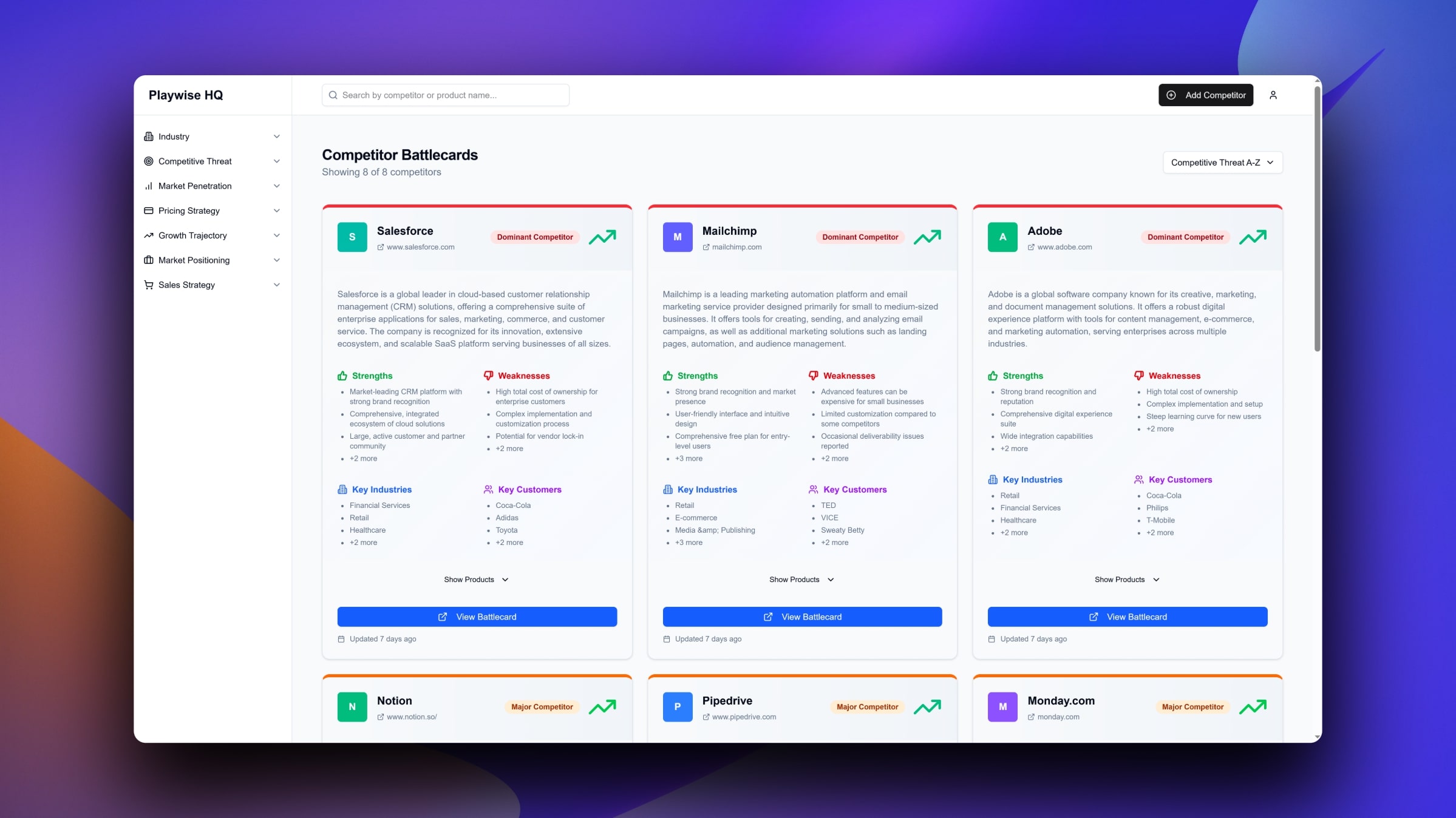
Building great scripts is step one. Getting them into the hands of every rep, at the right moment, with the right competitive context — that’s where most organizations fall apart.
This is exactly the problem Playwise HQ was built to solve.
- Embedding scripts directly into competitive battlecards. Instead of maintaining a separate “pricing objection” document, your price-objection scripts live inside the battlecard for each competitor. When a rep opens the battlecard for Competitor X, they see the specific value-framing scripts, TCO comparison narratives, and proof points that work against that competitor — not a generic talk track.
- Keeping TCO and pricing comparisons current. When competitors change their pricing — and they will — your battlecards update in one place, and every rep immediately has the latest competitive pricing updates and alerts. No more reps quoting outdated numbers in live negotiations.
- Capturing rep feedback to sharpen scripts. Through sales-sourced competitive insights, reps can flag which scripts landed, which fell flat, and what new objections they’re hearing. This creates the feedback loop that turns your script library from a static asset into a living, improving system.
Practical Examples: Price Objection Scripts in Action
Theory is useful. Seeing it work in a live deal is better. Here are four scenarios with specific script approaches.
Scenario 1: “You’re 20% More Expensive Than Competitor X”
Context: Mid-deal, the economic buyer has received a competing quote and is using it as leverage.
Script approach (TCO + Value Framing):
“Thanks for sharing that — transparency on pricing helps us both make the right decision. I want to make sure we’re comparing the full picture, though. Competitor X’s base price doesn’t include [implementation services / API access / premium support] — which based on your requirements, you’ll need. When our customers have done the side-by-side, the total cost of ownership is typically within 5-8% of each other. But here’s the real question: [Customer Name in their industry] evaluated both of us last year and chose us specifically because [specific outcome — e.g., they were live in 4 weeks vs. the 12-week average with Competitor X]. What would that speed-to-value be worth for your team?”
Why it works: It doesn’t dismiss the objection. It reframes the comparison on fair terms, then pivots to a concrete customer proof point that shifts the conversation from cost to outcome.
Scenario 2: “We Didn’t Budget This Much for This Project”
Context: Early-to-mid deal. The champion is bought in but needs to justify the investment internally.
Script approach (Risk + Executive Value Framing):
“That’s a fair concern, and I don’t want to put you in an awkward position internally. Can I ask — when this project was budgeted, was it scoped against the full set of requirements you’ve shared with us? What I’ve seen with teams like yours is that the initial budget was set before they fully understood the cost of [the problem you solve — e.g., manual competitive research eating 10+ hours per week per analyst]. If we can build a business case showing [specific ROI metric], would that give you what you need to have the budget conversation with your CFO?”
Why it works: It positions the rep as an ally, not an adversary. It also equips the champion with ammunition for the internal conversation — which is where many deals actually die.
Scenario 3: “Competitor Y Is Offering Aggressive Discounts to Win Our Business”
Context: Late-stage deal. The competitor is buying the deal with pricing concessions.
“I appreciate you telling me that. When a competitor discounts aggressively to win a deal, it’s worth asking: why do they need to? In our experience, that kind of discounting usually signals one of two things — they’re behind on their numbers this quarter, or they know their product doesn’t win on merit at full price. Either way, that discount disappears at renewal. Our pricing reflects the value we deliver consistently — and our [retention rate / NPS / expansion rate] reflects that customers agree.”
Scenario 4: “We’ll Go With the Cheaper Option and Revisit You Next Year”
Context: The deal is slipping. The buyer is rationalizing a lower-cost choice.
“I respect that decision, and I want to be honest with you: we hear this sometimes, and what usually happens is that teams spend the next 12 months working around the limitations of the cheaper tool, then come back to us having lost a year of [specific outcome]. I’d rather help you avoid that. Would it make sense to run a 30-day pilot so your team can validate the difference before you commit either way?”
Common Pitfalls to Avoid
- Over-engineering the scripts. If a script takes 90 seconds to deliver, it’s a monologue, not a conversation. Keep each component tight enough to feel natural.
- Ignoring the emotional layer. Price objections often carry anxiety — about looking foolish, about budget scrutiny, about making the wrong choice. Scripts that only address logic miss half the conversation.
- Treating all competitors the same. A script that works against a well-known enterprise incumbent won’t work against a scrappy startup offering aggressive discounts. Competitor-specific context is non-negotiable.
- Updating scripts annually instead of continuously. Competitive pricing shifts quarterly, sometimes monthly. If your battlecard content for pricing reflects last year’s landscape, your reps are fighting with outdated weapons.
- Measuring activity instead of outcomes. “Reps accessed the battlecard” is not a success metric. “Win rate improved 8% on deals where price was the primary objection” is.
Bringing It All Together: A New Standard for Competitive Price Conversations
The shift from reactive discounting to proactive value and TCO storytelling isn’t a nice-to-have. It’s the difference between teams that protect their margins and teams that give them away one deal at a time.
As Paul Towers notes: “Your price-objection response is the single highest-leverage moment in a competitive deal. It either reinforces your positioning or destroys it. There’s no neutral ground.”
A living battlecard system, one that adapts to competitive changes, captures field intelligence, and delivers the right script at the right moment, beats static enablement decks every time. It’s how you turn standardized messaging across teams from an aspiration into an operational reality.
Ready to operationalize your price-objection scripts? Book a demo of Playwise HQ and see how teams are embedding competitive price narratives directly into battlecards, turning “you’re too expensive” from a deal-killer into their most winnable objection.