

Your best rep just lost a deal they should have won. Not because the product was wrong, not because the pricing was off, but because a competitor repositioned their messaging three weeks ago, and nobody told the rep working the deal from her home office in Denver.
She found out from the prospect.
This scenario plays out hundreds of times a day across distributed sales organizations. And it exposes a fundamental truth: competitive enablement isn’t a nice-to-have for remote sales teams. It’s the difference between reps who control the narrative and reps who get blindsided by it.
The shift to remote and hybrid selling didn’t just change where reps work. It dismantled the informal knowledge-sharing networks that competitive intelligence once traveled through — the hallway conversations after a lost deal, the whiteboard sessions before a big demo, the quick tap on a colleague’s shoulder to ask, “What are you hearing about Competitor X?”
Without those organic channels, distributed teams face a compounding set of problems: fragmented intel scattered across Slack threads and personal docs, battlecards that were last updated two quarters ago, and tribal knowledge that walks out the door every time a tenured rep leaves.
The business impact is real. Organizations with strong competitive enablement programs see measurably higher win rates, shorter deal cycles, and faster rep ramp times. The gap between companies that get this right and those that don’t is widening — especially as remote selling becomes the permanent default, not a temporary adjustment.
This guide covers how to design, deploy, and sustain competitive enablement for remote revenue teams — from strategy and battlecard architecture to adoption, measurement, and the governance that keeps everything current.
Understanding Competitive Enablement in a Remote-First World

Let’s draw a clear line between competitive intelligence and competitive enablement, because conflating the two is where most programs go sideways.
- Competitive intelligence is the practice of gathering, analyzing, and synthesizing information about your competitors — their products, pricing, positioning, GTM motions, and strategic direction.
- Competitive enablement is what happens when that intelligence gets translated into seller-ready content, delivered in context, at the moment a rep needs it to win a deal.
The distinction matters enormously for remote teams. A CI analyst can produce a brilliant 15-page competitive landscape report. But if a remote AE on a live Zoom demo can’t access a concise, battle-tested rebuttal in under 10 seconds, that intelligence has zero revenue impact.
“Competitive intelligence without enablement is just expensive research. Enablement without intelligence is just guessing. Remote teams need both, stitched together so tightly that reps can’t tell where one ends and the other begins.” according to Paul Towers, Founder and CEO of Playwise HQ.
Remote selling motions create specific pressure points where competitive enablement must show up:
- Discovery calls, where reps need to plant landmines against competitors the prospect is also evaluating
- Demos and technical evaluations, where Sales Engineers need precise feature-by-feature differentiation
- Negotiation and procurement, where pricing objections tied to competitor quotes need immediate, confident responses
- Renewal and expansion conversations, where incumbents face displacement threats from new entrants
Each of these moments happens in isolation when your team is distributed. There’s no manager leaning over to whisper guidance. There’s no war room to huddle in before the call. The battlecard is the war room.
The key stakeholders who must collaborate to make this work — sales enablement, CI, RevOps, presales, and frontline managers — are themselves distributed. Which means the system you build needs to function without relying on any single person being available at the right time.
Designing a Competitive Enablement Strategy for Distributed Teams

Before you build a single battlecard, you need a strategy that maps to how your remote reps actually sell — not how your org chart says they should.
Map the Workflow First
Start by documenting the real-world touchpoints where competitive intelligence influences deal outcomes. For most B2B sales organizations, these cluster around five moments:
- Pre-call research — Rep prepares for a discovery or demo knowing a specific competitor is in play
- Live objection handling — Prospect raises a competitor’s claim mid-conversation
- Deal strategy sessions — Manager and rep plan how to position against a known competitor in a late-stage deal
- Proposal and negotiation — Prospect uses competitor pricing or capabilities as leverage
- Post-loss analysis — Team debriefs on what the competitor did differently
Each of these moments has different content needs. Pre-call research benefits from depth. Live objection handling demands speed. Strategy sessions need nuance. Your enablement architecture must serve all five without forcing reps to dig through the same monolithic document.
Identify Core Use Cases
Not every competitive scenario deserves equal investment. Prioritize based on revenue impact:
- New logo acquisition against your top 3-5 competitors — This is where most competitive deals happen and where battlecards deliver the highest ROI
- Head-to-head bake-offs and technical evaluations — These require deeper, more technical content and often involve presales
- Renewal defense — When a competitor is actively trying to displace you in an existing account
- Expansion into new segments or geos — Where the competitive landscape may look different from your core market
Align to Revenue Metrics
Competitive enablement programs that survive budget cycles are the ones tied to outcomes leadership cares about. Define your success criteria early:
- Win rate against named competitors — The most direct measure of competitive enablement effectiveness
- Deal velocity — Are deals moving faster when reps have the right competitive content?
- New rep ramp time — How quickly can a new remote hire become competent in competitive positioning?
- Average contract value — Are reps holding price better when they can articulate differentiation?
As we explore in our guide on competitive intelligence ROI, tying CI to revenue metrics is what transforms it from a cost center into a strategic investment.
Building Centralized, Up-to-Date Competitive Battlecards
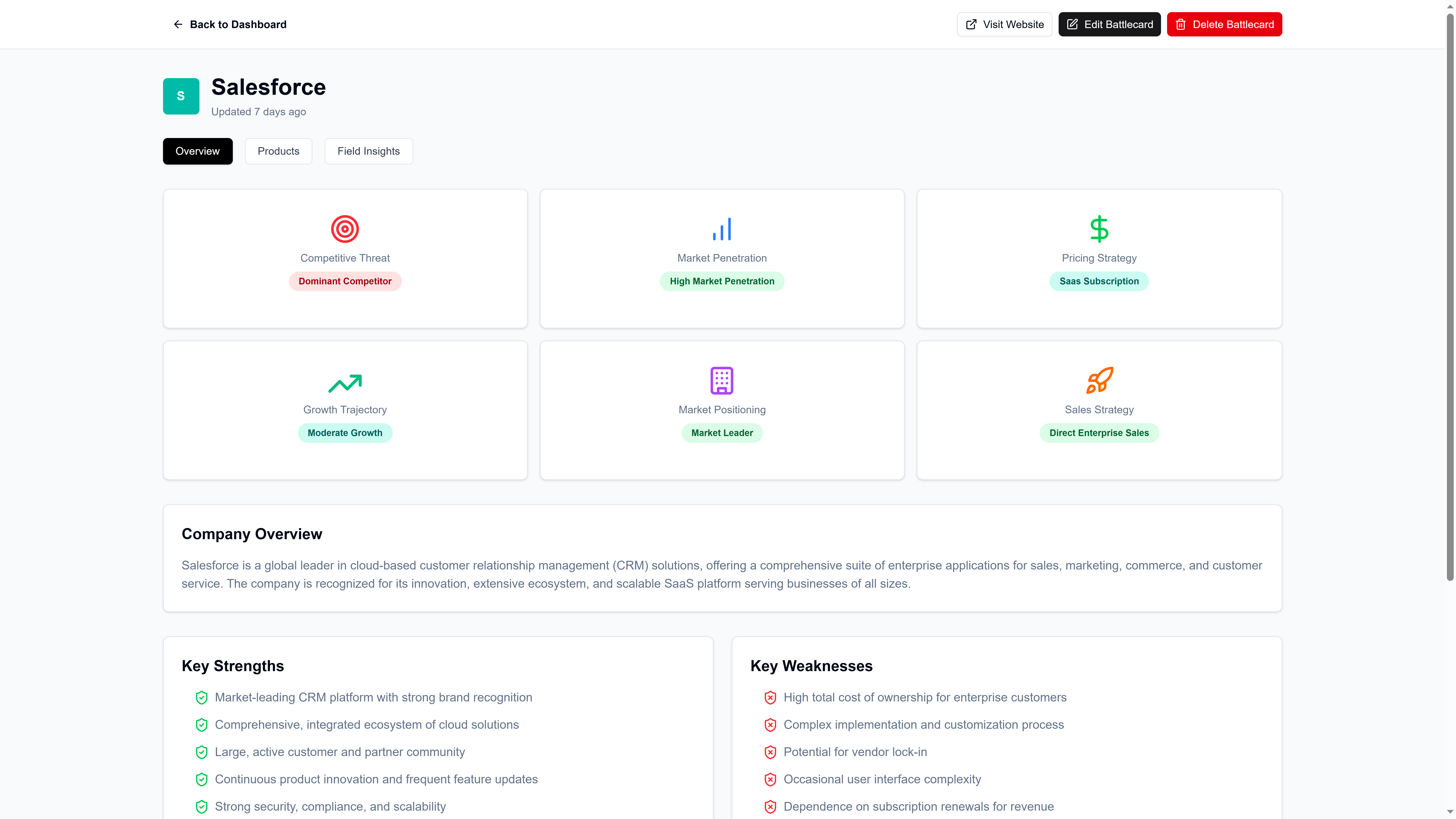
The battlecard is the atomic unit of competitive enablement. Get this wrong, and nothing downstream works — no matter how good your strategy or technology stack.
What “Good” Looks Like for Remote Sellers
Remote reps consume battlecards differently than in-office reps. They’re often accessing them during a live call, with a prospect on screen and limited time to scan. This means your battlecards need to be:
- Scannable in under 30 seconds — A rep should be able to find the relevant section and extract the key point without scrolling through pages of context
- Structured consistently — Every battlecard should follow the same architecture so reps build muscle memory for where information lives
- Written in seller language — Not analyst language, not marketing language, not product management language
Reflecting on what makes a great battlecard for remote sales teams Paul Towers notes that “The best battlecard is the one a rep can glance at mid-call and immediately sound smarter than the competitor’s rep on the other side of the deal. If it takes more than a few seconds to find what you need, you’ve already lost the moment.”
Must-Have Sections
Every competitive battlecard should include these core components:
- Competitor overview — Who they are, what they sell, and their primary positioning (2-3 sentences, not a Wikipedia entry)
- Key differentiators — Where you win and why, stated in customer-impact terms
- Landmines — Questions your reps should ask prospects that expose the competitor’s weaknesses
- Objection handling — “If they say X, you say Y” formatted responses to the most common competitor claims
- Proof points — Customer stories, data points, or third-party validation that back up your positioning
- Pricing intelligence — What you know about their pricing model, common discount patterns, and how to respond to price-based objections
- Technical comparison — Feature-level differentiation for SE-led conversations
Playwise HQ’s objection handling capabilities are specifically designed to make this section dynamic — reps can access battle-tested rebuttals organized by the specific claims competitors make, rather than hunting through static documents.
Standardize to Eliminate Fragmentation
One of the fastest ways competitive enablement breaks down in remote teams is when individual reps or managers create their own “shadow battlecards” — personal Google Docs, Notion pages, or Slack bookmarks that contain their version of competitive intel.
These shadow documents are dangerous because they’re unversioned, ungoverned, and often wrong. Standardizing on a single template and a single source of truth eliminates this problem.
Governance and Ownership
Every battlecard needs a named owner. This owner is responsible for:
- Reviewing and approving updates before they go live
- Conducting quarterly freshness audits
- Soliciting field feedback on accuracy and usefulness
- Coordinating with product, marketing, and CI on changes
For most organizations, the CI manager or a senior enablement lead owns the battlecard program, with subject-matter contributors from sales, presales, and product marketing.
Making Competitive Content Truly Seller-Ready

There’s a critical gap between “accurate competitive intelligence” and “content a remote rep can actually use to win a deal.” Bridging that gap is what separates competitive enablement programs that drive revenue from those that collect dust.
From Intel to Talk Tracks
Raw intelligence — “Competitor X launched a new analytics module in Q1” — is useless to a rep on a live call. Seller-ready content transforms that into a narrative:
“You may hear [Competitor X] talk about their new analytics module. Here’s what to know: it’s a bolt-on that requires a separate license, doesn’t integrate natively with their core workflow, and early customer feedback suggests the reporting is limited to pre-built dashboards. When this comes up, steer the conversation toward our embedded analytics that ship standard with every plan and let users build custom reports without IT involvement.”
That’s the difference between intelligence and enablement.
Format for Speed
Remote reps need to access competitive content while maintaining eye contact on a video call. Design for that reality:
- Bold the key phrase in every objection response so reps can grab it at a glance
- Use “If they say / You say” formatting for the most common competitive claims
- Keep proof points to one sentence with a link to the full case study if the rep wants to go deeper
- Front-load the most critical information — don’t bury the best rebuttal at the bottom of a section
As it relates to format, Paul Towers states that “format is strategy. A perfectly researched battlecard that’s poorly formatted will lose to a mediocre one that’s scannable in five seconds.”
Keeping Competitive Intel Fresh: Real-Time Updates for Remote Sellers

Stale battlecards are worse than no battlecards. They create false confidence. A rep walks into a negotiation armed with pricing data from six months ago, and the prospect corrects them — instantly destroying credibility and trust.
For remote teams, the staleness problem is amplified because there’s no physical proximity to trigger informal updates. Nobody walks past a CI manager’s desk and mentions what they heard on a call yesterday.
Build Systematic Feedback Loops
The best competitive intelligence often comes from the field. Your remote reps are having conversations with prospects every day, and those prospects are telling them exactly what competitors are saying, pricing, and promising.
The challenge is capturing that intelligence systematically rather than letting it evaporate after the call ends. Playwise HQ’s sales-sourced competitive insights feature solves this by giving reps a frictionless way to contribute field intelligence directly to the relevant battlecard — no separate form, no Slack message that gets buried, no email that nobody reads.
Imagine this: A mid-market AE in Austin is negotiating a renewal when the prospect mentions that Competitor Y offered a 40% discount with a three-year commitment — a pricing play your team hasn’t seen before. In a co-located office, she might mention this at lunch and the CI manager would update the battlecard that afternoon. In a remote environment, without a structured feedback mechanism, that intel dies in her personal notes. With a systematic capture workflow, it gets flagged, validated, and pushed to the entire team within hours.
Monitor and Alert
Beyond field intelligence, your program needs to track competitor changes proactively:
- Messaging and positioning shifts on their website, in their content, and in analyst reports
- Product launches and feature updates that change the competitive comparison
- Pricing and packaging changes that affect deal-level positioning
- GTM moves — new segments, new partnerships, new sales motions
When changes are detected, the relevant battlecards should be updated and the team notified. As we discuss in why sales battlecards go stale, the root cause is almost always a lack of process, not a lack of information.
Version Control Matters
Remote teams need confidence that the battlecard they’re looking at is current. This means:
- Clear version dates visible on every battlecard
- Update history showing what changed and why
- Automated notifications when a battlecard they’ve recently used gets updated
“Trust is the currency of competitive enablement. The moment a rep opens a battlecard and wonders if it’s still accurate, you’ve lost them. They’ll go back to asking a colleague on Slack, which is exactly the unscalable behavior you’re trying to replace.” — Paul Towers, Founder and CEO of Playwise HQ
Driving Adoption and Engagement Across Remote Sales Teams

Building great battlecards is necessary but not sufficient. The hardest part of competitive enablement — especially for remote teams — is driving consistent adoption across the entire sales organization.
The adoption challenge is well-documented. Our comprehensive guide on competitor battlecard adoption covers this in depth, but here are the strategies most relevant to distributed teams.
Onboarding: Start Strong
New remote hires should encounter competitive enablement content in their first week — not as an afterthought in month two. Include competitive positioning in your onboarding curriculum alongside product training and sales methodology.
Specifically:
- Week 1: Introduce the top 3 competitors and the corresponding battlecards
- Week 2: Role-play competitive scenarios using the battlecard content
- Week 3: Shadow a tenured rep on a competitive deal and debrief using the battlecard
- Week 4: Handle a live competitive objection with manager observation
Ongoing Enablement: Mix Sync and Async
Remote teams need a blend of live and self-paced competitive enablement:
- Monthly competitive briefings (30-minute live sessions) covering what’s changed, new intel from the field, and updated battlecards
- “Battlecard of the week” spotlights delivered via Slack or email, highlighting one competitor and one key talking point
- Async learning paths with short video walkthroughs of how to use specific battlecard sections in common deal scenarios
- Recorded win/loss debriefs that remote reps can watch on their own schedule
Manager-Led Reinforcement
Frontline managers are the single biggest lever for driving battlecard adoption. When managers consistently reference competitive content in deal reviews, pipeline calls, and coaching sessions, reps learn that competitive enablement isn’t optional — it’s how the team operates.
Where this shows up: An enterprise AE is preparing for a final presentation where the CFO has expressed concern that Competitor Z offers a “more complete platform.” The manager pulls up the relevant battlecard during their 1:1 prep session, walks through the differentiation narrative, identifies two proof points from similar deals, and rehearses the “If they say / You say” responses. The AE walks into the meeting prepared, confident, and armed with specific evidence. That’s manager-led reinforcement in action — and it works regardless of whether the manager and rep are in the same building or different time zones.
Recognize and Reward
Create visible recognition for reps who:
- Contribute field intelligence that improves a battlecard
- Use competitive content to win a deal and share the story
- Achieve the highest competitive win rate in a given quarter
Recognition doesn’t need to be monetary. A shout-out in the all-hands, a “CI MVP” badge, or a featured win story in the team newsletter can be powerful motivators.
Measuring the Impact of Competitive Enablement on Remote Selling

You can’t improve what you don’t measure, and you can’t defend budget for what you can’t quantify.
Core Metrics
| Metric | What It Tells You |
|---|---|
| Win rate vs. named competitors | Direct effectiveness of competitive positioning |
| Competitive deal cycle length | Whether intel is accelerating or stalling deals |
| Average contract value in competitive deals | Whether reps are holding price |
| New rep time-to-first-competitive-win | How quickly enablement is ramping new hires |
Adoption and Usage Analytics
Beyond outcome metrics, you need to understand how competitive content is being consumed:
- Which battlecards are accessed most frequently — and which are ignored
- When in the deal cycle reps access competitive content
- Which sections get the most engagement (objection handling? pricing? proof points?)
- Correlation between battlecard usage and deal outcomes
Qualitative Feedback
Numbers tell part of the story. Supplement with:
- Quarterly rep surveys asking which battlecards are most useful, what’s missing, and what’s outdated
- Win/loss interview excerpts that reference competitive positioning
- Manager observations from deal reviews and coaching sessions
Use both quantitative and qualitative data to iterate. If a battlecard has high usage but low win correlation, the content might need refinement. If a battlecard has low usage but high win correlation when used, you have an adoption problem, not a content problem.
Common Pitfalls and How to Avoid Them
After working with sales teams building competitive enablement programs, certain failure patterns emerge repeatedly. Here’s how to sidestep them.
Pitfall 1: Information Overload
The instinct is to put everything you know about a competitor into the battlecard. Resist it. Remote reps need focused, actionable guidance — not a research paper. If a section doesn’t directly help a rep win a deal, it doesn’t belong in the battlecard.
“The discipline of competitive enablement is knowing what to leave out. Every sentence in a battlecard should earn its place by answering one question: does this help a rep win a deal in the next 30 days?” according to Paul Towers.
Pitfall 2: Shadow Battlecards
When the official competitive content is hard to find, slow to load, or out of date, reps create their own. These shadow battlecards proliferate in Google Docs, Notion, personal notes, and Slack bookmarks. They’re ungoverned, unversioned, and often contain outdated or inaccurate information.
The fix isn’t to ban personal notes — it’s to make the official source so good, so accessible, and so current that there’s no reason to maintain a personal version.
Pitfall 3: Set-It-and-Forget-It
A battlecard created in January and never updated is actively harmful by July. Competitive landscapes shift constantly. Establish a minimum update cadence (monthly review, quarterly deep refresh) and stick to it.
Pitfall 4: CI as a Silo
When competitive intelligence operates independently from enablement, sales, and product, the result is content that’s analytically rigorous but operationally useless. The best programs embed CI contributors directly into the revenue team’s workflows, not in a separate department that publishes reports nobody reads.
Building a Sustainable Competitive Enablement Engine for Remote Teams
Effective competitive enablement for remote sales teams rests on four pillars:
- Centralized, structured content — A single source of truth with consistent battlecard architecture
- Contextual delivery — Competitive intel surfaced where reps work, not buried in a separate tool
- Continuous freshness — Systematic feedback loops, proactive monitoring, and disciplined governance
- Measurable impact — Clear metrics tying competitive enablement to revenue outcomes
A Phased Roadmap
Phase 1 (Weeks 1-4): Foundation
- Audit existing competitive content across all channels
- Identify your top 3-5 competitors by deal frequency and revenue impact
- Build initial battlecards using a standardized template
- Assign ownership for each battlecard
Phase 2 (Weeks 5-8): Activation
- Roll out battlecards to the sales team with live training sessions
- Integrate competitive content into sales workflows
- Establish the field feedback mechanism for reps to contribute intel
Phase 3 (Weeks 9-16): Optimization
- Analyze usage data and win/loss correlation
- Refine content based on rep feedback and deal outcomes
- Expand coverage to additional competitors and segments
- Introduce manager-led reinforcement in deal reviews
Phase 4 (Ongoing): Scale
- Automate competitor monitoring and update alerts
- Build role-specific and segment-specific battlecard views
- Tie competitive enablement metrics to leadership dashboards
- Continuously iterate based on data
“Most teams try to boil the ocean on day one. Start with three competitors and five battlecards that are genuinely excellent. That’s worth more than fifty battlecards that are mediocre.” according to Paul Towers.
The Path Forward
Remote selling isn’t going back to the way it was. The organizations that thrive will be the ones that build competitive enablement into the fabric of how their distributed teams operate — not as an occasional project, but as a continuous, governed, measurable capability.
The gap between knowing about your competitors and enabling your reps to win against them is where revenue lives. For remote teams, closing that gap requires intentional design, the right technology, and a commitment to keeping content fresh and accessible.
If you’re ready to move from scattered competitive intel to a centralized, real-time enablement engine your remote team will actually use, book a demo of Playwise HQ and see how purpose-built battlecard infrastructure transforms competitive selling — wherever your reps happen to be sitting.