
Your best rep just lost a deal to a competitor you thought you had figured out. The post-mortem reveals the buyer cited a feature comparison your team didn’t know existed, an objection nobody had a rebuttal for, and a pricing play that caught your AE flat-footed in the final negotiation.
The worst part? Another rep on your team encountered the exact same competitor tactic two months ago — and won. But that insight lived in a Slack thread nobody could find.
This is the state of competitive intelligence in most enterprise sales organizations: fragmented, reactive, and trapped inside the heads of individual performers. Competitive deal reviews should be the mechanism that fixes this. But for most teams, they’re little more than unstructured conversations that generate heat without light.
It’s time to change that. This guide lays out a system, not just a meeting format, for running competitive deal reviews that measurably improve win rates, build durable competitive assets, and turn every deal into organizational learning.
The Real Problem: Competitive Chaos in Enterprise Deals

Enterprise deals rarely fail because of a single moment. They fail because of accumulated competitive blind spots that compound across a sales cycle.
Here’s what that looks like in practice:
- Fragmented battlefield intel. Competitive insights are scattered across Slack channels, email threads, call recordings, and ad-hoc notes. No single person, including the deal owner, has the full picture.
- Inconsistent competitive narratives. Rep A positions against a competitor by attacking their pricing model. Rep B leads with a feature comparison. Rep C avoids the competitor entirely. There’s no shared playbook, so every rep improvises.
- “Post-mortem only” culture. Most teams only analyze competitive dynamics after a deal is lost. By then, the insights are stale and the emotional sting makes objective analysis harder.
- Tribal knowledge walking out the door. Your top performer has battle-tested talk tracks for every major competitor. But when they get promoted, change roles, or leave, that knowledge evaporates overnight.
These aren’t minor operational gaps. They’re systemic failures that directly erode win rates in competitive scenarios. And no amount of generic pipeline reviews will fix them.
Why Most Competitive Deal Reviews Fail to Change Win Rates
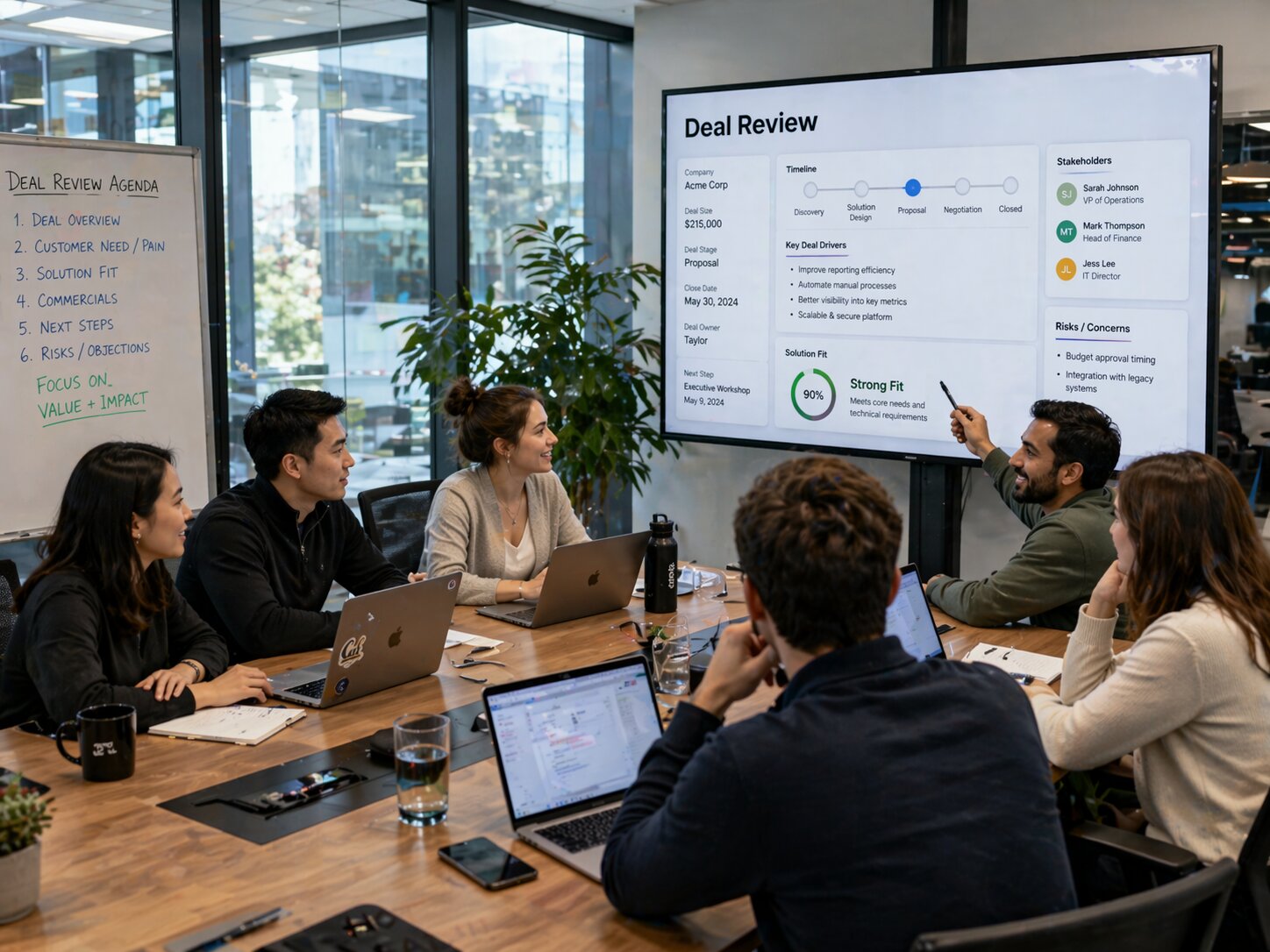
If your team already runs some version of competitive deal reviews and you’re not seeing measurable improvement, the problem likely isn’t effort, it’s structure.
Unstructured, anecdote-driven conversations produce unstructured, anecdote-driven outcomes. A room full of smart people sharing opinions about a deal isn’t a review — it’s a brainstorm. Without a clear framework, the loudest voice wins, confirmation bias runs unchecked, and the session ends with vague action items nobody follows up on.
No standard roles or expectations. When everyone in the room has the same undefined role (“participant”), nobody owns the outcome. The deal owner dominates the conversation. The CI lead sits silently. The enablement manager takes notes that never get distributed.
Insights never reach a central, reusable system. This is the most expensive failure mode. Even when a review surfaces a brilliant competitive insight — a new objection rebuttal, a pricing counter, a positioning angle — it stays locked in meeting notes or a single rep’s memory. It never becomes organizational knowledge.
Battlecards treated as static documents. If your battlecards are PDFs that get updated quarterly, they’re not competitive intelligence — they’re historical artifacts. The gap between what your battlecards say and what’s actually happening in deals grows wider every week.
As Paul Towers, founder of Playwise HQ, puts it: “The real waste isn’t running bad deal reviews, it’s running good ones where the insights die in a Google Doc nobody opens again.”
The Shift: Treating Competitive Deal Reviews as a System, Not a Meeting
The highest-performing competitive teams don’t just run better meetings. They operate a closed-loop system where every competitive deal review feeds directly into the assets, playbooks, and workflows that reps use in future deals.
Here’s the mental model shift:
- Instead of relying on random commentary on deals, shift to a repeatable deal review framework.
- Move away from generic pipeline reviews with a competitive sidebar, and focus on targeted competitive deal reviews for high-stakes opportunities.
- Replace opinion-based narratives like “I think they’re weak on…” with evidence-backed win/loss signals validated across multiple deals.
- And rather than maintaining static battlecards updated quarterly, adopt continuously updated, deal-tested competitive playbooks.
This shift matters because it transforms competitive intelligence from a passive resource into an active revenue system. Every review becomes an input that makes the next deal easier to win.
Defining Roles and Attendees for High-Impact Competitive Deal Reviews
Structure starts with clarity about who’s in the room and what they’re responsible for. Ambiguity here is where most reviews go sideways.
Core Roles (Required for Every Session)
- Deal Owner (AE/AM): Presents the deal context, competitive landscape, and specific challenges. Comes prepared with pre-work completed.
- Facilitator: Runs the agenda, manages time, ensures the conversation stays structured and outcome-oriented. This is not the deal owner, they need to participate, not moderate.
- Competitive Lead (CI or Enablement): Brings current battlecard content, validates or challenges competitive claims, and identifies gaps in existing intel.
- Note Owner: Captures structured insights in real time, tagged to specific competitors and deal stages. Responsible for post-session documentation.
Recommended Attendees
- Sales leadership: For coaching and pattern recognition across the pipeline.
- Presales/Solutions Engineering: For technical competitive depth and demo strategy.
- Enablement: To identify content gaps and training opportunities.
Optional Participants
- Product Marketing: When messaging or positioning needs strategic input.
- Product: When technical differentiation claims need validation.
Setting Expectations
Every attendee should know before the session:
- What pre-work is required (deal owner completes a structured brief; competitive lead pulls relevant battlecard content)
- How long the session will run (timebox to 30–45 minutes per deal)
- What the expected output is (updated competitive insights, specific next actions for the deal, battlecard update candidates)
A Structured Agenda for Competitive Deal Reviews That Actually Improves Win Rates

A structured deal review process isn’t bureaucracy — it’s the difference between a conversation that feels productive and one that actually is. Here’s a phase-based deal review framework you can adopt immediately.
Pre-Work: Qualifying Which Deals Are “Competitive Review Worthy”
Not every deal needs a competitive review. Focus your sessions on deals where:
- A known competitor is actively engaged
- The deal is in mid-to-late stage (discovery complete, evaluation underway)
- The deal size or strategic importance justifies the time investment
- The rep has identified specific competitive unknowns or challenges
Qualifying ruthlessly protects the time of your best people and ensures every session has enough substance to generate real insights.
Phase 1: Deal Context, Stakeholders, and Current Position (10 minutes)
The deal owner briefs the room:
- Buyer context: Who’s the economic buyer? Who’s the technical evaluator? What’s the decision process?
- Current deal position: Where are we in the cycle? What’s our relationship strength?
- Competitive landscape: Which competitors are in play? What do we know vs. what are we guessing?
The facilitator’s job here is to keep this phase tight. Context-setting should inform the competitive discussion, not replace it.
Phase 2: Competitor Landscape, Threats, and Unknowns (15 minutes)
This is the core of the competitive review. The competitive lead pulls up the relevant battlecard content and the team works through:
- Known competitor strengths in this specific deal context
- Threats: Where is the competitor likely to attack our positioning?
- Unknowns: What don’t we know about the competitor’s approach, pricing, or messaging in this deal?
- Buyer perception gaps: Where might the buyer have a misconception about us vs. the competitor?
Mini-scenario — CFO objection in a late-stage deal: An AE is competing against a lower-priced competitor for a $180K deal. The CFO has flagged cost as a primary concern. During Phase 2, the competitive lead surfaces a battlecard rebuttal showing that the competitor’s base price excludes implementation and support costs that are included in your offering. The presales engineer adds that a similar deal last quarter required a TCO comparison slide to shift the CFO’s framing. The team builds a specific action plan: deliver a customized TCO analysis before the next executive meeting, anchored to proof points from the battlecard.
Phase 3: Messaging, Objection Handling, and Next-Move Planning (10 minutes)
With the competitive landscape mapped, the team shifts to action:
- What specific messaging should the rep use in the next interaction?
- What objections are most likely, and what are the strongest rebuttals?
- What’s the single most important next move to strengthen our competitive position?
This phase should reference existing objection handling content and identify gaps where new rebuttals are needed.
Phase 4: Codifying Learnings into Battlecard-Ready Insights (5 minutes)
The note owner summarizes:
- New competitive intelligence surfaced during the session
- Battlecard updates to recommend (new rebuttals, updated pricing intel, positioning adjustments)
- Patterns emerging across multiple deals against the same competitor
This final phase is what separates a competitive deal review from a regular pipeline review. Without it, you’re generating insights that evaporate the moment the meeting ends.
Capturing and Validating Deal-Level Insights Using Battlecards
Raw seller anecdotes are valuable — but they’re not battlecard-ready until they’ve been structured, validated, and tested.
From Anecdote to Structured Entry
When a rep reports “the buyer said Competitor X just launched a new integration,” that’s a signal, not a fact. The process for turning it into a usable competitive asset:
- Capture the claim with context (who said it, when, in what deal stage)
- Structure it using a standard template: claim, source, supporting evidence, suggested counter-positioning
- Tag it to the specific competitor and deal stage
Validation Before Core Messaging Updates
A single data point shouldn’t change your battlecard. The validation threshold matters:
- One deal: Flag as “emerging intel” — worth monitoring
- Two to three deals: Elevate to “validated pattern” — draft a rebuttal or positioning update
- Four+ deals: Promote to core battlecard content — update messaging across the organization
This approach prevents knee-jerk reactions to outlier situations while ensuring genuine competitive shifts get captured quickly.
Experimental vs. Proven Plays
Not all talk tracks are created equal. Label competitive plays clearly:
- Proven: Validated across multiple deals with positive outcomes
- Experimental: Promising but unvalidated — use with awareness that results may vary
- Deprecated: Previously effective but no longer relevant due to market changes
This taxonomy gives reps confidence in what they’re using and gives CI teams a clear framework for measuring competitive content impact.
How Playwise HQ Operationalizes Competitive Deal Reviews
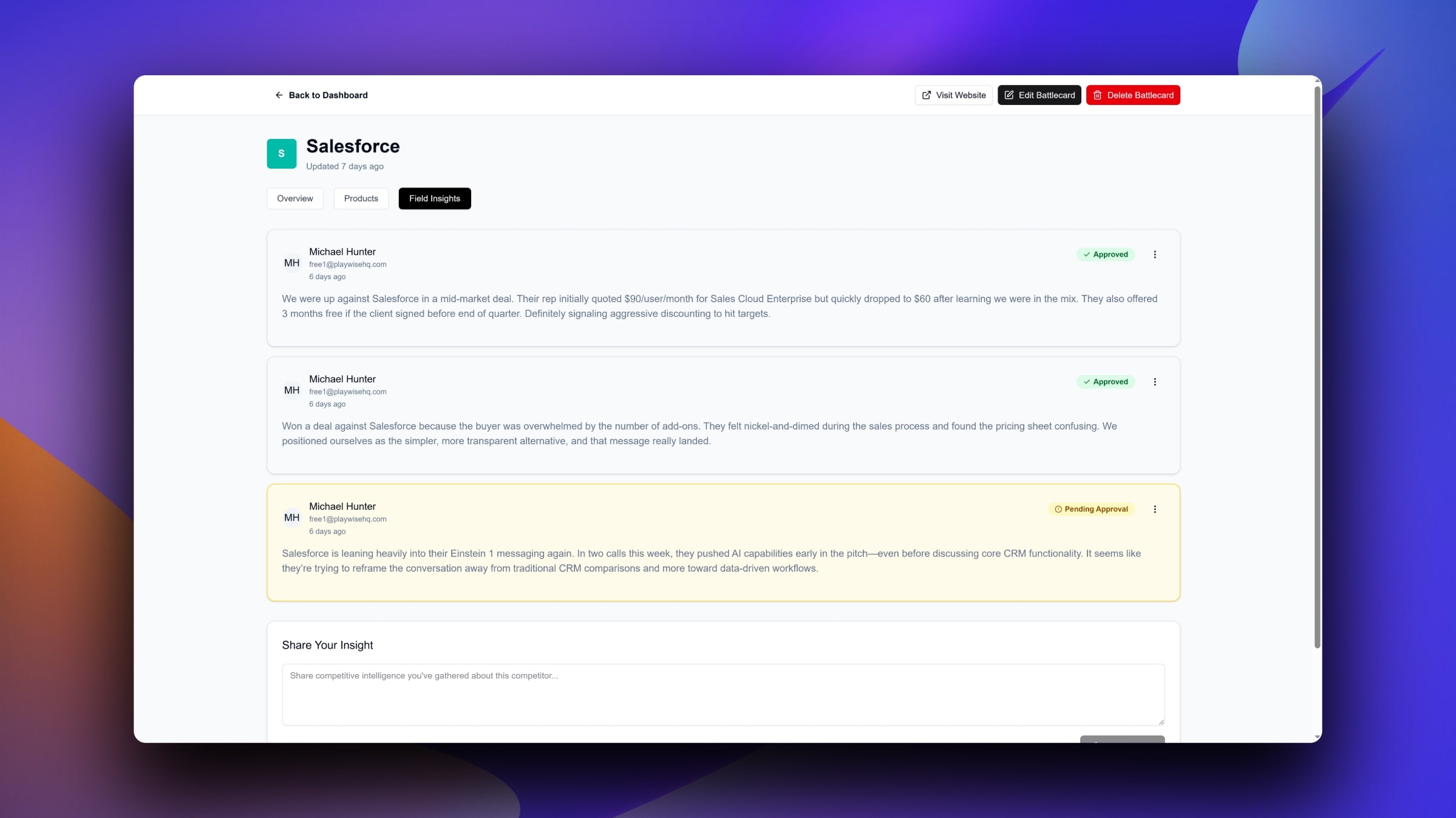
Running great competitive deal reviews is only half the challenge. The other half is ensuring insights flow from those reviews into the systems reps actually use during deals.
This is where most teams hit a wall — and where purpose-built tooling makes the difference.
Centralizing competitive notes into one knowledge repository. Instead of insights scattering across meeting notes, Slack, and email, Playwise HQ provides a centralized competitive knowledge repository where every insight from every review lives in a structured, searchable format.
Mapping insights to specific competitor battlecards. When a review surfaces a new pricing tactic from Competitor X, that insight gets tagged directly to the Competitor X battlecard — not buried in a generic “meeting notes” folder. Teams can use AI-powered battlecard capabilities to accelerate the process of structuring and updating this content.
Prompting real-time updates. After each review session, the competitive lead can immediately update rebuttals, differentiators, and positioning within the relevant battlecards. No quarterly update cycle. No waiting for the next enablement sprint.
Practical Playwise HQ Workflow: From Live Review to Battle-Tested Battlecard
Here’s what the end-to-end workflow looks like in practice:
- During the review: The facilitator shares the relevant competitor battlecard on screen. The team references existing content and identifies gaps in real time.
- Tagging in-session: The note owner tags new insights to specific competitors, deal stages, and market segments as they emerge — no post-meeting cleanup required.
- Post-session structuring: Within 24 hours, the competitive lead converts raw session notes into structured battlecard entries: claims, proof points, counters, and validation status.
- Distribution: Updated battlecards are immediately available to all reps through the Playwise HQ platform.
- Closing the loop: Track which updated battlecard entries get used in subsequent deals and whether those deals show improved outcomes.
Reps can also contribute competitive insights directly from the field, creating a continuous feedback loop between deal execution and competitive content.
What to Implement This Month: A Practical Checklist
If you’re ready to move from ad-hoc competitive conversations to structured deal reviews, here’s your starting point:
- [ ] Identify 3–5 deals currently in mid-to-late stage with active competitive dynamics
- [ ] Assign core roles for your first review: facilitator, deal owner, competitive lead, note owner
- [ ] Create a standard pre-work brief the deal owner completes 24 hours before the session
- [ ] Adopt the four-phase agenda outlined above and timebox each phase
- [ ] Pull existing battlecard content for the competitors in play before the session starts
- [ ] Designate a “note owner” responsible for structuring and tagging insights post-session
- [ ] Establish a validation threshold (e.g., 3+ deals) before updating core battlecard messaging
- [ ] Set a review cadence — weekly for high-velocity teams, bi-weekly for enterprise cycles
- [ ] Track one metric from day one: number of battlecard updates generated per review session
- [ ] Schedule a 30-day retrospective to evaluate the process and refine
Common Pitfalls to Avoid
Even well-intentioned teams can undermine their competitive deal reviews. Watch for these failure modes:
- Reviewing too many deals per session. One to two deals per 45-minute session is the maximum. More than that and depth suffers.
- Letting the deal owner facilitate. They can’t objectively assess their own deal while also managing the conversation. Separate these roles.
- Skipping Phase 4 (codification). The temptation to end the meeting after action planning is strong. Resist it. Without codification, the review’s value is limited to a single deal.
- Updating battlecards based on a single data point. One rep’s experience isn’t a pattern. Use the validation framework to avoid overreacting to outliers.
- Excluding presales and solutions engineering. Technical evaluators increasingly drive enterprise buying decisions. Your competitive reviews need technical depth, not just sales perspective.
Strategic Impact: From Better Conversations to Measurable Competitive Advantage

When competitive deal reviews operate as a system, the compounding effects are significant:
Faster, more confident objection handling. Reps stop improvising and start deploying battle-tested rebuttals. The time between hearing an objection and delivering a credible response shrinks from days to seconds.
Consistent competitive narratives. Whether a buyer talks to your Boston rep or your London rep, they hear the same differentiated positioning — adapted for context, but grounded in the same validated competitive intelligence.
Increased win rates in head-to-head scenarios. Teams that systematically capture and deploy competitive insights from deal reviews see measurable lift in competitive win rates. This isn’t theoretical — it’s the direct result of better preparation meeting better content.
Shorter sales cycles. When reps can address competitive concerns proactively rather than reactively, deals move faster. Buyers spend less time comparing and more time deciding.
As Paul Towers notes: “The teams winning the most competitive deals aren’t the ones with the most intel, they’re the ones with the fastest path from a new insight to a rep’s next conversation.”
Turning Lost Deals into Fuel for Future Wins
Competitive deal reviews aren’t just for active opportunities. The same structured approach applies to post-mortems of lost deals, where the emotional distance and outcome clarity can surface even richer competitive insights.
The key difference: in a post-mortem review, Phase 2 shifts from “what threats do we face?” to “what threats did we miss, and why?” The codification phase becomes even more critical — every lost deal should generate at least one battlecard update or a documented gap that needs filling.
Teams that build this discipline create a virtuous cycle: losses inform battlecard updates, updated battlecards improve preparation, better preparation drives higher win rates.
Make Every Competitive Deal Review a Force Multiplier
Competitive deal reviews shouldn’t be one-off meetings that feel productive but change nothing. They should be the engine that transforms scattered battlefield intelligence into a durable, shared competitive asset your entire revenue organization can leverage.
The formula is straightforward:
- Structure the session with clear roles, a phased agenda, and defined outputs.
- Capture and validate insights using a consistent framework that distinguishes signal from noise.
- Codify learnings into living battlecards that reach reps at the point of need.
- Measure the impact — not just whether reviews happen, but whether updated competitive content drives better outcomes.
Stop letting your best competitive intelligence die in meeting notes. Start building a system that makes every review a force multiplier for every future deal.
Ready to operationalize competitive deal reviews for your team? Book a demo of Playwise HQ to see how structured battlecard workflows and real-time competitive updates can turn your review sessions into measurable win-rate improvement.