
Every sales leader has one. That competitor who keeps showing up in deals, keeps muddying the water, and keeps walking away with logos that should have been yours.
Maybe it’s the low-cost disruptor who undercuts your pricing before you’ve even had a chance to frame value. Maybe it’s the entrenched incumbent whose “good enough” narrative makes buyers hesitant to switch. Or maybe it’s the well-funded all-in-one platform that overwhelms evaluators with a feature checklist you can’t, and shouldn’t, match.
Here’s the uncomfortable truth: you’re probably not losing these deals for the reasons you think. It’s rarely about product gaps. It’s almost always about pattern blindness — the inability to see, diagnose, and systematically counter the specific playbook a competitor type runs against you.
This post is designed to help you identify those patterns, build targeted counterplays, and operationalize them so every rep on your team, not just the top 10%, knows exactly how to win when a specific competitor type enters the deal.
The Hidden Pattern Behind Losing to [Competitor Type]
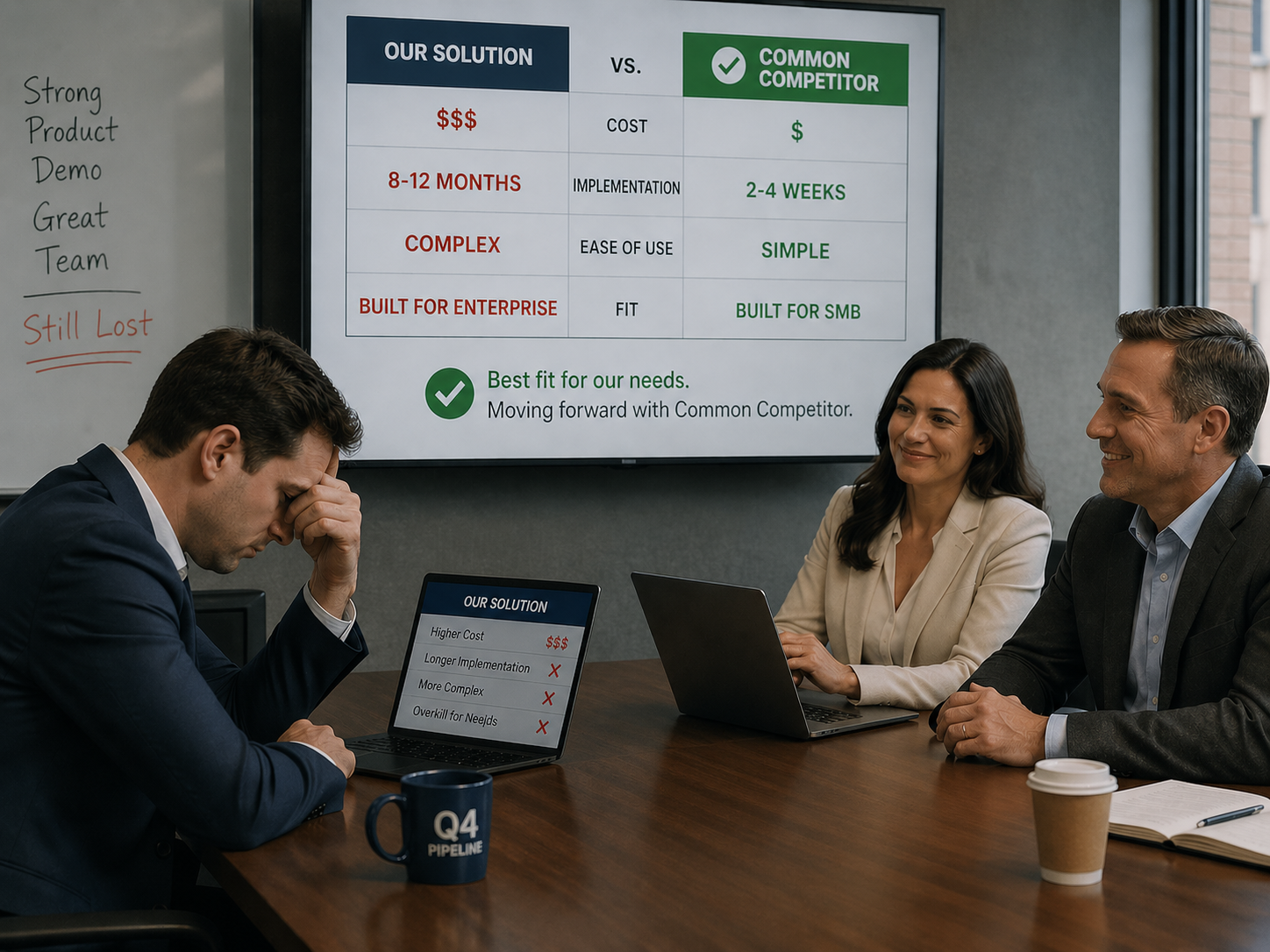
Most teams treat competitive losses as isolated events. A bad demo here. A pricing miss there. A champion who went dark.
But when you line up five, ten, or twenty losses to the same competitor type, something different emerges: a pattern. And it’s almost always the same failure modes repeating at predictable stages.
The same late-stage collapse, over and over
Here’s what it typically looks like. Your rep gets to the final two. The deal feels winnable. Then somewhere between the technical evaluation and the business case review, the competitor reframes the conversation, around price, around risk, around scope, and your team doesn’t have a ready answer. The deal stalls, the champion loses internal momentum, and you get the “we decided to go another direction” email.
This isn’t bad luck. It’s a competitor running a playbook your team hasn’t mapped.
How competitor types exploit confusion
Different competitor types exploit different gaps. Low-cost disruptors thrive when buyers can’t articulate the cost of choosing cheap. Incumbents win when switching costs feel ambiguous and scary. All-in-one platforms win when the evaluation criteria reward breadth over depth.
The competitor doesn’t need to be better than you. They just need to control the frame. And if your team doesn’t recognize which frame is being set, and when, they’ll keep losing the same way.
Why “sell harder” never fixes it
The instinct after a string of losses is to push reps to be more aggressive: more follow-ups, bigger discounts, more executive involvement. But effort doesn’t fix a structural problem. If your team lacks a clear, tested counter-narrative for how a specific competitor type wins deals, more activity just means losing faster.
Recognizing the early signals
The losing pattern usually starts well before the final stage. Watch for these early indicators:
- The buyer uses the competitor’s language to describe their requirements
- Evaluation criteria appear that map perfectly to the competitor’s strengths — and you didn’t shape them
- Your champion can’t articulate your differentiation back to their internal team
- Pricing comes up before value is established, and your rep responds defensively
If you’re seeing these signals repeatedly against the same competitor type, you don’t have a closing problem. You have a competitive execution problem.
Where Deals Go Sideways: Messaging, Pricing, Demos, Objections
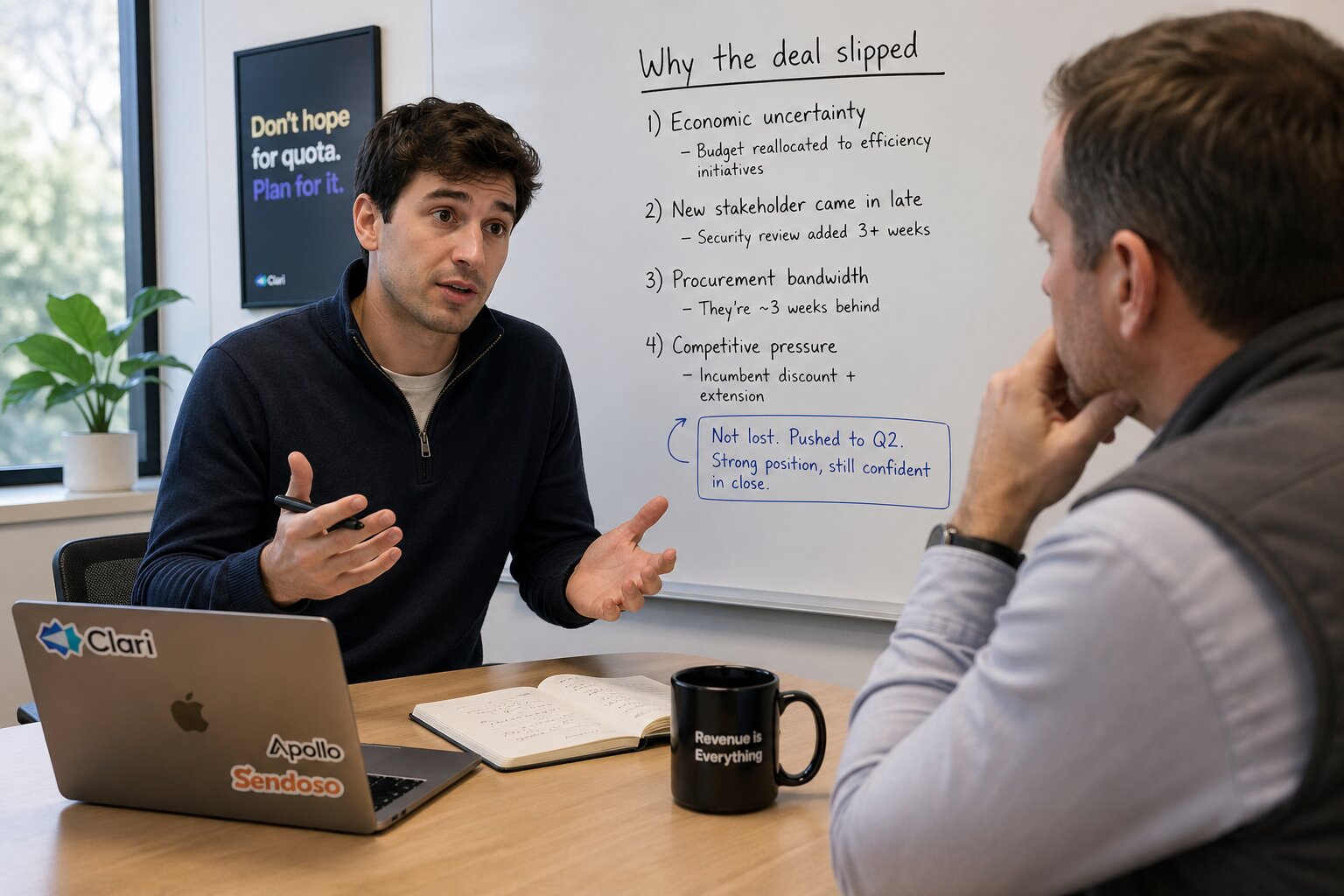
Once you accept that losses follow patterns, the next step is diagnosing exactly where in the deal those patterns take hold. In our experience, there are four consistent failure points.
Messaging drift: vague differentiation and copycat narratives
Most reps, when asked “why should a buyer choose us over [Competitor]?”, default to feature comparisons or generic claims: “We’re more flexible,” “Our platform is more modern,” “We have better support.”
None of that lands. Buyers hear the same claims from every vendor. When your messaging sounds like a slightly reworded version of what the competitor says, you’ve already lost the differentiation battle.
What works instead: positioning that names the specific tradeoff the buyer is making by choosing the competitor type. Not attacking them — reframing the decision around what matters most for the buyer’s specific situation.
Pricing confusion: discounting defensively vs. framing value
When a low-cost competitor enters the deal, the most common rep reaction is to discount. When an all-in-one platform enters, the reaction is to bundle more. Both are reactive moves that hand the competitor the pricing frame.
Mini-scenario: The CFO objection. Your champion tells you the CFO is pushing back because the competitor came in 40% cheaper. Your rep panics and offers a discount. But the real issue isn’t price — it’s that nobody built the business case for the cost of the competitor’s limitations. The CFO never saw the TCO comparison, the implementation risk, or the productivity gap. Your rep didn’t lose on price. They lost on pricing framing, and no discount will fix that.
Demos that reinforce the competitor’s story
This one is subtle and devastating. If the competitor is an all-in-one platform, and your demo walks through a checklist of features trying to prove you can match them, you’ve just validated their frame. You’re playing their game on their field.
Effective competitive demos don’t respond to the competitor’s narrative. They reframe the evaluation around the outcomes and workflows where your solution creates disproportionate value.
Objection handling as improv
Perhaps the most fixable failure point: reps handling competitive objections on the fly, with no tested playbook. Every rep invents their own response. Some are good. Most aren’t. And the organization never learns which responses actually work.
As Paul Towers, founder of Playwise HQ, puts it: “The gap between your best rep’s objection handling and your average rep’s is your biggest competitive vulnerability. That gap is a choice — you either close it with a system, or you accept the losses.”
Why Current Competitive Approaches Don’t Change Win Rates
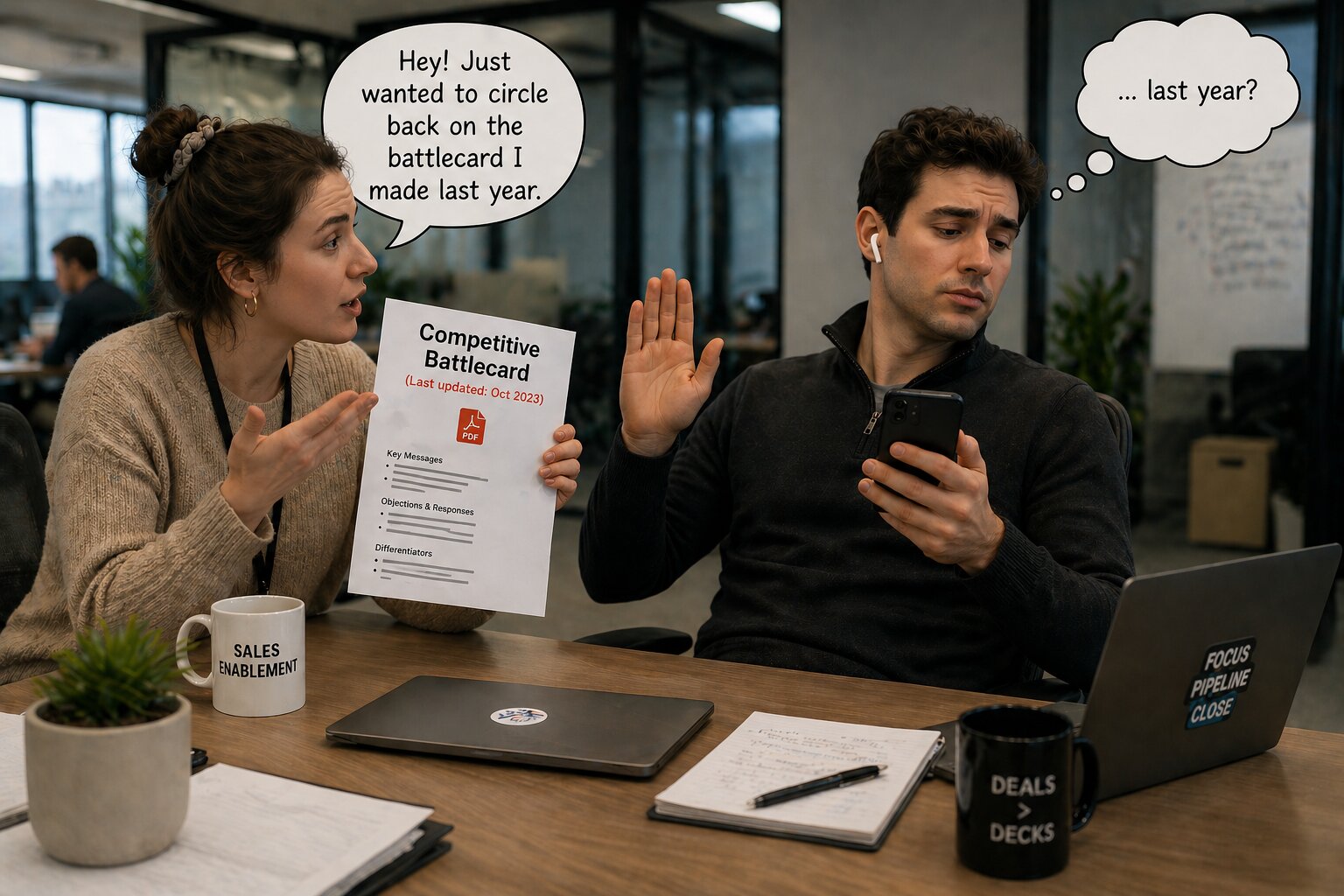
If you already have battlecards, CI reports, or competitive enablement sessions, you might be wondering why the patterns persist. The answer is usually structural.
Static battlecards that nobody opens
A Google Doc or Notion page with competitor information isn’t a battlecard, it’s a reference document. It sits in a folder, gets stale within weeks, and requires reps to leave their workflow to find it. Adoption craters because the content isn’t accessible at the moment of need.
One-off enablement with no reinforcement
A 45-minute competitive training session might spike awareness for a week. But without reinforcement, without the plays being embedded in daily deal execution, knowledge decays fast. By the time a rep faces the competitor in a live deal, they’ve forgotten most of what was covered.
CI reports that describe but don’t prescribe
Many CI programs produce excellent analysis: competitor product updates, pricing changes, market positioning shifts. But analysis without actionable guidance doesn’t change rep behavior. Knowing that a competitor launched a new feature is useless if the rep doesn’t know what to say when a buyer brings it up.
Tribal knowledge locked in top reps
Your best reps probably know how to beat the competitor. They’ve developed intuitions, talk tracks, and objection responses through experience. But that knowledge lives in their heads. It doesn’t scale. When they leave, it walks out the door with them.
The goal isn’t more information. It’s competitive execution infrastructure, plays that are tested, accessible, and continuously improved.
The Shift: From Static Intel to Real-Time Competitive Execution

Fixing the pattern requires a fundamental shift in how you think about competitive intelligence. It’s not a research function. It’s an execution capability.
Competitive deals as a repeatable, coachable motion
Every competitive deal against a specific competitor type should follow a known playbook, not a rigid script, but a structured set of moves that reps can adapt to context. This means:
- Pre-call preparation with competitor-specific talk tracks and landmines
- In-deal messaging calibrated to the stage and the buyer’s concerns
- Post-call debriefs that capture what worked and what didn’t
When you treat competitive deals as coachable motions, you stop relying on individual heroics and start building organizational muscle.
Every objection becomes a scripted, tested counterplay
The best competitive teams don’t just document objections — they test responses. They track which counterplays lead to next steps and which ones fall flat. Over time, this creates an objection handling playbook that reflects real-world effectiveness, not theoretical best practices.
Win/loss feedback loops as daily workflows
Most win/loss analysis happens quarterly, if at all. By then, the insights are stale and disconnected from active deals. The shift is to make feedback loops continuous — capturing what happened in every competitive deal and feeding it back into the plays within days, not months.
Frontline reps as co-creators
Your reps are on the front line of competitive intelligence. They hear what competitors are saying in demos, what buyers are confused about, what objections are surfacing. The best CI programs don’t just push content to reps — they pull insights from reps and integrate that field intelligence into the competitive playbook.
Designing Counterplays for a Specific Competitor Type
Let’s get practical. Here’s how to build a counterplay system for a specific competitor type, whether that’s the low-cost disruptor, the entrenched incumbent, or the all-in-one platform.
Step 1: Map the competitor type’s playbook
Before you can counter it, you need to understand it. For any competitor type, map these four dimensions:
| Dimension | What to Identify |
|---|---|
| Narrative | How do they position themselves? What story do they tell about the market and the buyer’s problem? |
| Proof | What evidence do they use? Case studies, logos, analyst rankings, free trials? |
| Pricing | How do they structure pricing to create advantage? Per-seat, usage-based, bundled, freemium? |
| Land & Expand | How do they get in the door? What’s their wedge, and how do they grow from there? |
Step 2: Build deal-stage-specific counter-narratives
Generic competitive messaging doesn’t work because buyer concerns shift at each deal stage. Your counterplays need to match:
- Discovery/Qualification: Frame the evaluation criteria before the competitor does. Plant questions that expose the competitor type’s weaknesses.
- Technical Evaluation: Shift the demo from feature parity to workflow impact. Show what the competitor can’t do in the context that matters most.
- Business Case/Pricing: Reframe the cost conversation around TCO, risk, and time-to-value — not unit price.
- Final Decision: Arm your champion with the internal narrative they need to defend choosing you.
Step 3: Template your objection handling
For each competitor type, document the top 5-7 objections your reps hear and build structured responses:
Example — “They’re cheaper” (Low-Cost Disruptor)
“That’s a fair point — [Competitor] does come in at a lower sticker price. What we’ve found is that teams who choose based on initial cost often face [specific hidden cost: implementation time, lack of support, feature limitations that require workarounds]. Can I share a quick comparison of what the first-year total cost typically looks like for teams in your situation?”
Mini-scenario: The Technical Evaluator. Your SE is in a deep-dive with a technical buyer who keeps referencing the competitor’s API documentation and integration breadth. Instead of trying to match every integration claim, the SE pivots: “I want to make sure we’re evaluating integrations that actually matter for your stack. Can you walk me through the three workflows that are most critical for your team in the first 90 days?” This reframes the conversation from breadth to relevance — and moves it onto ground where your solution excels.
Step 4: Build pricing frames that neutralize competitor positioning
Different competitor types require different pricing frames:
- Against low-cost disruptors: TCO analysis, cost-of-switching-later, and productivity gap calculations
- Against incumbents: Cost of inaction, opportunity cost of staying with a declining platform, and migration support as a value-add
- Against all-in-one platforms: Best-of-breed ROI, the cost of unused features, and the risk of vendor lock-in
How Playwise HQ Operationalizes These Counterplays in Real Time
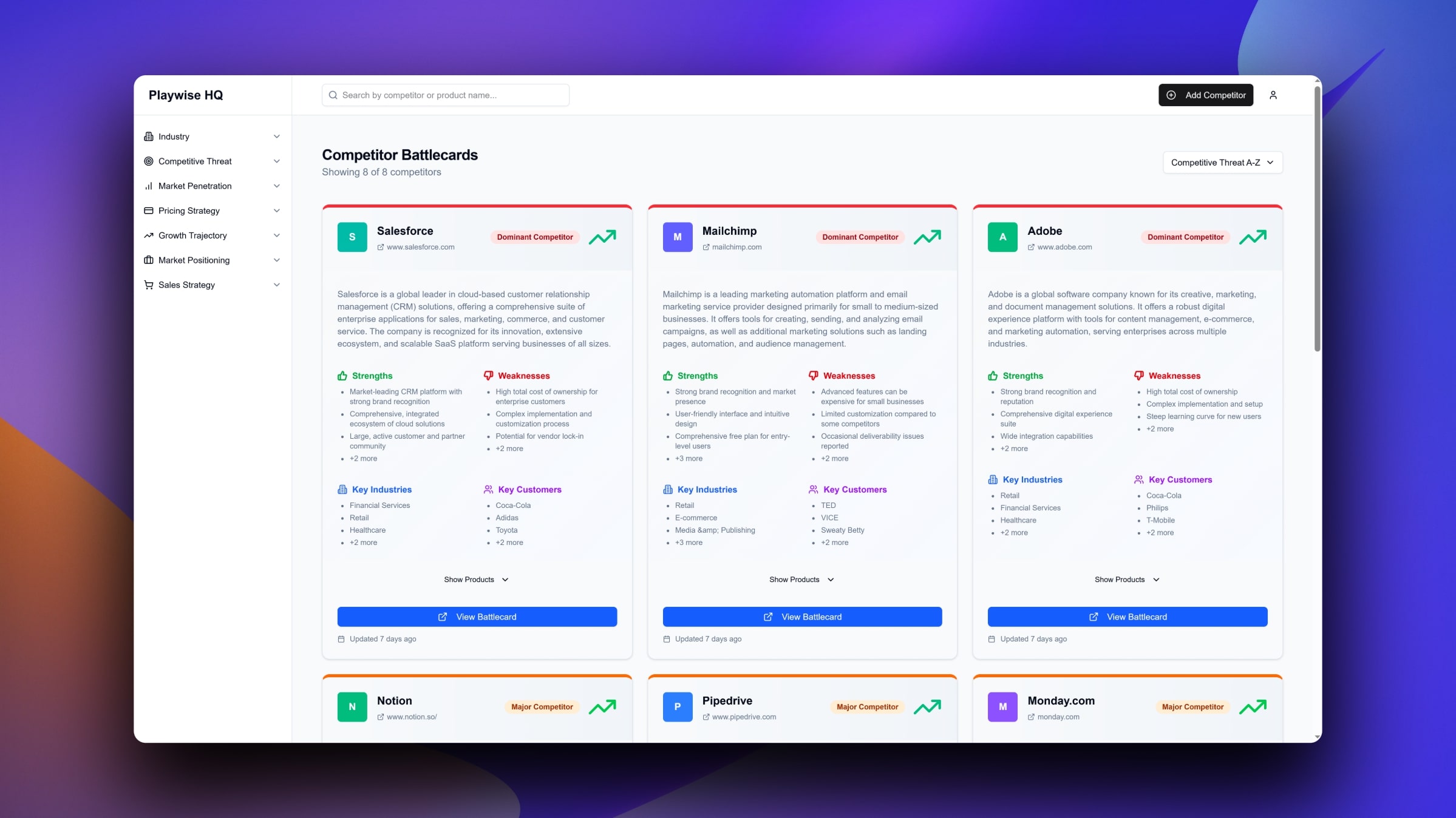
Building counterplays is one thing. Getting them into reps’ hands at the right moment, and keeping them current, is the operational challenge most teams fail to solve.
Battlecards that mirror real conversations
Playwise HQ’s battlecard builder is designed around how reps actually sell, not how analysts think about competitors. Cards are structured around objections, talk tracks, pricing frames, and proof points, the things reps need in the moment, not feature comparison grids they’ll never reference.
Real-time updates when competitors shift
Competitors change pricing, launch features, and adjust messaging constantly. Static documents can’t keep up. Playwise HQ’s real-time update and alert system ensures that when a competitor type shifts their playbook, your counterplays evolve with it, and reps are notified before their next competitive call, not after they’ve already lost.
Seller feedback loops that refine plays continuously
After every competitive call, reps can log which counterplays they used, what objections surfaced, and what worked. This creates a continuous improvement cycle where your competitive playbook gets sharper with every deal, not just when someone remembers to update a document.
Usage insights that prove what works
Not all counterplays are created equal. Playwise HQ’s analytics show which battlecards and plays are being used most, which correlate with higher win rates, and which are being ignored. This lets you measure the actual impact of your competitive intel and double down on what moves the needle.
Practical Usage: What Top Teams Do Differently in Live Deals
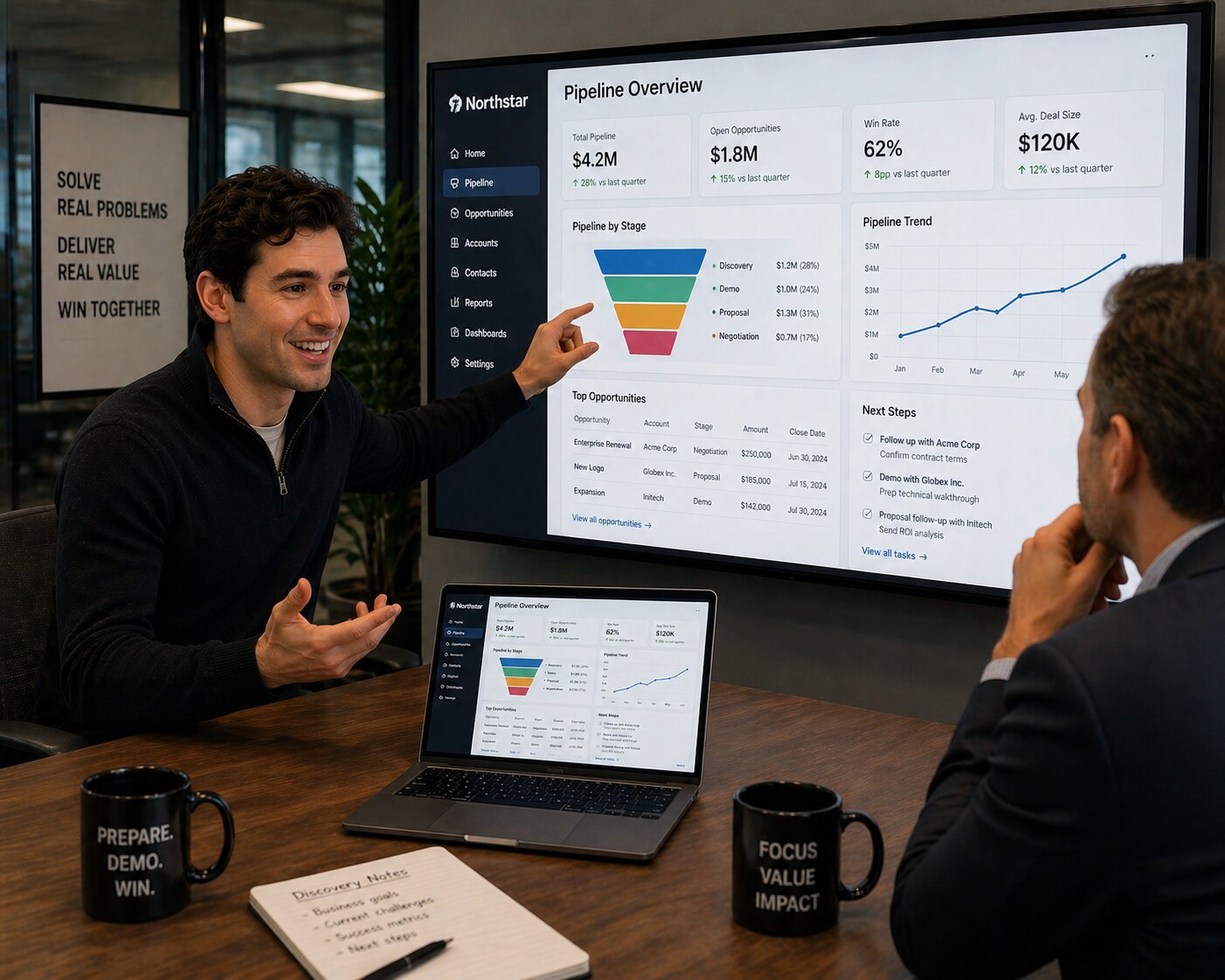
The difference between teams that consistently beat a competitor type and teams that keep losing to them isn’t knowledge, it’s workflow integration. Here’s what the best teams do at each stage of a competitive deal.
Before calls
- Read the competitor-specific battlecards
- Review the top 3 objections and tested counterplays for the current deal stage
- Identify 1-2 landmine questions to plant that expose the competitor’s weaknesses
- Check for any recent competitor updates or pricing changes
During calls
- Reference in-the-moment prompts for objections as they surface
- Use proof points and customer stories that directly counter the competitor’s narrative
- Frame pricing proactively rather than waiting for the buyer to raise it
After calls
- Log which objections came up and which counterplays were used
- Note any new competitor claims or tactics that weren’t in the current battlecard
- Flag whether the counterplay worked, partially worked, or fell flat
Reviewing lost deals
- Run structured post-mortems that identify where the competitor’s playbook won
- Turn recurring failure patterns into new battlecard sections and counterplays
- Share learnings across the team within days, not quarters
What to Implement This Month
If you’re ready to stop losing to a specific competitor type, here’s a focused checklist to get started:
- [ ] Identify your #1 competitor type by loss volume and revenue impact
- [ ] Pull 10 recent losses to that competitor type and look for stage-specific patterns
- [ ] Map the competitor’s playbook across narrative, proof, pricing, and land/expand
- [ ] Document the top 5 objections reps hear from buyers evaluating that competitor
- [ ] Build tested counterplays for each objection with specific language, not bullet points
- [ ] Create deal-stage-specific talk tracks for discovery, evaluation, pricing, and close
- [ ] Establish a feedback loop where reps log competitive call outcomes weekly
- [ ] Set a 30-day review cycle to update plays based on what’s working and what isn’t
- [ ] Measure battlecard adoption — if reps aren’t using the plays, diagnose why
- [ ] Share one competitive win story per week to reinforce the new playbook
Common Pitfalls to Avoid
Even teams that commit to building counterplays often stumble on execution. Watch for these:
- Over-engineering the first battlecard. Perfection is the enemy of adoption. Ship a “good enough” card with the top 5 objections and iterate from there.
- Building for analysts, not reps. If your battlecard reads like a market research report, reps won’t use it. Every section should answer: “What do I say when…?”
- Ignoring the pricing frame. Most teams spend 80% of their competitive effort on features and 20% on pricing. Buyers often decide the other way around.
- No governance or ownership. A battlecard without a named owner and a review cadence will be stale within 60 days. Assign ownership and schedule updates.
- Treating all competitors the same. A low-cost disruptor and an entrenched incumbent require fundamentally different counterplay strategies. Generic competitive content helps no one.
As Paul Towers notes: “The teams that win consistently against a competitor type aren’t the ones with the most intel. They’re the ones who’ve turned that intel into muscle memory across the entire sales floor.”
Strategic Impact: From “We Keep Losing to Them” to “We Know This Game”
When you operationalize counterplays against a specific competitor type, the impact compounds over time:
- Cleaner competitive qualification. Reps recognize the competitor’s playbook earlier and qualify deals more accurately — spending time on winnable opportunities instead of grinding through deals where the frame was set before they arrived.
- Higher head-to-head win rates. Teams that run structured counterplays against a specific competitor type typically see measurable win rate lifts within 1-2 quarters.
- Consistent execution across all reps. The gap between your best rep and your newest rep shrinks dramatically when both are working from the same tested playbook.
- A competitive playbook that compounds. Every deal — won or lost — feeds back into the system. Your counterplays get sharper, your objection handling gets tighter, and your team gets harder to beat.
This is the difference between a team that reacts to competitors and a team that systematically dismantles their playbook.
Stop Treating Competitive Losses as One-Offs
If you keep losing to the same competitor type, it’s not a series of unfortunate events. It’s a pattern — and patterns are fixable.
The fix isn’t more effort, bigger discounts, or louder messaging. It’s structured competitive execution: mapping the competitor’s playbook, building deal-stage counterplays, arming every rep with tested responses, and continuously improving based on real outcomes.
This is what Playwise HQ is built for — turning competitive intelligence from a static research artifact into a living, breathing execution system that helps your team win the deals that matter most.
Ready to stop losing to your #1 competitor type? Book a demo and we’ll walk through how to build your first counterplay system — from pattern diagnosis to live deal execution.