
You just landed the competitive intelligence role. Congratulations – and good luck.
That’s not sarcasm. It’s a genuine acknowledgment of what you’re walking into. As a new CI manager in an enterprise sales organization, you’ve inherited a mandate that sounds deceptively simple: help reps win more deals against the competition. But the reality is messier. You’ll find scattered Google Docs masquerading as battlecards, tribal knowledge locked in the heads of a few veteran reps, and a leadership team that expects measurable impact… fast.
The difference between CI managers who build lasting programs and those who get buried under ad-hoc requests comes down to one thing: a structured plan for the first 90 days. Not a vague “get up to speed” timeline, but a deliberate, phased approach that builds credibility, delivers quick wins, and creates the infrastructure for long-term revenue influence.
This is that plan.
“Most new CI managers make the mistake of trying to boil the ocean in their first month,” says Paul Towers, Founder and CEO of Playwise HQ. “The ones who succeed treat their first 90 days like a product launch – phased, prioritized, and obsessively focused on what sellers actually need to close deals.”
What follows is a comprehensive 30-60-90 day framework designed for CI managers joining enterprise sales organizations. It covers everything from stakeholder alignment and governance design to battlecard creation, getting sales on board, and analytics. Whether you’re building a CI function from scratch or inheriting an underperforming program, this plan will help you move from onboarding to measurable revenue impact in three months.
Setting the Foundation (Days 0–30): Onboarding, Discovery & CI Governance Basics

Your first 30 days aren’t about producing deliverables. They’re about understanding the landscape, earning trust, and designing the operating model that everything else will run on. Resist the urge to start building battlecards immediately. The intelligence you gather about your own organization during this phase is what makes everything in months two and three actually land.
Clarify Your CI Charter and Success Metrics
Before you create a single asset, get crystal clear on what your role actually owns. Competitive intelligence can mean wildly different things depending on who you ask. Your CRO wants deal support. Product marketing wants positioning validation. RevOps wants data. Enablement wants content.
Start by defining your remit explicitly:
- Competitive insights (battlecards, competitor profiles, differentiation narratives)
- Market intelligence (industry trends, analyst reports, market shifts)
- Deal support (live deal competitive coaching, objection handling, RFP assistance)
You probably can’t own all three equally from day one. Have direct conversations with your CRO, VP of Sales Enablement, Head of Product Marketing, and RevOps lead to align on where CI will have the highest initial impact.
Then establish your KPIs. These should be concrete and tied to revenue outcomes:
- Win-rate lift against key competitors
- Battlecard usage rate across the sales team
- Time-to-insight (how quickly reps can access competitive guidance)
- Seller satisfaction scores on CI content quality and relevance
“If your CI KPIs don’t connect directly to pipeline velocity or win rates, you’re measuring activity, not impact,” notes Paul Towers. “The best CI programs are accountable to the same numbers the sales team lives and dies by.”
Understand the GTM Motion and Current Sales Reality
You can’t build effective competitive intelligence without deeply understanding how your company sells. Spend meaningful time in the first two weeks mapping:
- Core sales motions: What segments do you serve? What are typical deal sizes? How long are sales cycles? What does the stage progression look like?
- Top competitors by context: Which competitors show up most in enterprise deals vs. mid-market? Which ones are regional threats? Which emerge only at specific deal stages?
- Existing competitive assets: Audit everything. Every Google Doc, Confluence page, Slack channel, and “competitive cheat sheet” that’s floating around. You’ll likely find a mix of outdated gold and dangerous misinformation.
Shadow at least 5-10 sales calls during this period. Sit in on pipeline reviews. Read recent win/loss notes. The goal is to understand not just who you compete against, but how those competitive dynamics actually play out in live conversations.
Design CI Governance and Workflows From Day One
This is the step most new CI managers skip — and it’s the one that determines whether your program scales or collapses under its own weight.
Governance doesn’t need to be bureaucratic. It needs to be clear. Define:
- Ownership model: Who creates battlecards? Who reviews them? Who’s responsible for keeping them current? (Hint: it shouldn’t all be you.)
- Source standards: What qualifies as credible intelligence? How do you validate field reports vs. competitor marketing claims vs. analyst data?
- Update frequency: How often are battlecards reviewed? What triggers an out-of-cycle update?
- Intake process: How do reps submit competitive intel from the field? How do stakeholders request new battlecards or updates?
A simple intake form and a lightweight review workflow will save you hundreds of hours of reactive firefighting later. Understanding why battlecards go stale early in your tenure helps you design processes that prevent it.
Centralize Your Tooling and Infrastructure
If your competitive intelligence lives in scattered documents, slides, and Slack threads, adoption will never happen at scale. One of your most important first-month decisions is choosing how to centralize your CI program.
At minimum, you need:
- A single source of truth for all competitive content
- Search and categorization so reps can find what they need in seconds
- Version control so you always know what’s current
- Access controls so sensitive intelligence is appropriately gated
You can start with a structured Notion workspace or a free battlecard template to get moving quickly. But if you’re building for an a proper sales team, evaluate purpose-built platforms like Playwise HQ early — even if full deployment comes in month two or three. The architecture decisions you make now will either enable or constrain everything that follows.
Building the First Scalable Battlecards (Days 31–60): From Insights to Seller-Ready Assets
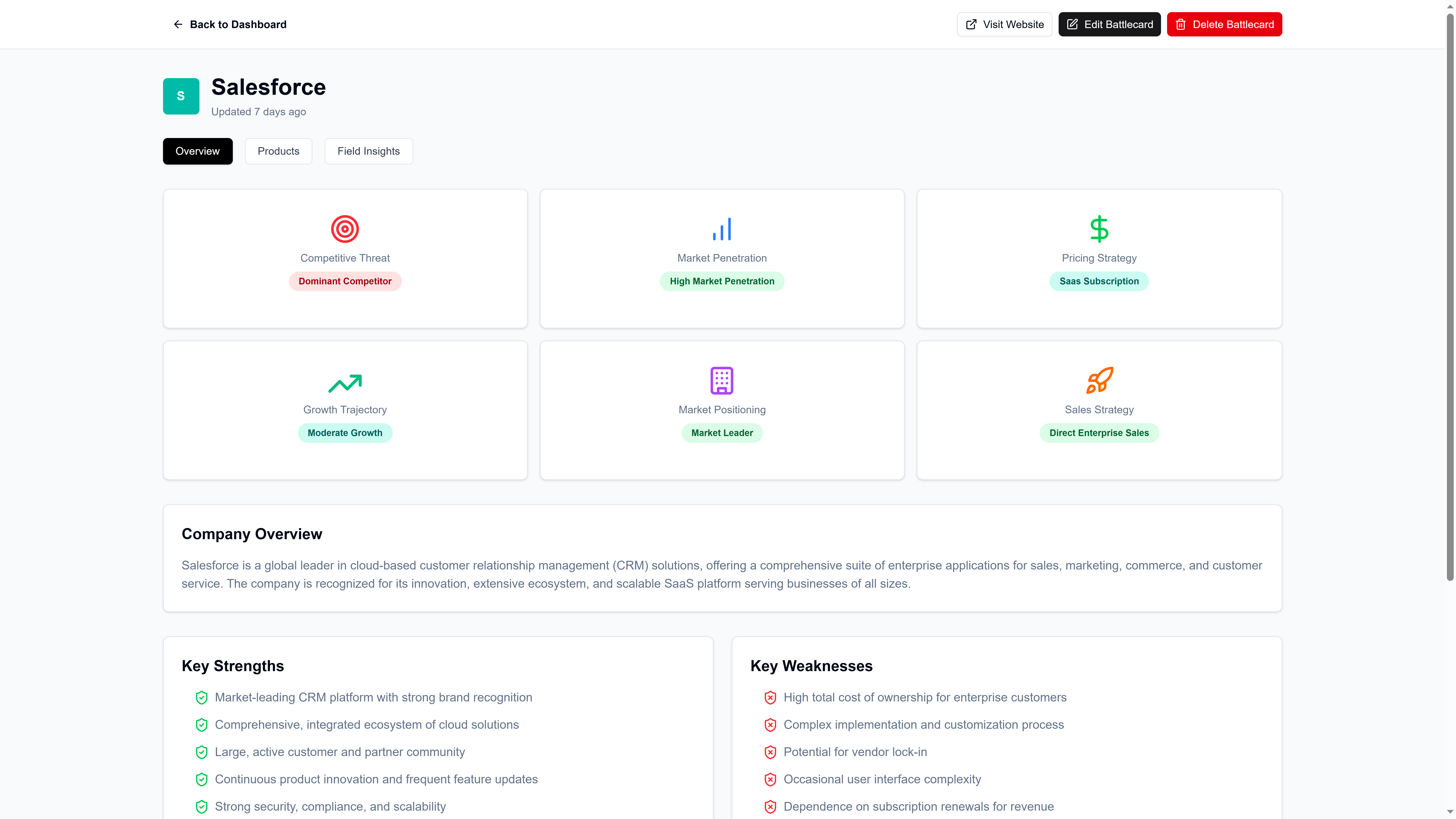
With your foundation set, month two is where you start producing tangible value. The goal is clear: launch your first set of high-impact battlecards that reps actually use in real deals.
Prioritize Your First Battlecards for Quick Wins
You don’t need to cover every competitor on day 31. You need to cover the right ones.
Work with sales leadership to identify 3-5 competitors based on:
- Deal volume: Which competitors appear most frequently in your pipeline?
- Deal risk: Which competitors are you losing to disproportionately?
- Revenue impact: Where would a 5-point win-rate improvement move the needle most?
Mini-scenario: The pricing objection that keeps killing deals. Imagine your top competitor just launched an aggressive bundling strategy. Your enterprise AEs are hearing “Competitor X gives us the full platform for 30% less” in nearly every negotiation. This is your first battlecard priority — not because it’s the most interesting research project, but because it’s costing you revenue right now. Your battlecard needs to reframe the pricing conversation around total cost of ownership, implementation risk, and value realization timelines.
“The best first battlecard isn’t about the biggest competitor, it’s about the competitor that’s costing you the most deals this quarter,” says Paul Towers. “Start where the pain is sharpest.”
Structure Battlecards for Enterprise Sales Teams
A battlecard is not a competitor profile. It’s a decision-support tool for a seller in a live conversation. Every section should answer the question: “What do I say or do when this comes up in a deal?”
Core sections for enterprise battlecards:
- Positioning statement: How to frame your solution vs. this competitor in 30 seconds
- Key differentiators: 3-5 defensible advantages with proof points
- Landmines: Questions to plant early that expose competitor weaknesses
- Objection handling: Specific rebuttals for the most common competitor claims
- Pricing framing: How to navigate pricing comparisons without discounting
- Proof points: Customer stories, benchmarks, or data that validate your position
Standardize the format across all battlecards. Reps shouldn’t have to learn a new layout for each competitor.
Playwise HQ’s AI-powered battlecard builder can accelerate this process significantly, giving you structured templates and AI-assisted content generation so you’re not starting from a blank page.
Create a Centralized CI Repository and Content Taxonomy
As you build battlecards, simultaneously build the system that organizes them. Design a taxonomy that maps to how your sales team thinks:
- By competitor (obviously)
- By vertical or industry (healthcare, financial services, manufacturing)
- By product line (if you have multiple products)
Implement versioning from the start. Every battlecard should have a “last reviewed” date, an owner, and clear sunset criteria for when intelligence is too old to trust. Link source materials — analyst reports, call recordings, win/loss summaries — directly to the relevant battlecard sections so reviewers can validate and reps can go deeper when needed.
Launch and Enable: Getting Sales to Adopt Early Battlecards
Building great battlecards that no one uses is the most common failure mode in competitive intelligence. Driving battlecard adoption requires deliberate enablement, not just a Slack announcement.
Partner with your Enablement team to:
- Run focused training sessions on each new battlecard (15-20 minutes, not hour-long lectures)
- Host “office hours” where reps can bring live deal scenarios and get competitive coaching
- Facilitate win/loss debrief sessions that both inform future battlecards and demonstrate the value of CI
Collect feedback aggressively. Ask reps: Is this useful? What’s missing? What objection did you hear that we didn’t cover? This feedback loop is what transforms your battlecards from “pretty good” to “indispensable.”
Operationalizing CI Workflows (Days 31–60): Real-Time Updates & Cross-Functional Collaboration

Simultaneously with battlecard creation, month two is when you operationalize the workflows that keep your CI program alive and responsive.
Implement Real-Time Competitive Updates and Alerting
Static battlecards are dead battlecards. Your competitors are making moves constantly — new features, pricing changes, leadership hires, partnership announcements — and your sales team needs to know what those moves mean for their deals.
Set up monitoring for:
- Competitor product releases and feature announcements
- Pricing and packaging changes
- Key executive hires or departures
- New customer logos or case studies
- Analyst reports and review site changes
But raw alerts aren’t enough. The magic is in translation. Every update should be framed by asking “what this means for your deals”. A competitor launching a new integration isn’t just news — it’s a signal that your AEs might hear about it in their next call, and they need a response ready.
Create a simple cadence: weekly competitive digests for general awareness, and just-in-time alerts for deal-critical changes.
Build Cross-Functional Collaboration Loops
CI doesn’t work in isolation. Your most valuable intelligence often comes from the field, and your most impactful outputs require input from multiple teams.
Mini-scenario: The technical evaluator who’s already sold on a competitor. Your SE joins a technical evaluation call and realizes the prospect’s infrastructure team has already done a proof-of-concept with a competitor. The SE captures this intel — the specific technical criteria the competitor met, the concerns the prospect still has, and the integration requirements that weren’t fully addressed. Through a structured feedback mechanism, this field intelligence flows back to the CI team, gets validated, and becomes a new section in the battlecard: “How to win when the prospect has already POC’d with Competitor Y.”
This kind of collaboration requires:
- Clear intake channels for field intel (not just “DM the CI person on Slack”)
- Review workflows where SEs and product experts validate technical claims
- Commenting and feedback loops that let contributors see how their input shaped the final content
Formalize CI Intake and Prioritization
By the middle of month two, you’ll start getting more requests than you can handle. This is a good sign — it means people are paying attention. But without a prioritization framework, you’ll drown.
Create a simple triage system:
| Priority | Type | SLA | Example |
|---|---|---|---|
| P1 | Live deal support | 4-8 hours | “We’re in a bake-off with Competitor X, final presentation is Thursday” |
| P2 | Battlecard update | 1 week | “Competitor Y changed their pricing model” |
| P3 | Strategic research | 2-3 weeks | “We’re entering a new market — who are the players?” |
Communicate clearly what CI will and won’t own. You’re not the team’s personal research assistant. You’re a strategic function that accelerates revenue.
Integrate CI Into Existing Sales Processes
Don’t create new meetings. Insert CI into the rituals that already exist:
- Pipeline reviews: Add a “competitive landscape” check for each major opportunity
- Forecast calls: Flag deals where competitive dynamics create risk
- Deal strategy sessions: Use battlecards as a standard input for account planning
- QBRs: Present competitive trends and their impact on territory strategy
“CI that lives outside the sales rhythm will always be an afterthought,” says Paul Towers. “The goal is to make competitive intelligence as natural a part of deal execution as updating your CRM.”
Scaling Impact (Days 61–90): Analytics and Program Maturity

Month three is about scaling what works, measuring what matters, and building the infrastructure for long-term program maturity.
Use Analytics to Measure Adoption and Win-Rate Impact
You can’t improve what you don’t measure, and you can’t justify CI investment without data. By day 61, you should have enough usage data to establish baselines.
Track:
- Battlecard views by rep, team, and segment: Who’s using them? Who isn’t?
- Usage by competitor: Which battlecards get the most traffic? Which are ignored?
- Correlation with outcomes: Do deals where battlecards were accessed have higher win rates?
- Feedback scores: Are reps rating the content as useful?
Understanding competitive intelligence ROI isn’t just about justifying your headcount — it’s about knowing where to invest your limited time for maximum revenue impact.
“The CI managers who thrive long-term are the ones who can walk into a leadership meeting and say, ‘Reps who used our battlecards won 12% more often against Competitor X this quarter,'” says Paul Towers. “That’s not a nice-to-have. That’s a revenue story.”
Expand Your Battlecard Program and CI Coverage
With your initial battlecards proving value, it’s time to expand coverage systematically:
- Tier 1 competitors (top 3-5): Full battlecards with deep positioning, objection handling, and technical differentiation. Updated monthly.
- Tier 2 competitors (next 5-10): Focused battlecards covering positioning and key differentiators. Updated quarterly.
- Tier 3 competitors (emerging/niche): Lightweight profiles with basic positioning. Updated as needed.
Beyond expanding competitor coverage, consider specialized content:
- Vertical-specific battlecards: How does competitive positioning shift in healthcare vs. financial services?
- Persona-specific content: What does the CFO care about vs. the technical evaluator?
- Multi-vendor bake-off guides: How to win when you’re one of three finalists
Mature CI Governance and Operating Rhythm
By day 90, your CI program should have a predictable operating rhythm:
- Weekly: Competitive digest published, urgent alerts triaged
- Monthly: Tier 1 battlecard review cycle, usage analytics review
- Quarterly: CI roadmap aligned to GTM strategy, executive scorecard presented, Tier 2 battlecard refresh
Formalize ownership for each battlecard. Assign a primary owner (usually you or a CI analyst) and a subject matter expert (usually from product marketing or solutions engineering) who validates content accuracy.
Communicate impact to executives with concise scorecards: battlecard adoption rates, win-rate trends against key competitors, and qualitative stories from the field about deals won because of CI support.
Common Pitfalls for New CI Managers (and How the 30-60-90 Plan Prevents Them)

Every pitfall below is something the structured approach above is designed to prevent:
Over-focusing on research vs. sales outcomes. It’s tempting to spend weeks building comprehensive competitor profiles. But if those profiles don’t translate into seller-ready guidance, they’re academic exercises. The 30-60-90 plan forces you to prioritize by deal impact, not intellectual curiosity.
Creating battlecards that live in static docs and never get used. If your battlecards exist in a Google Drive folder, adoption will be single digits.
Allowing intel sprawl without a centralized repository. Without a single source of truth, you end up with five versions of the same battlecard and no one knows which is current. Centralizing in month one prevents this entirely.
Inconsistent updates leading to stale or conflicting guidance. A rep who uses an outdated battlecard and gets burned in a deal will never trust CI again. The governance framework and update cadence built into the plan keeps content fresh.
“The number one reason CI programs fail isn’t bad intelligence — it’s bad distribution,” says Paul Towers. “You can have the most brilliant competitive analysis in the world, but if it’s sitting in a folder no rep ever opens, it’s worth nothing.”
Example 30-60-90 Day Competitive Intelligence Plan (Template)
Days 0–30: Foundation
- [ ] Complete stakeholder interviews (CRO, VP Sales, Enablement, PMM, RevOps)
- [ ] Define CI charter, scope, and success metrics
- [ ] Map GTM motion: segments, deal sizes, sales stages, top competitors
- [ ] Audit all existing competitive assets and tribal knowledge
- [ ] Design governance model: ownership, source standards, update cadence
- [ ] Create intake process for field intel and competitive requests
- [ ] Evaluate and select CI platform for centralized repository
- [ ] Shadow 5-10 sales calls and attend 2-3 pipeline reviews
Days 31–60: Build & Operationalize
- [ ] Launch 3-5 Tier 1 competitor battlecards
- [ ] Establish centralized CI repository with taxonomy and versioning
- [ ] Deliver first enablement sessions and battlecard training
- [ ] Set up competitive monitoring and alerting
- [ ] Implement field intel feedback loop
- [ ] Formalize intake prioritization framework (P1/P2/P3)
- [ ] Host first “office hours” and win/loss debrief sessions
- [ ] Insert CI touchpoints into pipeline reviews and deal strategy sessions
Days 61–90: Scale & Measure
- [ ] Establish analytics baseline: usage, adoption, win-rate correlation
- [ ] Expand to Tier 2 competitor coverage
- [ ] Create first executive CI scorecard
- [ ] Formalize quarterly CI roadmap aligned to GTM strategy
- [ ] Assign battlecard owners and review cycles for all Tier 1 content
- [ ] Collect and synthesize rep feedback for next iteration
- [ ] Present 90-day impact report to leadership
Adapting for Company Stage
Startups and early-stage companies: Compress the timeline. You may not need formal governance in month one — focus on getting 2-3 high-impact battlecards into reps’ hands immediately. Use lightweight tools and templates to move fast, then formalize as you scale.
Enterprise organizations: Expect longer stakeholder alignment cycles. Invest more time in month one on cross-functional buy-in and governance design. The political landscape matters — identify your champions early and let them amplify your work.
Turning Competitive Intelligence Into a Revenue Engine
The first 90 days of a CI manager’s tenure set the trajectory for everything that follows. A structured 30-60-90 day plan isn’t just a nice onboarding framework — it’s the difference between building a CI program that drives measurable revenue impact and one that gets deprioritized at the next budget review.
Here’s what the plan delivers when executed well:
- Days 0-30: You understand the business, earn stakeholder trust, and design the operating model.
- Days 31-60: You deliver tangible value with high-impact battlecards and operational workflows.
- Days 61-90: You scale through analytics, and expanded coverage — proving ROI with data.
The throughline is clear: centralized battlecards, real-time updates, and cross-functional collaboration transform competitive intelligence from a back-office research function into a front-line revenue accelerator.
Your next step is straightforward. Take this framework, adapt it to your organization’s specific context, and start executing. And if you’re looking for a platform purpose-built to power a scalable, adoption-first battlecard program — book a demo with Playwise HQ to see how it fits into your 30-60-90 day plan.
The competition isn’t waiting. Neither should you.