
The prospect just mentioned your biggest competitor. Your sales rep has maybe 10 seconds to respond with something better than “let me get back to you on that.”
This is the moment your battlecard either earns its existence or proves its irrelevance.
Competitive deals have become the default in B2B sales. When more than 70% of deals involve active competition, every sales conversation is a potential battleground. The question isn’t whether competitors will come up – it’s whether your rep can handle it when they do.
Here’s the uncomfortable truth: most battlecards fail this test. Not because the intelligence is wrong, but because the format prevents reps from finding what they need fast enough to matter.
“I’ve watched reps scroll through 12-page battlecard PDFs while a prospect waits for an answer,” says Paul Towers, Founder and CEO of Playwise HQ. “By the time they find the right objection response, the conversation has moved on. They wing it, the prospect senses hesitation, and we lose another deal we should have won.”
The single-page versus multi-page battlecard debate isn’t cosmetic. It directly impacts whether your competitive intelligence actually gets used when deals are on the line.
Why Battlecard Length Matters More Than Most Teams Realize
Battlecards serve one purpose: helping reps compete in critical selling moments. They’re not research reports for strategic planning. They exist to deliver the right competitive intel at the exact moment a rep needs it.
This context changes everything about how you think about battlecard format.
The 10-Second Decision
When a competitor comes up mid-call, reps make an instant judgment: will this battlecard help me right now, or should I improvise?
That decision happens in roughly 10 seconds. If they can’t immediately see that the battlecard will solve their problem, they abandon it. They’ll guess. They’ll deflect. They’ll promise to “circle back” and hope the prospect forgets they asked.
“Reps aren’t reading battlecards – they’re scanning them,” explains Towers. “Every second they spend debating a response in their mind is a second the prospect is waiting, wondering if your rep actually knows how to compete against their other option.”
The Confidence Gap
Long battlecards create a specific psychological problem: hesitation.
When a rep opens a document and sees walls of text, dense paragraphs, and page after page of content, their confidence drops. Instead of feeling prepared, they feel overwhelmed. The battlecard that was supposed to help them compete has become one more thing to navigate under pressure.
This hesitation is visible to prospects. It creates doubt about whether your rep, and by extension, your company, really understands the competitive landscape.
Where do reps turn when battlecards fail them?
- Tribal knowledge: whatever they remember from that one deal six months ago
- Slack messages: scrolling through chat history looking for someone else’s answer
- Improvisation: making something up that sounds plausible
None of these approaches win competitive deals consistently.
What Makes Any Battlecard Great (Regardless of Length)
Before choosing single-page or multi-page, the fundamentals must be right. Format can’t fix broken content, and brilliant content trapped in poor format still fails.
Principle 1: Speed Beats Completeness
Having five usable insights beats having fifty buried ones.
Every piece of information in a battlecard should pass a simple test: could a rep use this on a live call? If the answer is “maybe, in the right situation, if they had time to think about it,” cut it. Battlecards need content that’s immediately actionable, not potentially useful.
This is the hardest principle for competitive intelligence teams to accept. After weeks of research and analysis, cutting content feels like waste. But unused content is waste – it just lives in your battlecard instead of your trash folder.
Principle 2: Structure Drives Adoption
Consistent structure across all battlecards accelerates usage. When every competitor battlecard follows the same pattern, reps learn the format once and apply it everywhere.
Core sections every battlecard needs:
- Overview: Who is this competitor and what’s their positioning?
- Differentiators (Strengths/Weaknesses): Why should prospects choose you instead?
- Objections: What will prospects say, and how should reps respond?
- Win/Loss Patterns: What actually wins or loses deals against this competitor?
- Proof Points: What evidence backs up your claims?
“Consistency is a force multiplier,” notes Towers. “When a rep knows that objection responses are always in the same place across every battlecard, they can navigate any competitor in seconds. That predictability builds confidence.”
Principle 3: Build for Scanning, Not Reading
Visual hierarchy determines usability. Under pressure, reps scan—they don’t read paragraphs.
Effective battlecard formatting includes:
- Clear section headers that make structure visible at a glance
- Short content blocks instead of dense paragraphs
- Talk tracks formatted as actual language reps can say out loud
- Visual separation between different types of information
The “squint test” reveals whether your design works: if you squint at your battlecard and can’t see the structure, reps won’t find information fast enough.
Principle 4: Currency Is Non-Negotiable
Outdated intel is worse than no intel.
When reps cite competitor pricing that changed three months ago, they don’t just lose credibility on that point. The prospect questions everything else they’ve said. Static documents decay immediately—and in fast-moving markets, “decay” can mean weeks, not months.
This is where traditional battlecard approaches break down. PDF battlecards are frozen in time from the moment they’re published. Every day that passes, they become slightly less accurate, slightly less useful, slightly more dangerous.
Single-Page Battlecards: When They Work Best
The single-page battlecard has earned its reputation for good reason: it forces ruthless prioritization. When you can’t scroll, you can’t hide mediocre content in the margins.
The Power of Constraint
One page means every word must earn its space. There’s no room for company history that doesn’t help close deals. No space for feature matrices that prospects don’t actually compare. No margin for “nice to have” intelligence that “might come up.”
This constraint produces battlecards that are:
- Easy to scan before or during calls
- Simple to maintain because there’s less content to update
- More likely to be used because they don’t overwhelm
“The one-page constraint is actually a gift,” says Towers. “It forces teams to answer the question: what do reps absolutely need to know about this competitor? Everything else is noise.”
When Single-Page Works Best
Single-page battlecards excel in specific scenarios:
- Fast-moving sales teams with high call volumes and limited prep time
- SMB competitors with straightforward positioning and limited product complexity
- High-level positioning battles where differentiation is clear-cut
- New reps who need quick wins without information overload
The One-Page Rule: What Actually Fits
A great single-page battlecard includes only:
- Competitor positioning summary (2-3 sentences)
- 3-5 key strengths (acknowledged honestly)
- 3-5 key weaknesses (specific and provable)
- Core differentiators (what actually matters to your buyers)
- Top objections with responses (the 3-4 that come up most)
- 1-2 proof points (specific customer outcomes)
Notice what’s not on this list: comprehensive feature comparisons, detailed company history, market analysis, exhaustive objection libraries. That content has value – but not on a single-page battlecard.
The Font Size Test
Here’s a simple diagnostic: if you need size 9 font to fit everything on one page, you’ve already failed.
Shrinking text to pack in more content defeats the purpose. Reps won’t squint to read battlecards during calls. The solution is never smaller fonts—it’s less content.
“Cut content, don’t compress it,” advises Towers. “If something doesn’t fit, that’s the battlecard telling you it doesn’t belong. Listen to it.”
Multi-Page Battlecards: When They Become a Problem
The traditional multi-page battlecard has a failure mode that’s depressingly common: teams build 10-page “competitive research reports” disguised as sales tools.
The Competitive Research Report Problem
These documents look impressive. They demonstrate thorough analysis. They satisfy stakeholders who want to see comprehensive intelligence gathering.
They also don’t get used.
Multi-page battlecard failures share predictable characteristics:
- Reps can’t search fast enough: When a competitor comes up, there’s no time to scan through multiple pages
- Information gets buried: Critical objection responses hide on page 7, where nobody looks
- Adoption collapses over time: Reps try it once, can’t find what they need, and never open it again
“Long documents feel like homework,” observes Towers. “Reps have enough to do without reading a thesis on every competitor. When battlecards become reading assignments, they become unused assignments.”
The Real-Time Search Failure
The fundamental problem with multi-page PDFs is search speed.
PDF search is slow. Scrolling is slow. Finding the right section on page 4 of 12 is slow. Every second of slowness is a second the prospect is waiting, a second confidence is dropping, a second the competitive moment is slipping away.
When battlecards can’t keep pace with conversation speed, reps abandon them for improvisation.
When Multi-Page Can Work
Multi-page battlecards aren’t inherently broken – but they require specific conditions to succeed:
- Pages are modular: Each page has a distinct, clear purpose
- Navigation is instant: Reps can jump to specific sections without scrolling
- Content is separated by use case: Objection responses aren’t mixed with company history
- Reps never have to hunt: Information architecture eliminates searching
The key distinction: multi-page works when pages function as separate tools, not as continuous documents.
The Modern Solution: Modular Single-Page Sections
The future of battlecards isn’t longer documents. It’s single-screen clarity combined with instant navigation.
The “Tabbed Battlecard” Model
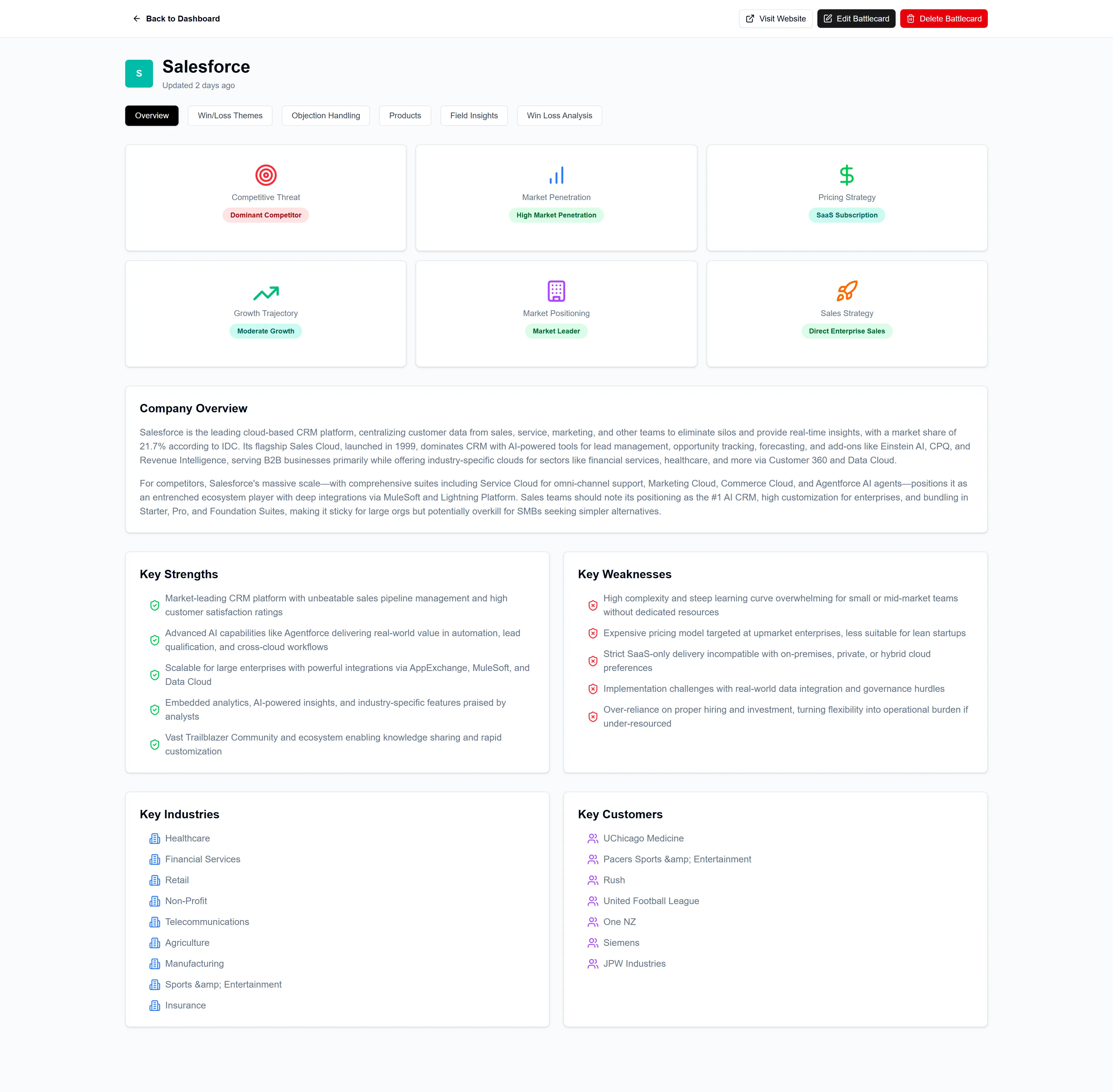
The best battlecard format delivers both depth and speed by organizing information into discrete sections that each follow the one-page rule. Think of it as multiple single-page battlecards connected by instant navigation – not a long document broken into parts.
Each section is self-contained:
- Overview tab: Competitor positioning, summary, at-a-glance intelligence
- Objections tab: What prospects actually say, with proven responses
- Win/Loss Themes tab: Patterns from real deals, not theoretical analysis
- Product Comparisons tab: Deeper evaluation when reps have time to prepare
“This model gives reps control over what they need in the moment,” explains Towers. “No scrolling. No searching. Just instant access to the exact section that matters right now. That’s what modern competitive intelligence looks like.”
How Playwise HQ Implements This
Playwise HQ’s battlecard structure embodies this tabbed approach. Instead of forcing everything into one PDF, the platform organizes intelligence into navigable sections that keep every screen digestible without sacrificing depth.
The result: reps can access comprehensive competitive intelligence without the adoption-killing friction of long documents.
Key benefits of the tabbed structure:
- Instant navigation between different types of intelligence
- Single-screen sections that each pass the one-page test
- Logical organization that matches how reps actually use intel
- Easy updates because sections are independent
- Higher adoption because the format matches conversation speed
The Depth-Speed Tradeoff Solved
The traditional battlecard debate assumed a tradeoff: depth or speed, not both. Comprehensive intelligence meant long documents. Quick access meant stripped-down content.
Modern platforms reject this tradeoff. Tabbed navigation delivers both:
- Depth: Multiple sections covering different aspects of competition
- Speed: Instant access to any specific section without searching
- Currency: Sections can be updated independently as intelligence changes
- Adoption: Format that matches how reps actually work under pressure
For Teams Building Battlecards Manually: The Realistic Approach
Not every team has access to modern battlecard platforms. For teams still using Google Docs, Notion, or Slides, different constraints apply.
The 1-2 Page Maximum
Manual battlecards work best at 1-2 pages maximum. Beyond that, you’re building a knowledge base, not a battlecard.
Page 1: Overview + Differentiation
- Competitor positioning (2-3 sentences)
- Your key differentiators (3-5 bullets)
- Their acknowledged strengths (3-4 bullets)
- Their vulnerabilities (3-4 bullets)
Page 2: Objections + Proof
- Top 3-4 objections with responses
- Supporting proof points
- Discovery questions that expose weaknesses
- Quick reference talk tracks
This structure forces the prioritization that makes battlecards usable while acknowledging that some depth is necessary.
Avoiding the “Competitive Essay” Trap
Manual battlecards often fail because they read like research reports instead of selling tools.
Don’t write:
- Long company histories
- Feature dumps without context
- Generic market commentary
- Analysis that doesn’t translate to talk tracks
Write:
- Rep-usable talk tracks: actual language they can say
- Crisp landmines: specific points that expose competitor weaknesses
- Proof-backed positioning: claims with evidence attached
- Discovery questions: what to ask to surface competitive advantages
“Every sentence in a battlecard should help a rep win a deal,” says Towers. “If you can’t connect content directly to a selling situation, it doesn’t belong.”
Free Templates That Follow Modern Principles
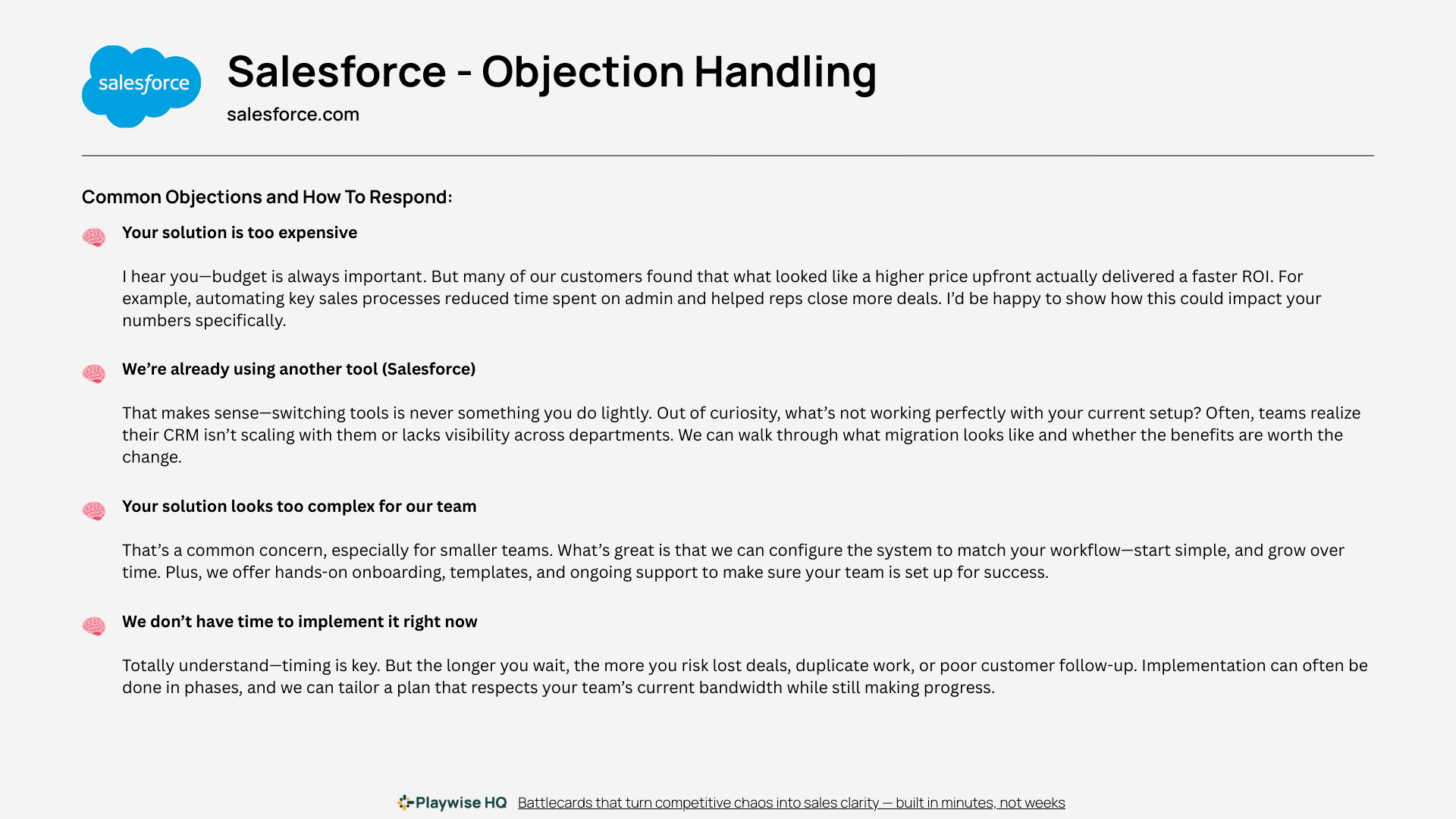
Even in free tools, the best battlecards mimic modular navigation. Playwise HQ offers free battlecard templates for Notion, Google Slides, and Canva that follow the same principles: one screen at a time, clear sections, no clutter.
These templates enforce structure without requiring specialized software:
- Notion layouts: Database-driven battlecards with filtered views by section
- Slides templates: One slide per section with consistent navigation
- Canva designs: Visual battlecards that prioritize scannability
For teams ready to move beyond manual maintenance, Playwise HQ offers free accounts that deliver the full tabbed experience.
Choosing the Right Format: A Quick Framework
Use this decision framework to select the right battlecard format for your team.
Choose Single-Page Battlecards When:
- Competitors are relatively straightforward
- Reps need maximum speed above all else
- You want the highest possible adoption rates
- Sales cycles are short with limited prep time
- You’re just starting your competitive program
Choose Multi-Section/Tabbed Battlecards When:
- You need deeper coverage across multiple dimensions
- You want real-time updates without version chaos
- You need integrated objection handling + win/loss intelligence
- Competitors are complex with multiple product lines
- Reps have varying needs based on deal stage
Avoid Multi-Page PDFs When:
- Your reps are already not using current battlecards
- Intelligence changes frequently
- You care about actual competitive execution
- Reps need mobile access during meetings
- You don’t have resources for constant manual updates
“The format choice isn’t about personal preference,” notes Towers. “It’s about what your sales team will actually use when deals are on the line. The best battlecard is the one that gets opened.”
The Bottom Line: Usability Wins Deals, Not Page Count
The single-page versus multi-page debate misses the real point. What matters isn’t how many pages your battlecard has – it’s whether reps can find the right answer in 10 seconds.
Great battlecards share common traits regardless of format:
- Scannable: Information is visible without reading paragraphs
- Structured: Consistent organization that reps can navigate instantly
- Current: Intelligence that reflects today’s competitive reality
- Built for selling moments: Content that helps reps compete, not just learn
Static PDFs, whether one page or twenty, are the outdated standard. The modern approach delivers:
- Single-screen clarity within each section
- Multi-section depth when reps need it
- Instant navigation between different types of intelligence
- Format that matches conversation speed
- Updates that don’t require manual document management
“Battlecards exist for one reason: to help reps win competitive deals,” concludes Towers. “Every format decision should serve that goal. Pages don’t win deals. Usability does.”
Your next competitive conversation is coming. The question isn’t how many pages your battlecard has—it’s whether it will help your rep respond with confidence when the moment arrives.
Ready to move beyond static PDFs? Create your free Playwise HQ account and experience battlecards built for how sales teams actually compete.