
Your new sales enablement manager just inherited the competitive intelligence “system.”
It’s a graveyard.
Abandoned spreadsheets with last year’s competitor pricing. PDFs nobody can find.
A Slack channel called #competitive-intel with 847 unread messages and zero actionable insights.
Three different Google Docs, each claiming to be the “official” battlecard for your biggest competitor, and none of them agree on basic facts.
Sound familiar?
The build vs buy question surfaces whenever sales teams face mounting competitive pressure. IT believes they can build something “just as good” for less. Finance questions why you need another SaaS subscription when “we already have Notion.” And someone always suggests that a few spreadsheets and some dedicated research time should be “more than enough.”
The stakes are higher than most organizations realize. Choose wrong and you’re looking at wasted development resources, perpetually stale intelligence, frustrated sales reps, and deals lost to competitors who simply showed up better prepared. Choose right and you create a competitive advantage that compounds with every deal, every quarter, every year.
This guide provides a framework for evaluating your specific situation -because the right answer depends on factors most organizations never consider until it’s too late. For most B2B sales teams, the math overwhelmingly favors buying purpose-built CI platforms. But there are specific scenarios where building makes sense.
Here’s how to know which camp you’re in.
Why “Let’s Just Build It” Feels Like the Right Call

The instinct to build internally comes from a reasonable place. When you’re staring at a $15,000-$40,000 annual subscription for enterprise CI platforms, the DIY path looks attractive.
The perceived cost savings drive most build conversations. Your team already has spreadsheets. You’re paying for Notion or Confluence anyway. Your developers could probably knock something out in a sprint or two. Why add another line item to the software budget when the tools are already in place?
Then there’s the customization argument. Your competitive landscape is unique. You need specific fields that no off-the-shelf tool provides. You want the data structured exactly the way your sales process demands. Building in-house means building it right… for you.
The integration fantasy follows closely behind. An internal system can plug directly into your existing stack. It’ll work exactly how your team works, not force your team to adapt to someone else’s workflow assumptions. No clunky middleware. No data synchronization headaches.
And underlying everything is the ownership mindset. No vendor lock-in. No worrying about price increases or feature deprecation. Your data stays entirely under your control, which matters for security-conscious organizations.
“I’ve heard every version of these arguments,” says Paul Towers, founder and CEO of Playwise HQ. “They sound logical in the planning meeting. The problem is they ignore the iceberg beneath the waterline – all the costs and complications that only surface months later, usually at the worst possible time.”
These arguments aren’t wrong. They’re incomplete. Let’s examine what the build approach actually requires.
The True Cost of Building In-House
Most organizations underestimate internal development costs by a factor of three to five. The visible, costs developer time, maybe some hosting fees, represent a fraction of the actual investment required to build and maintain a functional competitive intelligence system.
Initial Development: More Than a “Quick Project”
Building a CI system that sales reps will actually use requires far more than a few database tables and a basic interface. At minimum, you need database architecture capable of storing and relating competitor data across multiple dimensions – products, pricing, positioning, objections, etc. You need a user interface that reps can navigate quickly during live calls, not just a functional admin panel. You need a content management system that makes updates straightforward, or your battlecards will be outdated within weeks.
Then come the features that separate usable systems from abandoned ones:
- Search functionality that actually returns relevant results
- Permission systems that control who can edit versus view
- Strong UI that works for sales reps, not developers
Without these, you’re building something that technically exists but practically fails.
Conservative estimates put initial development at two to three months of full-time work for a single developer. At a fully-loaded cost of $150,000-$200,000 annually for a competent developer, that’s $25,000-$50,000 just for version one. And version one is rarely usable in production. Multiple iterations typically follow before the system handles real-world requirements.
The Maintenance Burden Nobody Budgets For
Here’s where internal projects quietly hemorrhage resources. Bug fixes accumulate as users encounter edge cases.
- Technical debt grows as quick patches become permanent fixtures.
- Security updates require regular attention – a CI system contains competitive intelligence that you definitely don’t want exposed.
- Infrastructure costs for hosting and backups add up.
- Integration maintenance becomes an ongoing tax as connected tools release updates that break your connections.
- And performance optimization becomes necessary as your competitor database grows.
Industry benchmarks suggest internal tools require approximately 20-30% of initial development time annually just for maintenance. Your $50,000 system costs $10,000-$15,000 per year simply to keep running at current functionality – not improving, just surviving.
Content Creation: Where DIY Systems Die
Development and maintenance costs pale compared to the real killer: content creation and updates. Someone must manually research each competitor. Someone must write the battlecard content in a way that’s actually useful to sales reps. Someone must update that information as competitors evolve – which, in fast-moving markets, happens constantly.
Manual spreadsheets contain errors in approximately 90% of cases. When your rep quotes outdated competitor pricing during a live sales call, you don’t just lose credibility – you often lose the deal entirely.
The time investment for proper competitive intelligence is substantial. Initial competitor research runs four to eight hours per competitor to do well. Monthly updates require two to four hours per competitor to maintain accuracy. Track ten competitors and you’re looking at 40-80 hours monthly just for content, before anyone touches the system itself.
“The dirty secret of DIY competitive intelligence is that the ‘free’ spreadsheet approach costs more than any platform subscription,” explains Towers. “You’re paying in lost deals, wasted time, and opportunity cost. It just doesn’t show up on the P&L where anyone notices it.”
The Complete Picture: Total Cost of Ownership
When you calculate the true 12-month cost of building and maintaining an in-house CI system, the numbers tell a different story than the initial pitch suggested:
| Cost Category | Year 1 Investment |
|---|---|
| Initial Development | $30,000-$50,000 |
| Ongoing Maintenance (20%) | $6,000-$10,000 |
| Content Creation (40 hrs/mo @ $75/hr loaded cost) | $36,000 |
| Opportunity Cost (sales leaders’ time) | $15,000+ |
| Total | $87,000-$111,000+ |
Compare that to purpose-built CI platforms: $3,000-$15,000 annually, typically including AI-assisted content creation, automatic updates, and maintenance handled entirely by the vendor.
What You Give Up By Building

Beyond the direct costs, building in-house means forfeiting capabilities that modern CI platforms provide – capabilities that most internal teams simply cannot replicate.
AI-Powered Intelligence Generation
Modern competitive intelligence platforms leverage AI to create battlecards in minutes rather than weeks. They can pull from competitor websites, news, job postings, and review sites for insights worth knowing. They surface insights that would require hours of manual research to discover.
Internal systems require manual effort. Every piece of intelligence, every update, every new competitor profile demands human time. As your competitive landscape expands, your internal system doesn’t scale – it just demands more hours from people who have other responsibilities.
Built-In Best Practices
Platform vendors have spent years optimizing battlecard formats, objection handling frameworks, and competitive positioning templates based on what actually works across thousands of sales teams. They’ve tested different approaches, measured results, and refined their methodology continuously.
When you build internally, you start from zero. You’ll make the same mistakes platform vendors made years ago. You’ll discover the hard way which battlecard formats reps actually use versus which ones look good in planning documents.
“Playwise HQ represents years of learning about what makes competitive intelligence actually useful to sales reps,” notes Towers. “We built it specifically because I spent 15 years in B2B sales watching internal CI efforts fail for predictable reasons. Every feature exists because we saw the alternative not work.”
Sales-First Design
Purpose-built CI platforms obsess over user experience for salespeople. They optimize for quick access during live calls. They prioritize the information reps need most in the moments that matter most.
Internal tools rarely achieve this level of polish. Development resources focus on functionality, not UX refinement. The result: systems that technically work but that sales reps avoid using because the friction isn’t worth the effort.
Continuous Product Innovation
Platform vendors invest in R&D. They benefit from feedback across their entire customer base. They compete for market share by constantly improving their products. Your subscription buys you a seat on that innovation train.
Your internal system’s roadmap competes with every other priority your development team faces, which usually means core product features win and internal tools languish. The CI system that works acceptably in year one becomes a liability by year three.
Field Intelligence Capture
The most valuable competitive intelligence comes from your sales reps’ actual conversations with prospects. Modern platforms make it easy for reps to contribute insights, a new objection they encountered, a pricing change a prospect mentioned, a feature gap that cost them a deal.
This creates a flywheel effect: battlecards improve with every competitive encounter, which makes them more useful, which increases usage, which generates more insights. DIY systems rarely include this functionality, and when they do, the contribution mechanisms are clunky enough that reps don’t bother.
When Building Actually Makes Sense
Honesty requires acknowledging scenarios where in-house development is defensible. They exist – but they’re narrower than most organizations assume.
Extreme Security or Compliance Requirements
Some organizations face security constraints that genuinely preclude external vendors.
- Defense contractors handling classified competitor intelligence.
- Healthcare organizations with unusually strict HIPAA interpretations.
- Financial services firms with specific data residency requirements that no vendor currently meets.
Note the emphasis on “genuinely preclude.” Most enterprise CI platforms meet SOC 2, HIPAA, and GDPR requirements. Most security objections reflect unfamiliarity with vendor capabilities rather than actual gaps. But for the small percentage of organizations with truly unique constraints, building may be the only path forward.
Deeply Integrated Workflow Requirements
Sometimes competitive intelligence represents a small module within a larger proprietary sales system. Perhaps you’ve built a custom CRM that handles your unique sales process, and CI needs to be a native feature rather than an integration. Perhaps you have an existing internal platform that already handles related functionality, and adding CI makes more architectural sense than bolting on a separate tool.
These scenarios are less about CI specifically and more about your broader internal tooling strategy.
Truly Unique Competitive Dynamics
A few markets genuinely don’t fit standard CI formats. Highly regulated industries with specific disclosure requirements. Markets where “competitors” aren’t easily categorized companies. Niche scenarios where the information architecture of existing platforms fundamentally doesn’t match your needs.
Again, these exceptions are rarer than they initially appear. Most organizations that believe their competitive dynamics are unique discover that purpose-built platforms handle their requirements, often better than expected.
Dedicated CI Engineering Resources
If your organization already maintains a team of developers supporting internal sales tools, and you have explicit budget allocated for CI system development and ongoing maintenance, and leadership has committed to treating this as a multi-year investment rather than a one-time project, building becomes more viable.
But be honest: how many organizations actually meet all three criteria?
“Maybe five percent of B2B sales organizations genuinely need to build their own CI system,” estimates Towers. “The other ninety-five percent would be better served by a platform that lets them focus on actually using competitive intelligence rather than building infrastructure.”
The Decision Framework: How to Make the Right Call

Rather than debating abstractions, work through these seven questions honestly. Your answers will clarify which path makes sense for your specific situation.
Question 1: Do you have dedicated development resources not allocated to core product?
If your developers are already stretched thin shipping product features, asking them to build and maintain internal tools creates conflict. The CI system will always lose prioritization battles against revenue-generating development work. If you don’t have dedicated internal tools resources, the answer is buy.
Question 2: Can you commit to ongoing maintenance for three or more years?
Internal tools are forever projects. The moment you stop maintaining them, they start degrading. If you can’t guarantee sustained investment over multiple years, through leadership changes, budget cycles, and shifting priorities, your system will become the same graveyard of abandoned spreadsheets you’re trying to escape. If you can’t commit long-term, buy.
Question 3: Do you have someone to create and update competitor content?
Building the system is one problem. Filling it with useful, accurate, current information is an entirely different challenge. Do you have a dedicated competitive intelligence analyst? A sales enablement manager with bandwidth for ongoing research? If the answer is “we’ll figure it out later,” buy.
Question 4: Is your competitive landscape stable?
If you’re tracking fewer than five competitors who rarely change their positioning, pricing, or feature sets, a simpler system might suffice. But if you’re in a dynamic market with frequent competitor moves, new entrants, and evolving positioning, you need a system that can keep pace. Manual approaches cannot. Buy.
Question 5: Do you have specific security requirements that no vendor can meet?
Not “we prefer to keep data internal” but “we have documented compliance requirements that we’ve confirmed with legal and security that preclude vendor solutions.” If you haven’t actually evaluated vendor security capabilities against your requirements, you’re assuming constraints that may not exist. Investigate before concluding you must build.
Question 6: Is speed-to-value less important than perfect customization?
Building takes months. Platforms deliver value in days. If your sales team needs competitive intelligence now, and they almost certainly do, how much are you willing to sacrifice waiting for the perfect custom solution? For most organizations, good-enough today beats perfect in six months. If time matters, buy.
Question 7: Do you have budget for $50,000+ in development plus $30,000+/year in maintenance?
If the real cost of building exceeds your available budget, or if that money would deliver more value invested elsewhere, the decision makes itself.
Score your answers. If you responded “no” to three or more questions, building will likely cost more than it saves. The more “no” answers, the stronger the case for buying.
The 90-Day Test
If you’re genuinely uncertain, consider a practical experiment rather than an extended analysis.
Start with a purpose-built platform. A platform like Playwise HQ even offers a free tier which is great for this process. Deploy it with a pilot team. Use it in real competitive situations for 90 days.
During that period, document every gap. Every feature you wish existed. Every customization you’d want. Every workflow that doesn’t quite fit.
After 90 days, evaluate honestly:
- Did the platform deliver value despite the gaps?
- Are the gaps truly dealbreakers, or are they nice-to-haves?
- What would building those missing features actually cost?
Most teams discover their “must-have customizations” either already exist in the platform (they just hadn’t found them) or aren’t actually critical to competitive outcomes.
Making the Transition: From DIY to Platform
For organizations that have already invested in building internal systems, switching to a platform can feel like admitting failure. It isn’t. It’s optimizing resources toward what actually drives competitive wins.
Audit What’s Working
Not everything about your current approach is wrong. Identify which competitors have the best coverage. Determine what content can be migrated. Understand which processes your team has developed that should continue regardless of platform.
This audit prevents you from losing institutional knowledge during the transition.
Plan the Migration
Most platforms support content import from spreadsheets and documents. Field intelligence and historical win/loss data can transfer. The transition doesn’t have to be all-or-nothing, start with a pilot team, prove value, then expand.
Work with your chosen vendor on migration assistance. They’ve helped other organizations make this transition; leverage their experience.
Reframe the Narrative
This isn’t abandoning an investment, it’s redirecting resources toward higher-value activities. Developer time shifts back to core product. Sales enablement focuses on actually enabling sales rather than maintaining infrastructure. The organization gets better competitive intelligence faster.
Calculate the Win
Quantify what the transition delivers:
- Developer hours freed for product work
- Content creation time saved through AI assistance
- Faster updates when competitors make moves
- Higher rep adoption through superior UX
- Improved competitive outcomes through better intelligence
These benefits compound. The sooner you transition, the longer you benefit.
What Modern CI Platforms Deliver
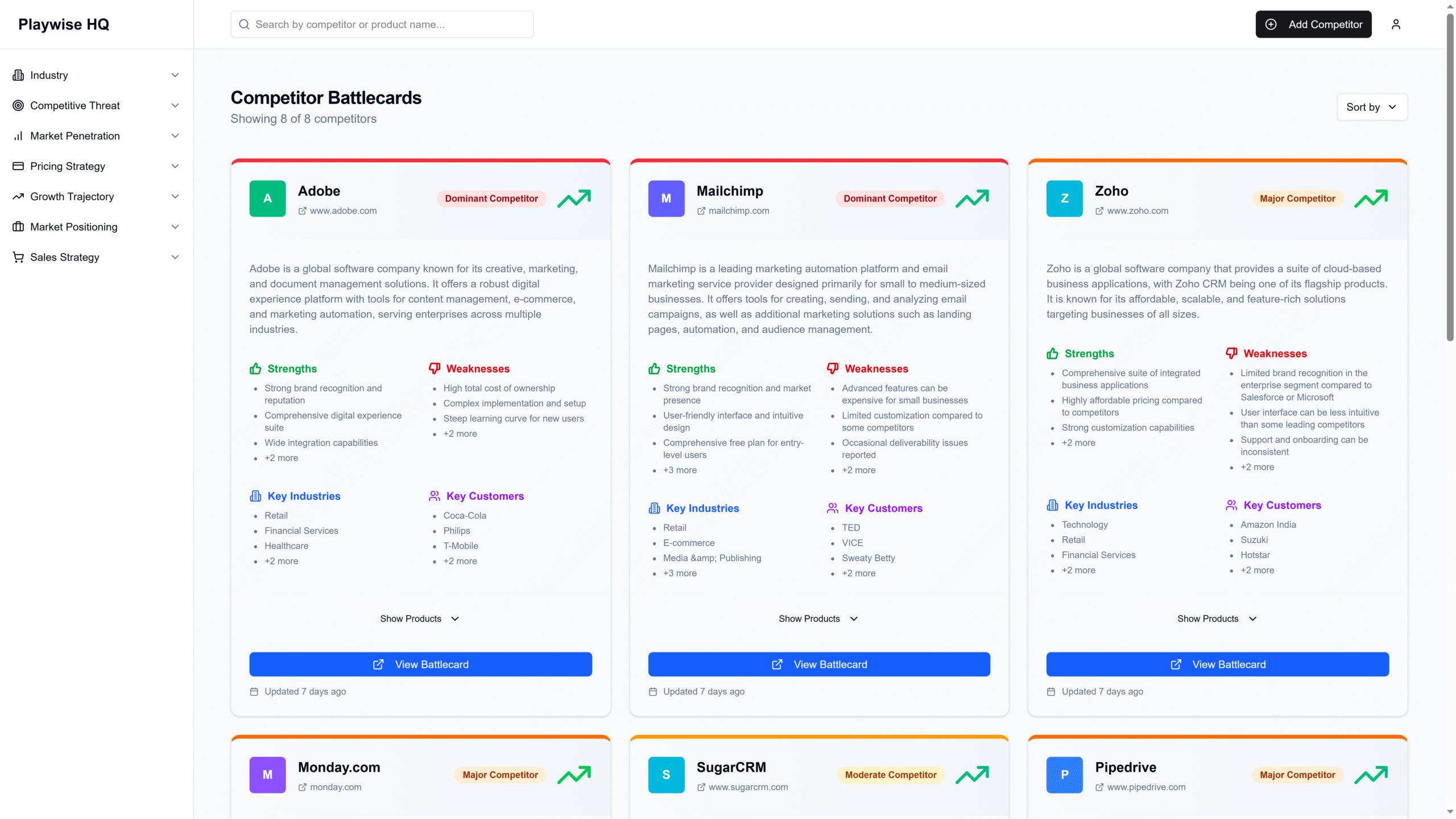
For context on what purpose-built solutions provide, consider Playwise HQ’s approach – representative of what the best platforms offer.
- Speed stands out first. AI-generated battlecards appear in minutes, not months of development and weeks of content creation. When a new competitor enters your market or an existing one shifts positioning, you can respond immediately rather than adding it to a development backlog.
- Adoption follows from design. The interface prioritizes what sales reps actually need during live calls. Mobile access works seamlessly. The friction that kills usage of internal tools simply doesn’t exist.
- The intelligence loop creates ongoing value. Reps can contribute insights from competitive encounters directly into the platform. Battlecards improve with use. Knowledge that would otherwise stay trapped in individual reps’ heads becomes organizational intelligence that benefits everyone.
- Maintenance disappears from your responsibility. Platform updates, security patches, infrastructure scaling, integration maintenance, all handled by the vendor. Your team uses the system; you don’t manage it.
- And the economics work at any scale. Platform pricing that starts at $250/month represents a fraction of internal development costs. One additional won deal per year pays for the subscription multiple times over.
“I built Playwise HQ specifically because I spent 15 years watching the build vs buy decision go wrong,” reflects Towers. “Sales teams kept trying to solve competitive intelligence with spreadsheets and internal projects. They kept losing deals they should have won. The pattern was so consistent that the solution became obvious: purpose-built tools that let sales teams focus on selling, not system maintenance.”
The Bottom Line
Building your own competitive intelligence system seems cheaper until you calculate the real costs.
- Development runs $30,000-$50,000 minimum.
- Maintenance adds $10,000-$15,000 annually.
- Content creation demands 40+ hours monthly.
And you still end up with a system that lacks the AI capabilities, field intelligence loops, and sales-first design that modern platforms provide.
For the vast majority of B2B sales organizations, buying purpose-built CI platforms delivers better competitive intelligence, faster, at lower total cost, with less organizational burden.
The exceptions exist, extreme security requirements, deeply integrated custom systems, genuinely unique competitive dynamics, but they’re far narrower than most organizations initially believe.
If you’re debating this decision, start with a platform trial. Deploy it with real users in real competitive situations. Measure what it delivers. Then make an informed choice based on evidence rather than assumptions.
Don’t let the build vs buy question delay getting your team the competitive intelligence they need. Every day without effective CI is a day your competitors might be showing up better prepared.
Ready to skip the build cycle? Create your first AI-powered battlecard in minutes with Playwise HQ’s free tier. No development required. No maintenance burden. Just competitive intelligence that helps your team win.
Frequently Asked Questions
Is it cheaper to build your own competitive intelligence system?
In most cases, no. While building seems free initially, the true costs include development time ($30,000-$50,000 for a functional system), ongoing maintenance (20-30% of development cost annually), and content creation (40+ hours monthly for meaningful competitor coverage). Purpose-built CI platforms typically cost $3,000-$15,000 per year with AI-assisted content creation included. When you factor in opportunity costs, developer time diverted from core product, sales leaders managing the system instead of coaching reps, the economics overwhelmingly favor buying for most organizations.
How long does it take to build an internal CI system?
Initial development typically requires two to three months of full-time developer work to create a minimally functional system. However, reaching feature parity with modern CI platforms, including AI-powered content generation, field intelligence capture, and seamless integrations, can take six to twelve months. And unlike a completed project, the system will require ongoing development indefinitely to maintain functionality and keep pace with changing requirements.
What are the main disadvantages of building CI in-house?
The primary disadvantages include:
- significantly underestimated development and maintenance costs that often exceed platform subscriptions
- lack of AI-powered features that modern platforms use to generate and update competitive intelligence
- inferior user experience compared to purpose-built tools optimized for sales rep workflows
- no access to vendor innovation and feature improvements
- and the opportunity cost of developer time that could otherwise support revenue-generating product work.
Additionally, internal systems rarely include field intelligence capture mechanisms, meaning they miss the valuable insights sales reps gather in actual competitive situations.
When should a company build their own CI system instead of buying?
Building makes sense primarily for organizations with:
- extreme security or compliance requirements that genuinely preclude vendor solutions (not just a preference for internal data)
- deeply integrated existing sales systems that require native CI functionality rather than integration
- dedicated development resources explicitly allocated to internal tools with multi-year maintenance commitment
- and budget for $50,000+ in initial development plus $30,000+ in annual maintenance.
These criteria apply to perhaps 5% of B2B sales organizations. For everyone else, purpose-built platforms deliver superior results at lower total cost.
Can we migrate from an internal CI system to a platform?
Yes. Most competitive intelligence platforms support content import from spreadsheets, documents, and other formats. The transition typically involves auditing your current system to identify what content can migrate, working with the vendor on data transfer, deploying with a pilot team to validate the new workflow, and then expanding organization-wide.
Many organizations find that reframing the transition, from “abandoning our investment” to “optimizing our resources”, helps stakeholders embrace the change. The key is planning the migration deliberately rather than treating it as an emergency response to a failing internal system.
How do I convince leadership that buying is better than building?
Focus on total cost of ownership rather than subscription price.
Present the full calculation: development costs, ongoing maintenance, content creation time, and opportunity costs of developer resources. Compare this to platform pricing plus the value of features your internal system won’t have, AI-powered content generation, field intelligence loops, continuous product innovation.
Quantify the risk: what does it cost when your internal system delivers outdated intelligence that loses a deal?
Finally, propose a time-boxed pilot with a platform to demonstrate value before committing either direction. Data from actual usage beats theoretical arguments.