
Your sales rep is mid-call with a high-value prospect when they mention your biggest competitor’s new feature. The rep freezes. Stammers. Promises to “circle back with more information.” By the time they locate the outdated PDF buried three folders deep in a shared drive, the deal momentum is gone, and probably the deal itself.
This scenario plays out thousands of times daily across B2B sales organizations. Reps don’t lose deals because they lack product knowledge or sales skills. They lose because they lack instant, reliable access to competitive intelligence when it matters most, during live conversations with prospects.
The challenge has only intensified. Today’s B2B buying committees typically include six to ten decision-makers, each comparing your solution against multiple competitors. When your reps can’t confidently answer competitive questions, they lose credibility. When they lose credibility, they lose deals.
That’s why finding the best tools for creating competitor battlecards in 2026 isn’t just about organization, it’s about revenue.
This guide breaks down every viable option for building and maintaining competitor battlecards, from free DIY approaches to enterprise-grade platforms. You’ll learn the honest strengths and weaknesses of each, so you can choose the right solution for your team’s size, budget, and competitive landscape.
What Makes a Great Battlecard Tool in 2026?
Before diving into specific tools, it’s worth understanding what separates effective battlecard solutions from those that create more problems than they solve.
The best tools for creating competitor battlecards share several characteristics:
- They make information instantly accessible during sales conversations, not locked away in folders.
- They stay current without requiring constant manual updates.
- They capture intelligence from the field, the insights your reps gather in actual competitive encounters.
- And critically, they’re simple enough that salespeople actually use them.
With those criteria in mind, let’s examine the three categories of battlecard tools available in 2026:
- Purpose-built battlecard platforms
- Manual document-based approaches, and
- Enterprise competitive intelligence suites.
Playwise HQ: The Modern Battlecard Platform For 2026
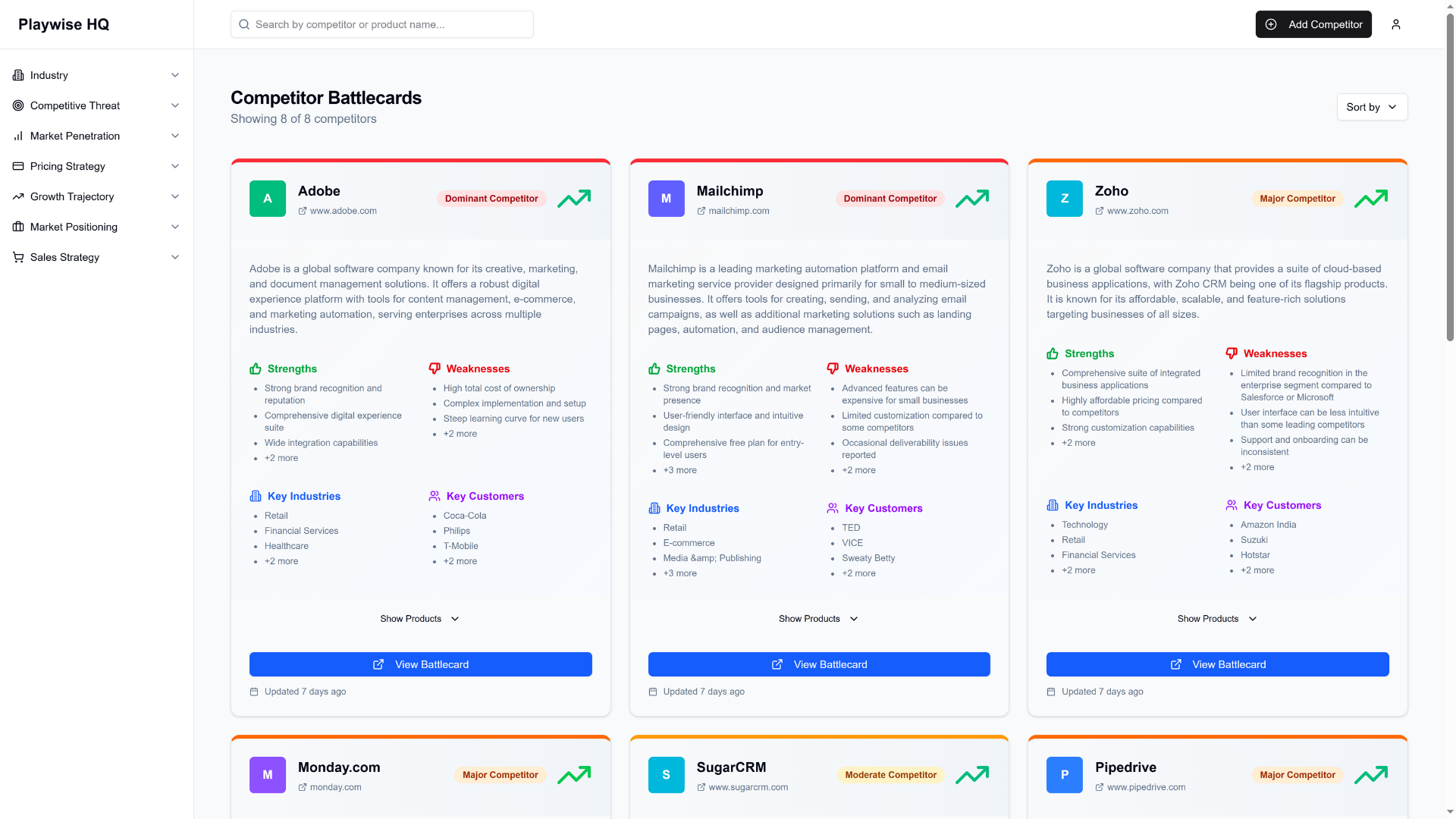
For most B2B sales teams searching for the best tool for creating competitor battlecards in 2026, Playwise HQ represents the optimal balance of power, simplicity, and value.
Playwise HQ is an AI-powered competitive intelligence platform built specifically for sales teams. Unlike tools designed for market research analysts, every feature focuses on what sellers need during live conversations with prospects.
How It Works
The platform combines AI-generated battlecards with sales-sourced intelligence to create a living competitive system. Rather than starting from scratch, teams can generate professional-grade competitor battlecards in minutes using AI. The system analyzes competitor positioning, identifies key differentiators, and structures the information in a format optimized for sales conversations.
But AI generation is just the starting point. What makes the platform genuinely valuable is how it captures ongoing intelligence from the field. When reps encounter new competitive objections, discover competitor pricing changes, or learn about feature gaps, they can contribute those insights directly to the relevant battlecard. This transforms static documents into dynamic resources that improve with every deal.
Key Strengths
- Speed to Value: Traditional competitive intelligence programs take months to build. Playwise HQ compresses that timeline dramatically. Teams can go from zero to full competitor coverage in a single afternoon. This matters because competitive situations don’t wait for lengthy implementation cycles.
- Built for Sellers, Not Analysts: The battlecard format is scannable and designed for quick reference during calls rather than lengthy study sessions. Each battlecard surfaces specific talking points, objection responses, and differentiation strategies that reps can use immediately.
- Sales-Sourced Intelligence: The platform makes it easy for reps to contribute competitive insights they gather in the field. This solves a persistent problem in sales organizations: tribal knowledge that stays trapped in individual reps’ heads and walks out the door when they leave. By systematically capturing field intelligence, teams build institutional knowledge that compounds over time.
- Win/Loss Analysis: Beyond individual battlecards, Playwise HQ helps teams identify patterns across deals. Which competitors pose the greatest threat in specific scenarios? What objections consistently derail opportunities? Which competitive positioning strategies drive the highest win rates? These insights transform anecdotal experience into data-driven strategy.
- Pricing: One of the most refreshing aspects of Playwise HQ is transparent pricing, a rarity in the competitive intelligence space where “contact sales” is the norm.
- Free: Up to 5 users, 5 battlecards, AI generation included
- Pro: $250/month for up to 10 users with unlimited battlecards, with the ability to pay for each additional user beyond the included 10.
- Enterprise: $450/month for up to 20 users with dedicated support, with the ability to pay for each additional user beyond the included 10.
- Additional Users: Extra users can be added at $19/month (Pro) or $24/month (Enterprise). This predictable pricing model allows teams to budget accurately without surprise costs.
Best For
Playwise HQ is ideally for mid-market B2B sales teams ranging from 5 to 200 reps, but can also be used by larger organizations and sales teams. It’s particularly well-suited for organizations that need to operationalize competitive intelligence quickly, want battlecards their reps will actually use, and prefer transparent pricing over enterprise sales negotiations.
The Verdict
For teams seeking the best tool for creating competitor battlecards in 2026, Playwise HQ offers a compelling combination: the speed of AI-powered creation, the accuracy of sales-sourced intelligence, and pricing that doesn’t require CFO approval. The free tier makes it easy to validate the approach before committing budget.
Manual Approaches to Creating Battlecards in 2026: Notion, Google Slides, and Canva
Not every team is ready to invest in dedicated battlecard software. For organizations just beginning their competitive enablement journey, manual tools offer a low-cost starting point. However, these approaches come with significant limitations that teams should understand before committing.
Notion For Creating Competitor Battlecards
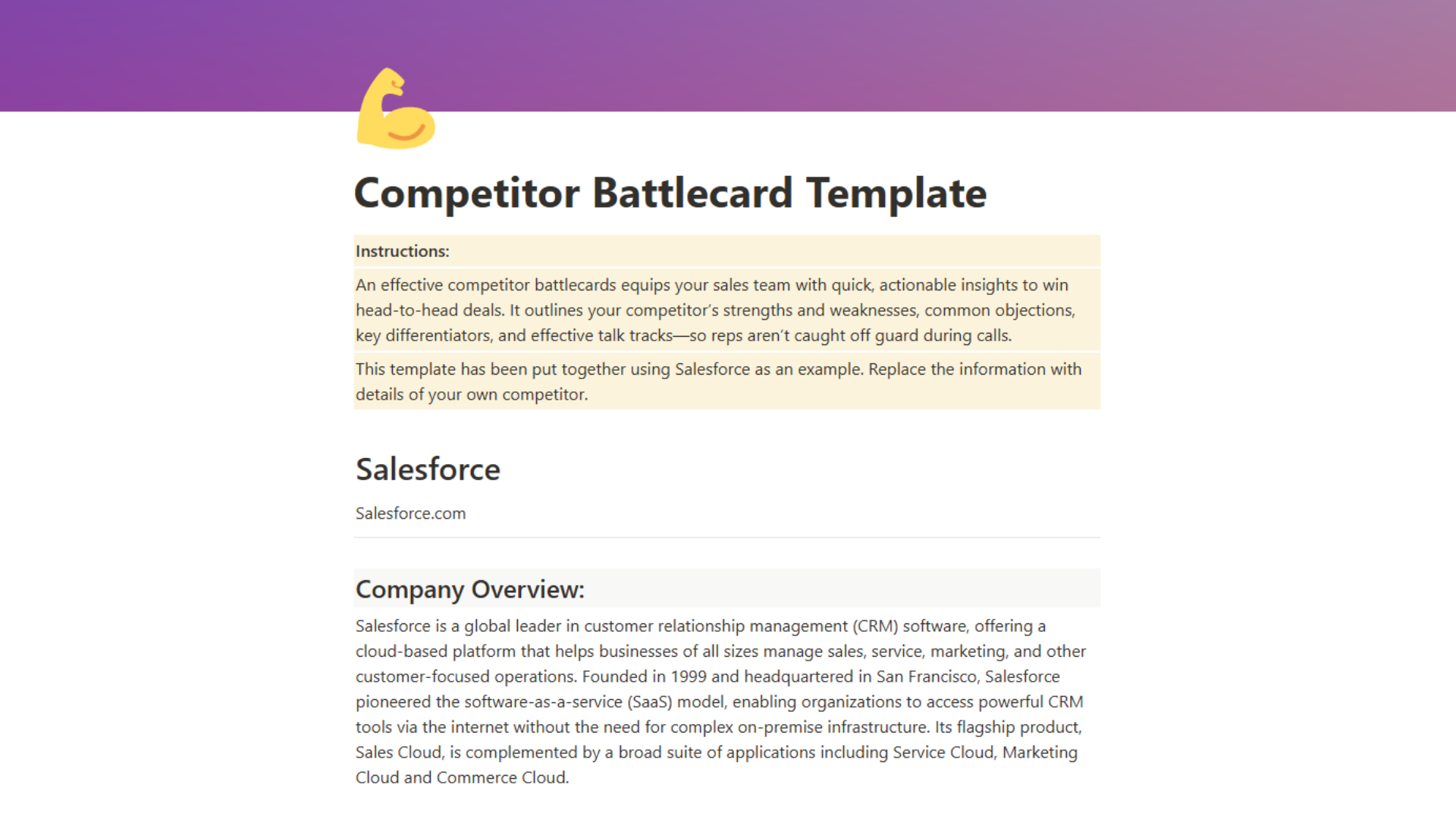
Notion has become a popular choice for teams looking to centralize competitive information. Its flexible database structure allows for custom battlecard templates, and the collaborative editing features make it easy for multiple team members to contribute.
What Works
Notion excels at organizing existing knowledge. Teams can create structured templates with sections for competitor overviews, pricing comparisons, feature matrices, and objection handling. The search functionality helps users find information quickly, and the free tier is generous enough for small teams to get started. If you are looking for a competitor battlecard template in Notion we have you covered.
What Doesn’t Work
The fundamental limitation is that Notion is a note-taking tool, not a competitive intelligence platform. Every piece of information must be manually researched, written, and updated. There’s no AI assistance, no automated monitoring, and no integration with sales workflows.
This creates what might be called the “created once, forgotten forever” problem. Teams invest significant effort building battlecards, feel accomplished when they’re done, then watch the information decay as competitors evolve. Within months, reps learn they can’t trust the battlecards because the information is outdated. They stop using them entirely.
The version control challenges compound this problem. Team members duplicate documents, make edits to copies, and suddenly no one knows which version contains the current information. The single source of truth becomes multiple sources of confusion.
Best For
Notion works reasonably well for very small teams (under 5 people) tracking one or two competitors, where a single person can realistically maintain the information. Beyond that threshold, the manual maintenance burden typically overwhelms available resources and you may be looking for an Alternative to Notion for your CI needs.
Battlecards Created with Google Slides
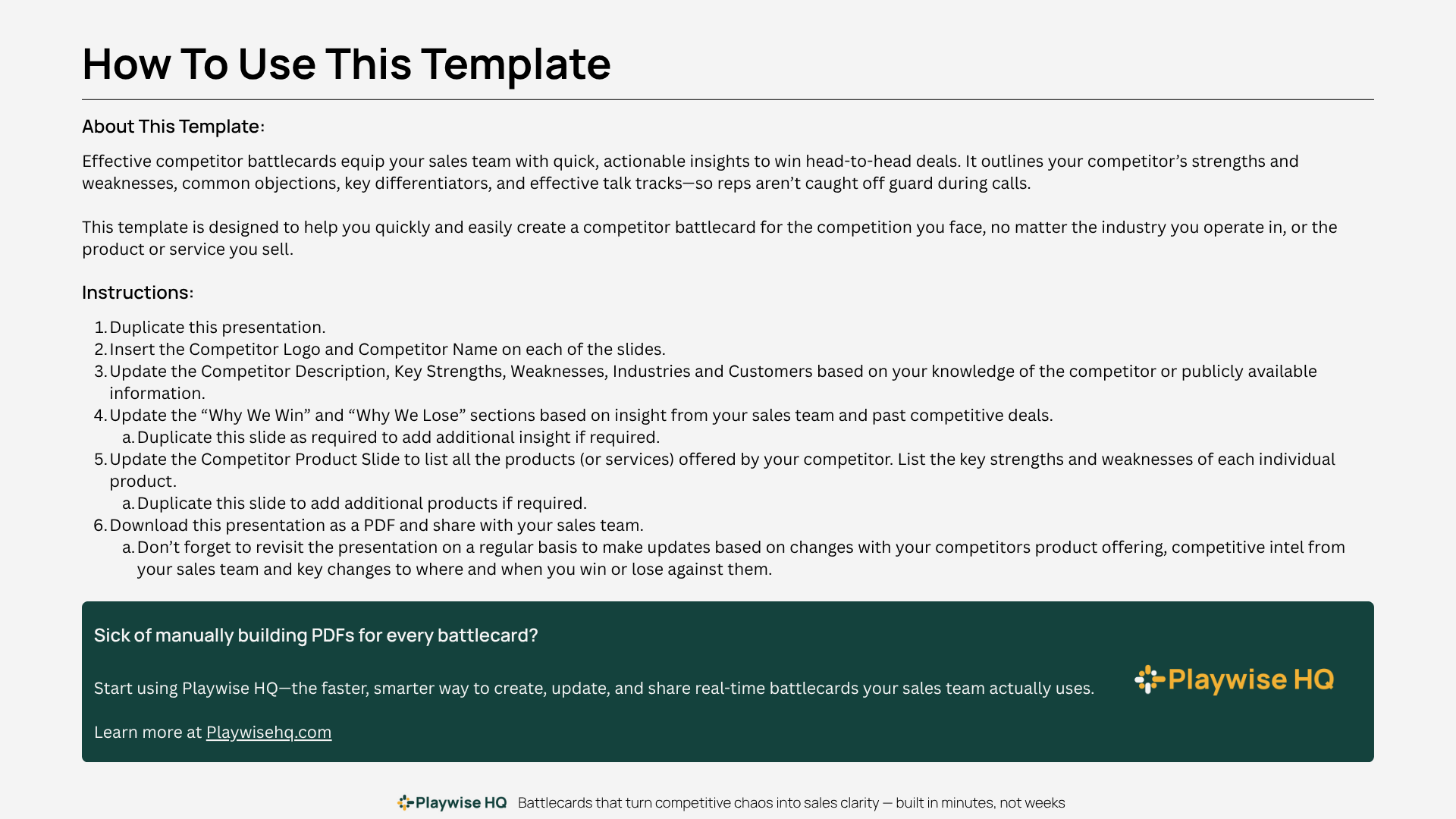
Many sales teams default to Google Slides for battlecards because it’s free, familiar, and produces visually presentable outputs. The collaborative features allow multiple people to contribute, and sharing is straightforward.
What Works
Google Slides makes it easy to create visually organized battlecard decks with consistent formatting. The commenting feature supports feedback and iteration, and the presentation format can work well for sales training sessions where teams walk through competitive positioning together.
What Doesn’t Work
Slides are inherently static, snapshots frozen in time. This creates severe version control problems that anyone who has worked in a large organization will recognize immediately. Files get named “Battlecard_Final_v3_UPDATED_USE-THIS-ONE” and scattered across personal drives, team folders, and email attachments. When a competitor changes their pricing or releases a new feature, who updates all seventeen copies floating around the organization?
The format also doesn’t integrate with sales workflows. Reps must leave their CRM, navigate to the correct folder, find the right file, and locate the relevant slide—all while a prospect waits on the other end of a call. In practice, this friction means battlecards don’t get used when they’re needed most.
Best For
Google Slides can work for creating initial battlecard content or for sales training presentations. It’s less suitable as an ongoing competitive enablement system because the maintenance burden and version control challenges become unmanageable at scale.
Canva – Design Orientated Battlecards in 2026
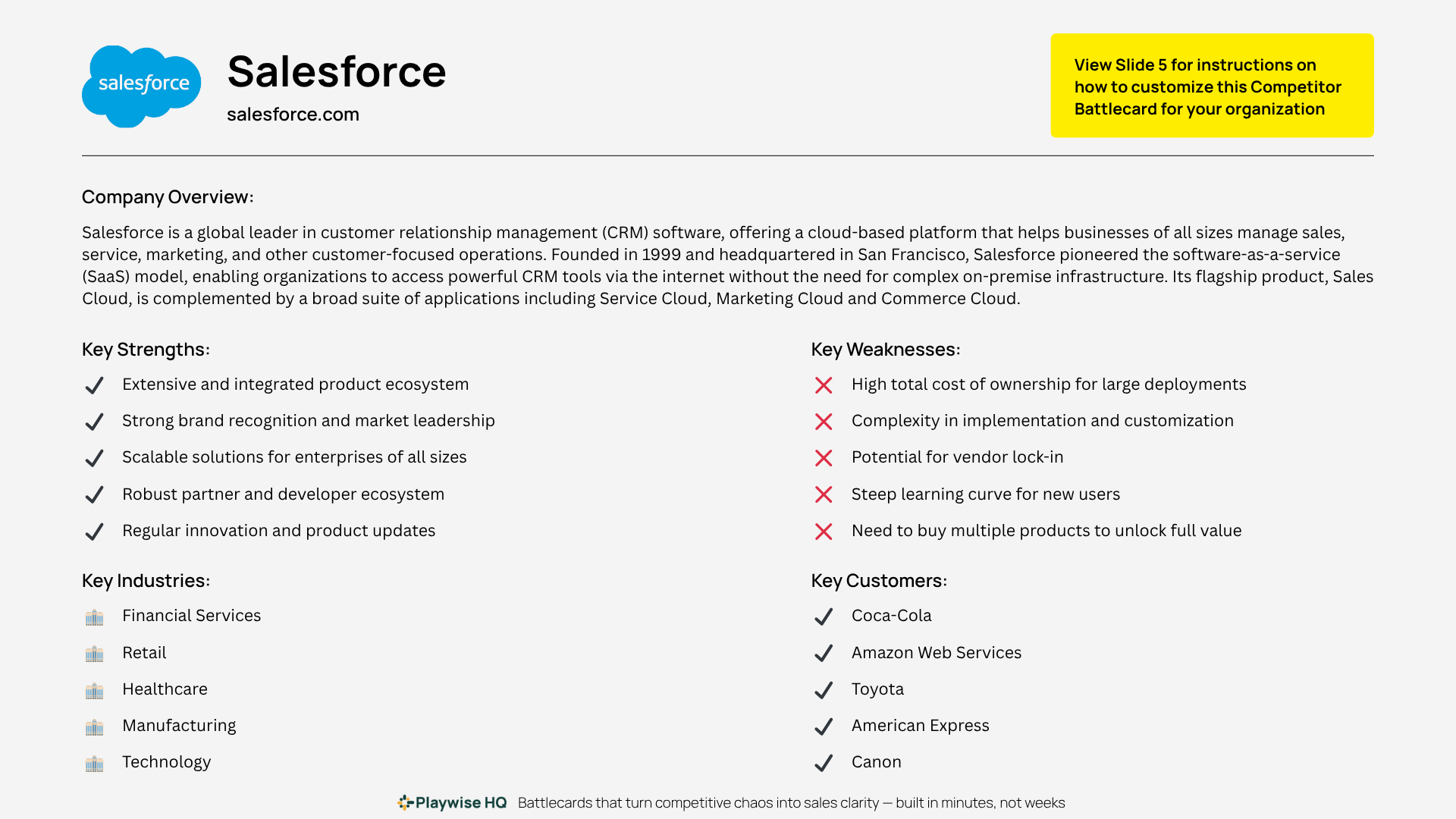
Canva appeals to teams who want their battlecards to look polished and professional. The design tool offers attractive templates (here’s a Canva template you can use for battlecards) and intuitive drag-and-drop editing that doesn’t require graphic design expertise.
What Works
Canva produces visually impressive outputs. For teams that need to present competitive information in executive briefings or customer-facing materials, the design quality matters. The template library provides starting points that look considerably better than default Google Slides or PowerPoint formatting.
What Doesn’t Work
Canva is a design tool, not an intelligence tool. It helps information look good but provides no assistance in gathering, analyzing, or updating that information. Every data point requires manual research. Every update requires someone to open the design, make changes, and redistribute the new version.
The export-and-forget pattern is particularly problematic. Teams create beautiful PDF battlecards, share them once, then never update them. The impressive design actually masks the underlying problem: the content becomes stale while the polished appearance suggests currency.
Best For
Canva works well for creating one-time visual battlecards for specific presentations or executive communications. It’s poorly suited for ongoing competitive enablement programs where information must stay current.
The Core Problem With Manual Approaches
All manual tools share a fundamental limitation: they create the illusion of competitive enablement without delivering the reality. Teams invest effort building battlecards, check the box, then discover six months later that reps aren’t using them because the information can’t be trusted.
The maintenance math simply doesn’t work:
- 10 competitors tracked
- Monthly updates required for each
- 2 hours of research and editing per update
- 20 hours monthly committed to maintenance alone,before any new competitor analysis or strategic work
Most teams don’t have that capacity, so battlecards decay.
If you’re determined to use manual tools, limit scope dramatically:
- Track only your top two or three competitors
- Assign specific ownership for each competitor’s updates
- Schedule monthly review cycles with calendar reminders
- Accept that information will lag behind competitive reality
Even with these guardrails, expect manual battlecards to fall behind what’s actually happening in the market.
Enterprise Competitive Intelligence Platforms (2026)
At the other end of the spectrum from manual tools sit enterprise competitive intelligence platforms. These solutions offer comprehensive features for gathering, analyzing, and distributing competitive information across large organizations. They also come with enterprise price tags, implementation timelines, and complexity.
Klue For Competitive Intel in 2026
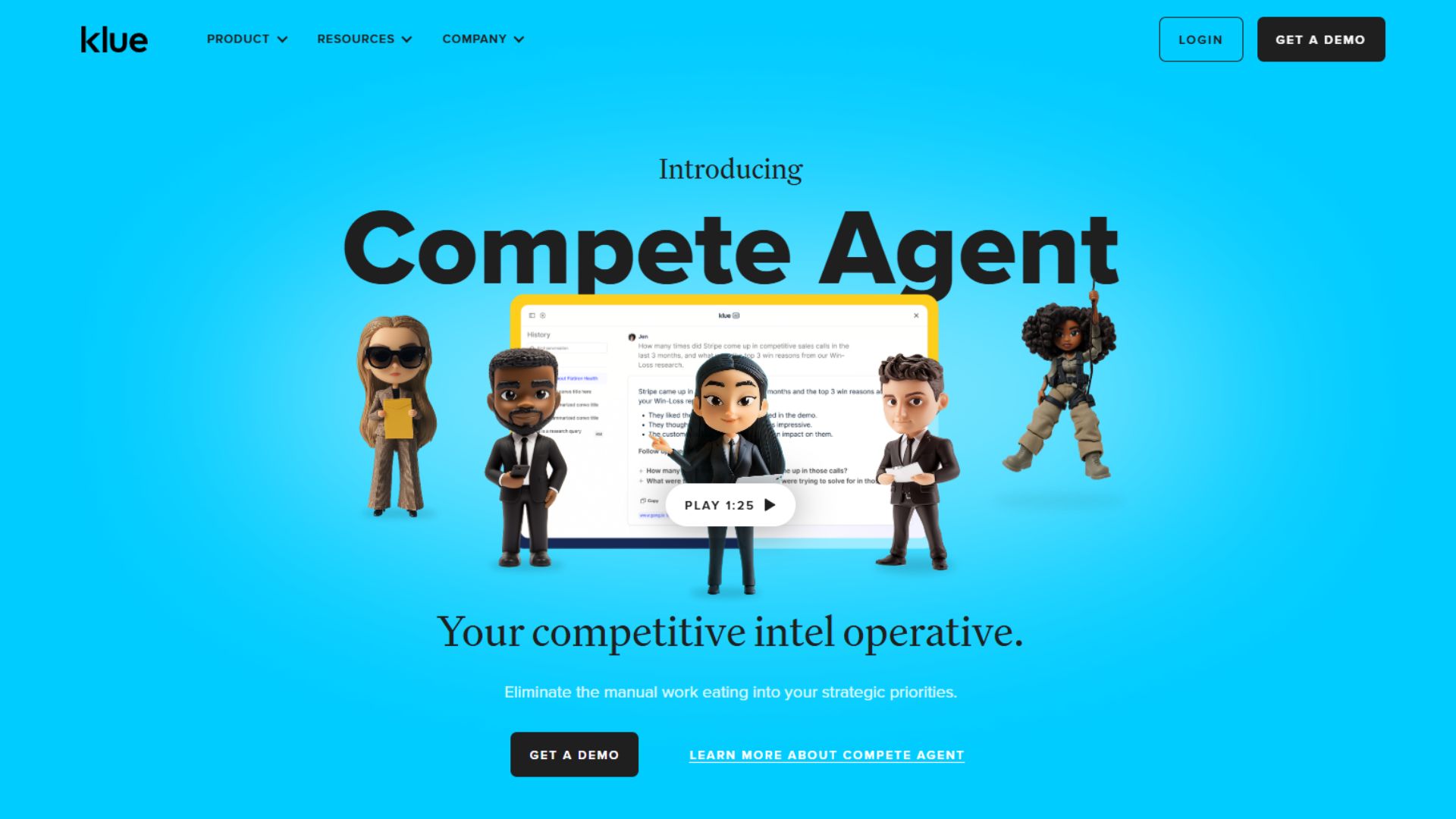
Klue positions itself as a competitive enablement platform that combines intelligence gathering with sales enablement. The company recently launched “Compete Agent,” an AI agent designed to deliver deal-specific competitive insights to sellers.
Strengths
Klue offers comprehensive data collection across many sources, including competitor websites, review sites, news, and internal documents. The platform integrates with enterprise tools like Salesforce and Slack, allowing competitive intelligence to surface where teams already work. The acquisition of DoubleCheck added win/loss analysis capabilities, including interview recordings searchable by keyword.
For large organizations with dedicated competitive intelligence teams, Klue provides the depth and breadth needed to track complex competitive landscapes. The battlecard functionality supports customization, and the digest feature helps distribute intel to revenue teams systematically.
Limitations
Klue’s pricing isn’t publicly available, requiring sales conversations to obtain quotes. Industry sources suggest it sits at the higher end of the market, with additional charges for different user roles (curators versus consumers) and integrations.
Implementation timelines are substantial. Competitor comparison data suggests setup takes seven to eight weeks, a significant commitment before teams see value. This extended timeline reflects the platform’s complexity; Klue offers many capabilities, but learning to use them effectively requires investment.
The platform was built primarily for competitive intelligence professionals and product marketers, not frontline sellers. While the sales enablement features have expanded, the tool’s depth can be overwhelming for organizations without dedicated CI resources, making Playwise HQ a great Klue alternative.
Best For
Klue makes sense for large enterprises with 500+ employees, dedicated competitive intelligence teams, and budgets that accommodate premium pricing. Organizations that need comprehensive market intelligence beyond just battlecards will find value in Klue’s breadth.
Crayon – Battlecards & CI in 2026
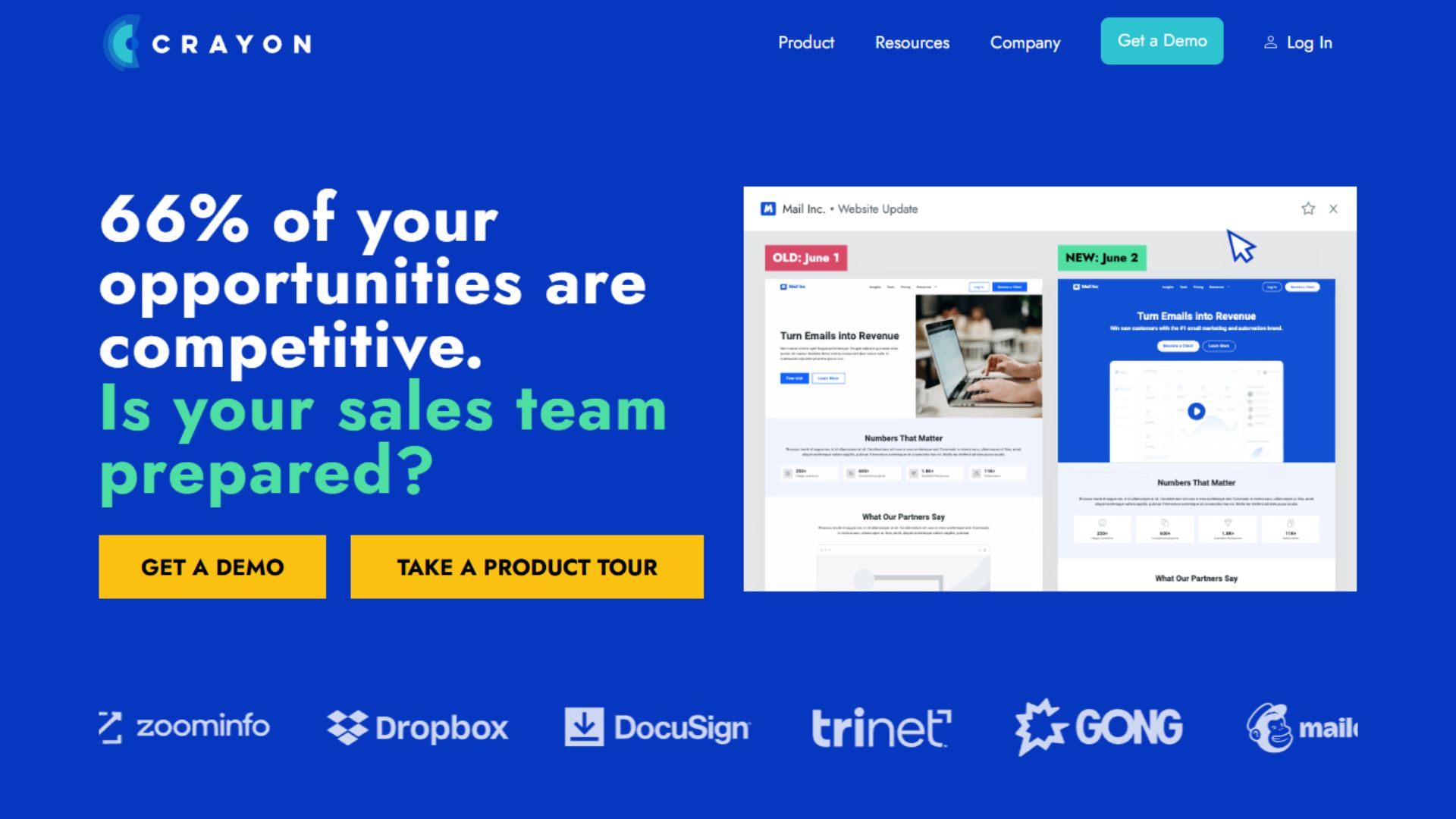
Crayon focuses on market and competitive intelligence, with particular strength in automated monitoring and alerts. The platform tracks competitor websites, pricing changes, product updates, news releases, and reviews, using AI to surface relevant insights.
Strengths
Crayon’s monitoring capabilities are comprehensive. The platform can track hundreds of competitors simultaneously, alerting teams to significant changes without requiring manual research. The “Sparks” AI feature automatically summarizes competitor news and can run on scheduled cadences to keep stakeholders informed.
The battlecard functionality integrates with tools like Salesforce, Slack, and Highspot, making competitive content accessible within existing workflows. The newsletter and digest features help CI teams distribute intelligence across the organization systematically.
For organizations that need to monitor broad competitive landscapes and market trends, Crayon’s intelligence gathering capabilities are robust.
Limitations
Like Klue, Crayon doesn’t publish pricing, requiring custom quotes. Reviews suggest costs are significant, particularly at enterprise tiers. Adding or modifying tracked competitors can involve delays and additional fees, reducing flexibility for teams in dynamic markets.
The platform’s strength in intelligence gathering doesn’t automatically translate to sales enablement. Crayon excels at collecting information but still requires human effort to transform raw intelligence into sales-ready battlecards. Organizations without dedicated CI resources may struggle to extract full value.
Implementation timelines mirror Klue’s, with setup typically requiring seven to eight weeks. This reflects the platform’s comprehensive nature but delays time-to-value for teams with urgent competitive needs. For a faster alternative to Crayon Playwise HQ is an attractive option.
Best For
Crayon is well-suited for enterprises that need comprehensive market intelligence beyond just sales battlecards. Product marketing teams, strategy groups, and dedicated CI functions will find value in the monitoring depth. Organizations primarily seeking sales enablement may find the platform more than they need.
Playwise HQ: Enterprise-Ready Without Enterprise Complexity
Before continuing with our exploration of traditional enterprise platforms, it’s worth noting that Playwise HQ scales effectively for larger organizations, without the implementation burden and opaque pricing that typically accompany enterprise software.
Why enterprise teams choose Playwise HQ:
- Rapid deployment: Get your entire sales organization equipped with battlecards in days, not the 7-8 weeks required by legacy platforms
- Transparent enterprise pricing: $450/month for up to 20 users, with additional seats at $24/month, no surprise costs or lengthy procurement negotiations
- Dedicated support: Enterprise plans include a dedicated account manager and personalized onboarding
- Scales with your team: The same intuitive interface works whether you have 20 reps or 200
The key difference is philosophy. Traditional enterprise CI platforms were built for competitive intelligence analysts first, with sales enablement added later. Playwise HQ was built for sellers from day one, ensuring that even at enterprise scale, the battlecards actually get used in competitive deals.
Kompyte For CI in 2026
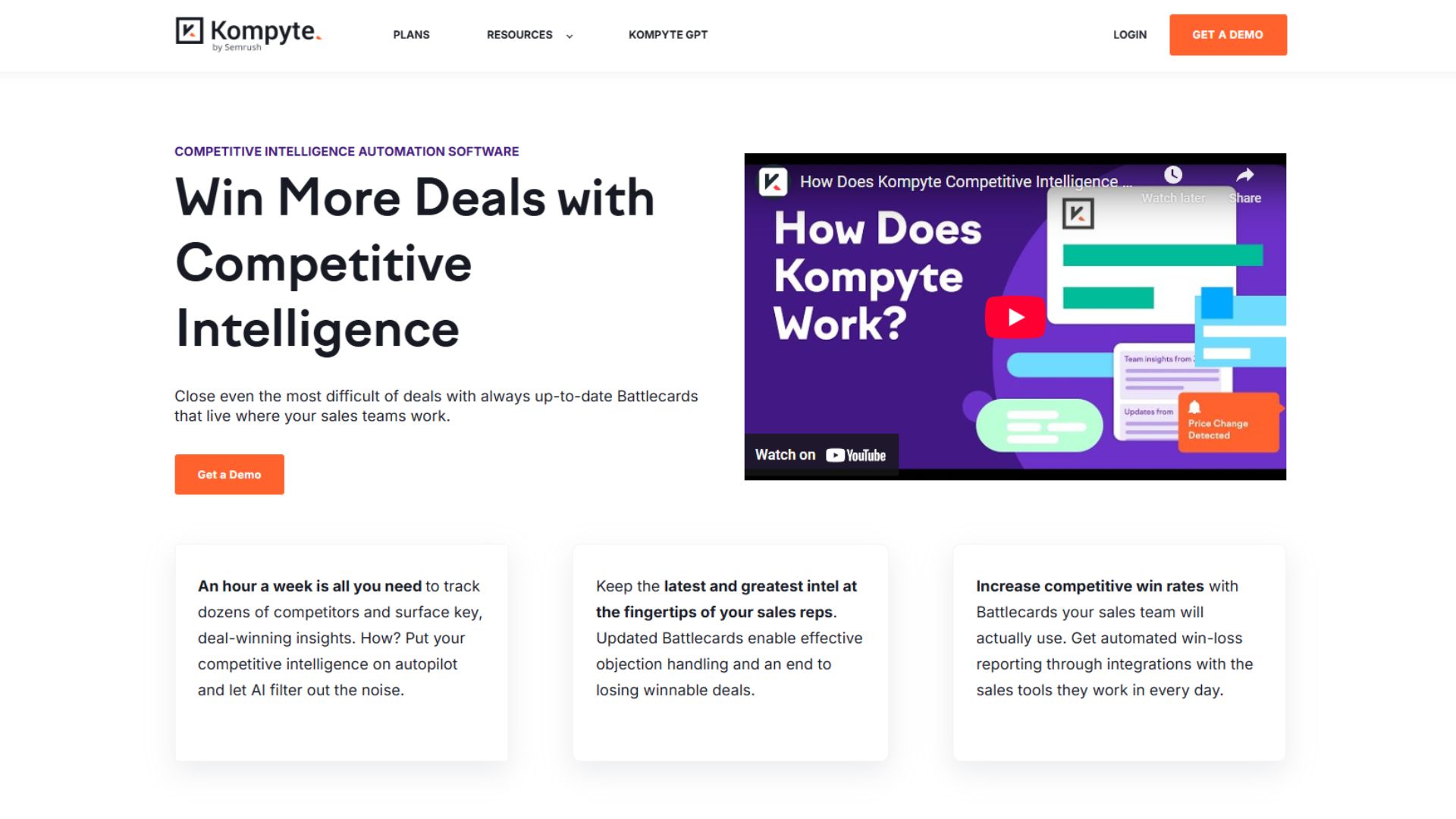
Kompyte, now owned by Semrush, positions itself as a competitive intelligence automation platform. The tool tracks competitors across websites, reviews, social media, advertisements, and job postings, using AI to filter signal from noise.
Strengths
Kompyte’s AI filtering has been in development since 2014, giving it maturity that newer solutions lack. The platform’s automation reduces the manual burden of competitive monitoring, with the company claiming that maintenance takes “about an hour a week” rather than days.
Setup is faster than competitors, with data appearing in as little as 24 hours and full implementation completing in one to two weeks. For teams that need to move quickly, this compressed timeline offers advantage.
The battlecard functionality includes unlimited battlecards on all plans, templates for quick creation, and integrations with Salesforce and HubSpot. The win/loss analysis features help teams understand competitive performance patterns.
Pricing, while not fully transparent, is reportedly more accessible than Klue or Crayon, making Kompyte a potential middle-ground option for organizations that want automation without enterprise budgets.
Limitations
Kompyte’s strength is web monitoring, tracking what competitors do online. It’s less focused on capturing sales-sourced intelligence from the field, the insights reps gather in actual competitive conversations. This means battlecards may reflect public information without incorporating the nuanced intelligence that drives deals. If you are looking for more of a sales orientated tool then Playwise HQ is a great alternative to Kompyte.
The platform is part of the larger Semrush ecosystem, which may or may not align with your existing tool stack. Organizations not using other Semrush products may find less integration value.
While more accessible than some competitors, Kompyte still requires meaningful investment and may be more than necessary for teams with straightforward competitive needs.
Best For
Kompyte works well for organizations that prioritize automated competitor monitoring, particularly those already using Semrush tools. It’s a reasonable middle-ground option for mid-market to enterprise companies with some CI resources but not dedicated teams.
Enterprise Platforms: The Trade-Off
Enterprise competitive intelligence platforms offer genuine power. They can track dozens of competitors, automate intelligence gathering, integrate with enterprise systems, and provide analytics that inform strategy.
But that power comes with costs beyond price. Implementation timelines stretch into months. Complexity requires dedicated resources to manage. Features built for CI professionals may overwhelm sales teams who just need quick competitive answers.
For large enterprises with established competitive intelligence functions, these platforms make sense. For mid-market teams seeking the best tools for creating competitor battlecards in 2026, they may be more than necessary, and more than budget allows.
How to Choose the Competitor Battlecard Software in 2026
With options ranging from free templates to enterprise platforms, selecting the right battlecard tool requires honest assessment of your team’s situation.
Start With These Questions
How quickly do you need to be operational?
If competitive situations are costing deals today, tools with lengthy implementation timelines won’t help. Playwise HQ and manual approaches offer same-day starts. Enterprise platforms require weeks to months.
Who will maintain the system?
Manual tools require someone to research, write, and update everything. Enterprise platforms need CI professionals to extract full value. Playwise HQ’s AI-assisted approach reduces maintenance burden for resource-constrained teams.
What’s your realistic budget?
Be honest about what you can spend. Manual tools are free but cost time. Playwise HQ starts free and scales to $450/month for enterprise needs. Klue and Crayon require enterprise budgets with custom pricing.
Will reps actually use it?
This is the most important question. A battlecard system that sales teams ignore delivers zero value regardless of sophistication. Tools that integrate with existing workflows and provide instant access during calls see higher adoption than those requiring extra steps.
Decision Framework
Choose Playwise HQ if:
- You need operational battlecards within days, not months
- Your team ranges from 5 to 200 sales reps
- You want AI assistance without enterprise complexity
- Transparent, predictable pricing matters to your planning
- You value sales-sourced intelligence that keeps battlecards current
Choose manual tools (Notion, Google Slides, Canva) if:
- You’re tracking only one or two competitors
- You have zero budget for software
- Someone has dedicated time for ongoing maintenance
- You’re testing the concept before investing in a platform
Choose enterprise platforms (Klue, Crayon, Kompyte) if:
- You have 100+ sales reps across the organization
- A dedicated CI team or full-time CI manager exists
- You need comprehensive market intelligence beyond battlecards
- Implementation timelines and premium costs are acceptable
The Hidden Cost of Choosing Wrong
The wrong choice isn’t always the tool that costs too much, sometimes it’s the tool that costs too little.
Free manual approaches seem attractive until you calculate the hours spent on maintenance, the deals lost to outdated information, and the frustration of reps who stop using battlecards they can’t trust. That “free” solution may cost more in lost revenue than a purpose-built platform would cost in subscription fees.
Similarly, enterprise platforms that exceed your needs create their own costs: budget consumed that could fund other initiatives, complexity that reduces adoption, and features that go unused because no one has time to learn them.
The best tool is the one your team will actually use, consistently, in the moments that matter.
The Bottom Line on Battlecard Tools in 2026
The competitive intelligence landscape has evolved significantly. Manual approaches that worked when companies faced two or three competitors struggle in markets where buyers evaluate a dozen alternatives. Enterprise platforms built for dedicated CI teams offer power that mid-market organizations often can’t operationalize.
The emergence of AI-powered battlecard platforms like Playwise HQ represents a middle path: sophisticated enough to deliver real value, simple enough for sales teams to actually use, and priced accessibly enough for organizations without enterprise budgets.
For most B2B sales teams evaluating the best tools for creating competitor battlecards in 2026, the decision comes down to this: Do you want a system that exists, or a system that gets used?
Battlecards that live in folders don’t win deals. Battlecards that surface during conversations do.
The tools you choose should make competitive intelligence instantly accessible, reliably current, and continuously improving with insights from the field. When your reps face competitive questions, they should have answers, not promises to circle back.
Ready to arm your sales team with battlecards they’ll actually use? Start with a free Playwise HQ account (or schedule a demo to see Playwise HQ in action) and see how quickly you can go from competitive uncertainty to competitive advantage.